Mold Remediation in Alpine, NJ
ExecPro Restoration & Cleaning provides mold inspection, mold remediation, water damage restoration, and full build-back and reconstruction for homes and businesses in Alpine, NJ. Alpine is a borough in Bergen County, on the Palisades above the Hudson, and the moisture problems here start with the ground a house sits on and the way water moves across it. Call (888) 300-3772 to schedule an assessment.
Mold Remediation Services for Alpine's Large-Lot Detached Homes
Alpine is the Borough of Alpine, in Bergen County, incorporated as a borough in 1903. It sits in North Jersey on the Palisades at the New York state line, and the Borough Hall publishes an Alpine, NJ 07620 address. The 2020 Census counted 1,762 residents, and the American Community Survey puts the borough at roughly 593 housing units.
That is a small housing base, and the borough's own zoning says more about the buildings than any average could. The current code principally permits one family detached dwellings across its residence zones, with minimum lot areas of 87,120 square feet in the R-A and R-R districts, 65,340 square feet in R-AA and 40,000 square feet in R-1. Alpine is a large lot, detached house borough by regulation, which is a different starting point from the attached and multi unit housing that shapes restoration work in much of the state.
With an inventory that size, the work happens on the property rather than from a pattern. Attic configuration, roof form, insulation arrangement, foundation type and where the exhaust fans actually terminate are all things we look at on the day, because on a street of individually built houses the one next door tells you very little about yours.
Where Water Goes on Alpine's Rocky Palisades Slopes
Slope, Runoff and Site Drainage
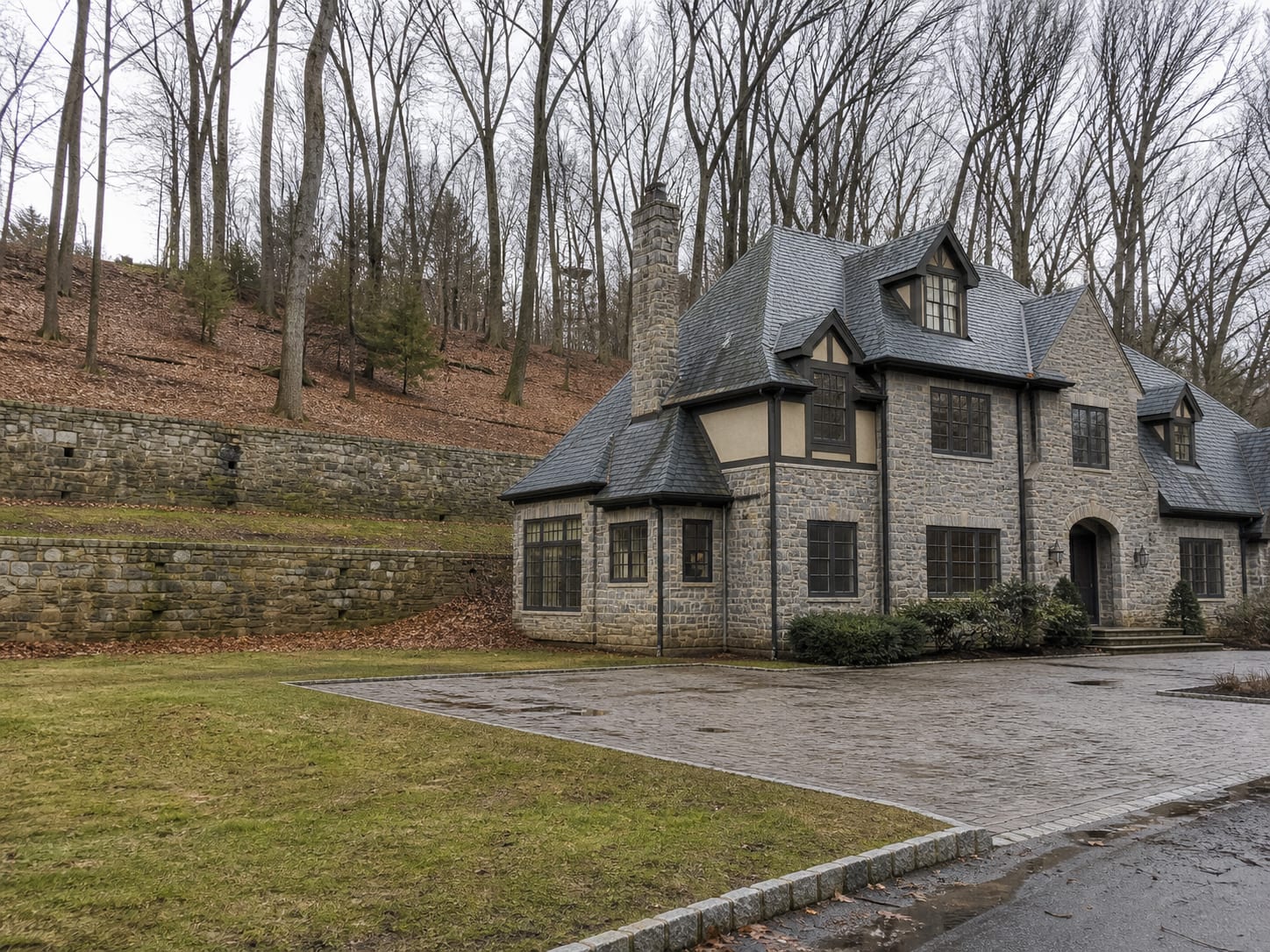
This is the condition that makes Alpine distinctive, and it is written into the borough's own code. Alpine identifies slope and rocky soil in its R-A, R-AA, R-1 and R-R zones, and requires new construction and additions in those zones to carry drainage, erosion, sediment and stormwater plans designed for a 50 year storm. Steep slope standards apply where a property falls in an area of 15 percent grade or greater, and the code treats wetlands and floodplains as environmentally sensitive features present on numerous sites.
For a property owner, that translates into a practical question after heavy rain: where did water go once it reached the ground, and did any of it end up against or under the building. Uphill runoff, a drainage path that has changed, and a discharge point that no longer carries water away are all more likely explanations here than a rising water table.
Roof, Attic and Envelope Water Entry
Attic mold remediation starts with the same split. Water arriving from above concentrates around the thing that let it in: a flashing, a valley, a chimney, a vent penetration or a failed roof covering. It runs, so it leaves directional staining and shows up on framing below the entry point. Complex roof forms and difficult access make this harder to inspect casually and easier to misread from the ground.
Attic Condensation
The other attic source is interior moisture, carried upward by warm air that meets cold roof sheathing and gives up its water there. It reads differently: broad discoloration across a plane rather than a defined patch, heaviest above bath fans, hatches, recessed fixtures and top plate gaps. The repair is air sealing and exhaust termination, and adding roof vents will not fix it while the supply continues.
Lower Level Moisture
Below grade spaces collect the results of everything happening outside, and basement flood cleanup is a different job from routine seepage. Seepage at a wall or slab joint, a failed sump or discharge line, condensation on cold surfaces in humid months, and water tracking in along a utility penetration all present as the same musty lower level. Distinguishing them is what decides whether the answer is drainage, plumbing, dehumidification or a repair to the envelope.
Plumbing and Appliance Failures
A burst pipe, a water heater, a dishwasher or a refrigerator line can put a large volume of clean water into a building quickly, and the damage often runs further than the visible wet area. What matters most in the first day or two is how fast the water is removed and whether the structure is dried, because the clock on secondary damage starts immediately.
HVAC Condensate and Indoor Humidity
HVAC mold remediation becomes relevant here. Air handlers, condensate pans and lines, and duct runs through unconditioned space all create surfaces where moisture can collect. When a system is contaminated or suspected of being contaminated, running it moves the problem around the building rather than solving it.
What the Mold Remediation Process Looks Like on a Sloped Alpine Lot
Inspection and Moisture Assessment
The first job is to name the source. That means a visual inspection, moisture readings, and a look at the water history of the space rather than a sample. Federal guidance is that where mold is visible, sampling is normally unnecessary, because visible growth is already the finding and the remediation does not change with a species name.
Containment and Water Removal
Containment is sized to the affected area. EPA guidance generally recommends limited containment for a contaminated area between 10 and 100 square feet, and full containment above 100 square feet. Minimum protective equipment is an N95 respirator, gloves and eye protection, and an HVAC system that is known or suspected to be contaminated should not be running.
Removal, Cleaning and Structural Drying
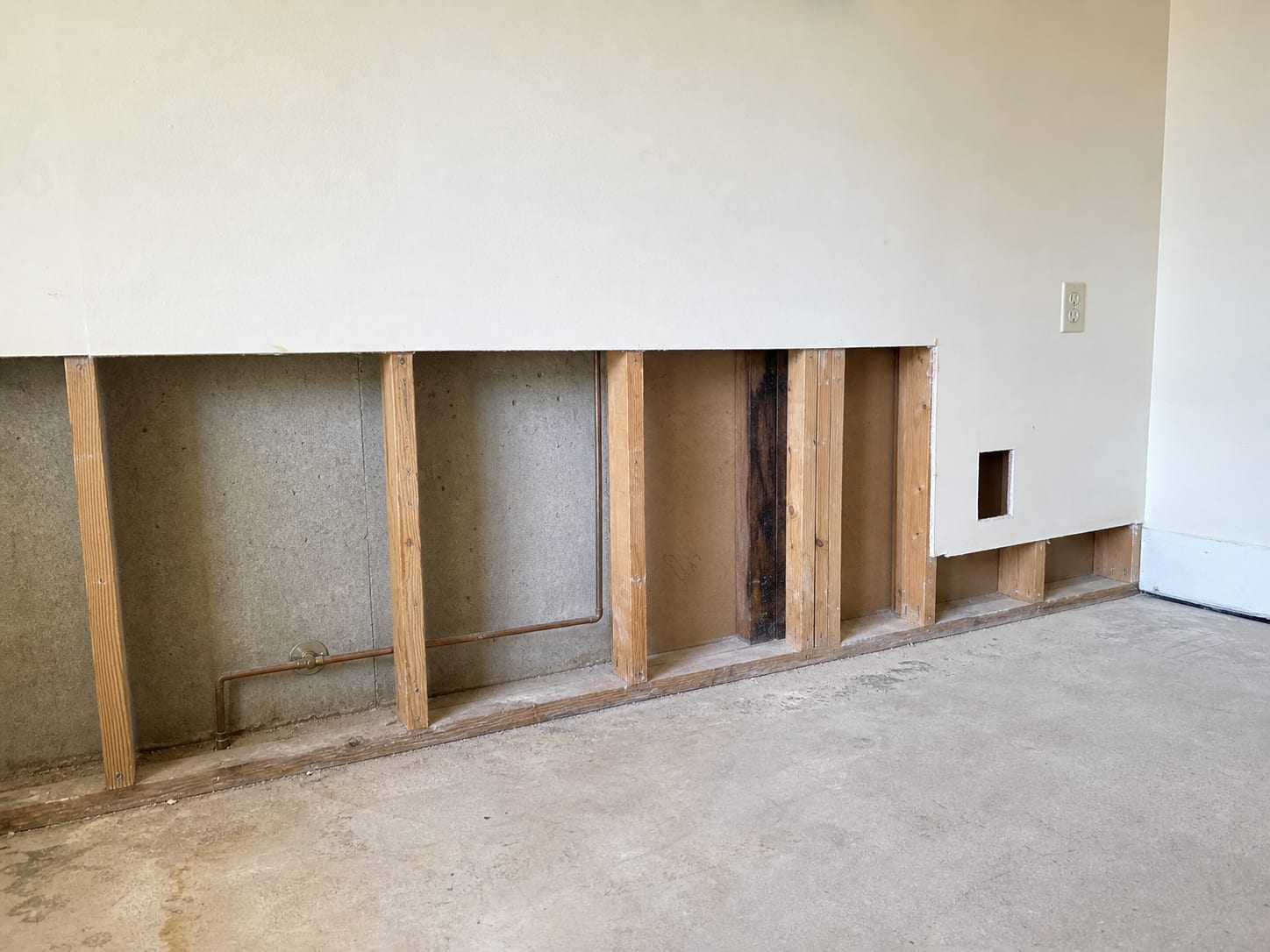
Materials are cleaned or removed according to their condition. Porous materials that are wet and carrying growth often cannot be salvaged. Wet items that are not moldy should be dried within 48 hours. Then the assembly itself is dried, which is a different job from removing what was visible and is why structural drying is scoped separately.
Source Correction and Verification
This is the step that decides whether the work holds. EPA is explicit that cleanup is not complete until the moisture problem is corrected, and that dead mold can still cause an allergic reaction, which is why fogging, biocide or paint alone is not remediation. Completion means the source is fixed, affected material is gone, there is no visible growth or moldy odor, and no return of water damage. Where a documented closeout is needed, post remediation verification records the conditions that were checked.
Services Available for Alpine's Individually Built Houses
ExecPro covers the full path from assessment through repair for Alpine homes and commercial space. These are the services that come up most often on a large lot, detached property, and each one has a boundary worth knowing before you choose it.
Mold Inspection
A documented assessment of a suspected moisture condition for an owner, buyer, seller, or manager. Mold inspection records accessible observations, water source indicators, material conditions, and stated limitations, and on a sloped Alpine lot it takes in the exterior grade and drainage path as well as the interior. What it cannot do is speak for a cavity nobody opened, or say anything about a person's health.
Mold Testing
EPA advises that routine sampling is often unnecessary where mold is already visible, and it has not established health based standards for acceptable indoor spore levels. Mold testing earns its place when there is a defined question the inspection and moisture evidence cannot answer alone, such as an unclear source, a transaction record, or verification after a cleanup. The file then preserves sampling locations, date, building conditions, method, laboratory chain of custody, and limits.
Air Quality Testing
Indoor air quality testing is useful when it answers a defined question about a pollutant source, ventilation, or a specific building condition, and an indoor sample is read against an outdoor control collected at the same time. Whatever comes back describes that spot, on that day, under the conditions in the room at the time. It cannot certify every room or settle a medical question, and no federal numerical standard exists for it to pass.
Black Mold Removal
Growth on a wall or a roof deck is removed by scoping the affected material, containing the work area, taking the material out or cleaning it according to its condition, drying the assembly, and correcting the water source behind it. Black mold removal follows that same path as any other growth, because the Centers for Disease Control states that color does not identify the type of mold or establish that it is more dangerous. The extent and the water pathway set the scope, not the shade.
Water Damage Restoration
Extraction, structural drying, selective removal, and repair planning after a documented water event, including emergency water extraction when water is still present. Water damage restoration treats the water category and the safe access question first, because those decide what can be dried in place and what has to come out.
Crawl Space and Basement Work
Crawl space mold remediation and basement mold remediation address the spaces where drainage, vapor management, and ventilation decide whether a cleanup lasts. On a sloped site the answer often sits outside the building, in where runoff goes once it reaches the ground.
Commercial Mold Remediation
On a commercial job the operational questions arrive with the technical ones: who can authorize the work, when the space can be handed over, and how shared building systems are affected. Commercial mold remediation is scoped around occupied areas, shared building services, and the access window, which is a different problem from a detached house at the same square footage.
Home Buyer and Seller Protection
What moves a closing along is a file with dates on it: what was looked at, what was found, what was repaired, and who checked the work afterward. Home buyer and seller protection and a pre purchase mold inspection give a party a decision useful file at a defined moment, which is separate from the borough's own resale inspection. None of that is a warranty. It is a record of conditions at one moment, which is a different and more honest thing to offer.
Build Back and Reconstruction
Drywall, insulation, flooring, trim, and paint restored after a defined mitigation scope removed or opened them, including drywall replacement after mold and structural mold repair where framing or sheathing is involved. Closing a wall over an uncorrected water path buries the problem rather than fixing it, which is why the source documentation travels with the rebuild scope.
Alpine Building Department Inspections and Permit Paperwork
Alpine directs Uniform Construction Code applicants to its Building Department, and publishes that UCC inspections are by appointment. Building, plumbing and mechanical inspections are held Tuesday and Thursday mornings, and electrical inspections Tuesday and Thursday between 11:00 a.m. and 3:00 p.m. The Borough also publishes UCC application, zoning review, construction guideline and inspection materials on its forms page.
Attic or basement cleaning is not published as a standalone Borough permit class. That is not an exemption, and the Borough does not publish one. The moment work extends into something code covered, which on a restoration job it frequently does, the position changes: structural repair, roofing, electrical, mechanical or exhaust work can all pull a scope into UCC review. Alpine's code also requires a zoning permit before a building permit, and gives the zoning officer 10 business days after a written application to grant or deny it.
Two more local details are worth knowing before work starts. The Borough states that construction related permits generating solid waste carry tonnage reporting, with reports due March 1 for the preceding calendar year, and whether that applies to a particular cleanup is a question for the Borough rather than an assumption. And Alpine added a certificate of continued occupancy for resale on October 25, 2023, requiring application at least 20 business days before a change of occupancy, with inspection within 10 business days of a complete application. That certificate is a general visual check for apparent violations and unsafe conditions. It is not a mold or indoor air clearance document.
One statewide fact belongs here too. The New Jersey Department of Health states that there is no state certification program for companies performing mold or general indoor air and environmental health services, and that its provider lists are not endorsements. A company advertising a New Jersey state certification for mold work is describing a credential the state does not issue.
Frequently Asked Questions from Alpine Homeowners on Slope, Flood Zones and Resale Certificates
Mold is a moisture problem before it is anything else, so the useful question on an Alpine property is where the water goes. The borough's own code names slope and rocky soil in several of its residence zones, treats runoff, erosion and soil slippage as live concerns, and asks new work in those zones to plan drainage for a 50 year storm. That tells you where to look on a sloped lot: the grade, the discharge points, and whether a path that used to carry water away still does. It is a reason to inspect a specific property carefully rather than a statement about the borough, and a house with sound drainage can sit next door to one that has a problem.
Areas We Serve Along Route 9W and Northeastern Bergen County
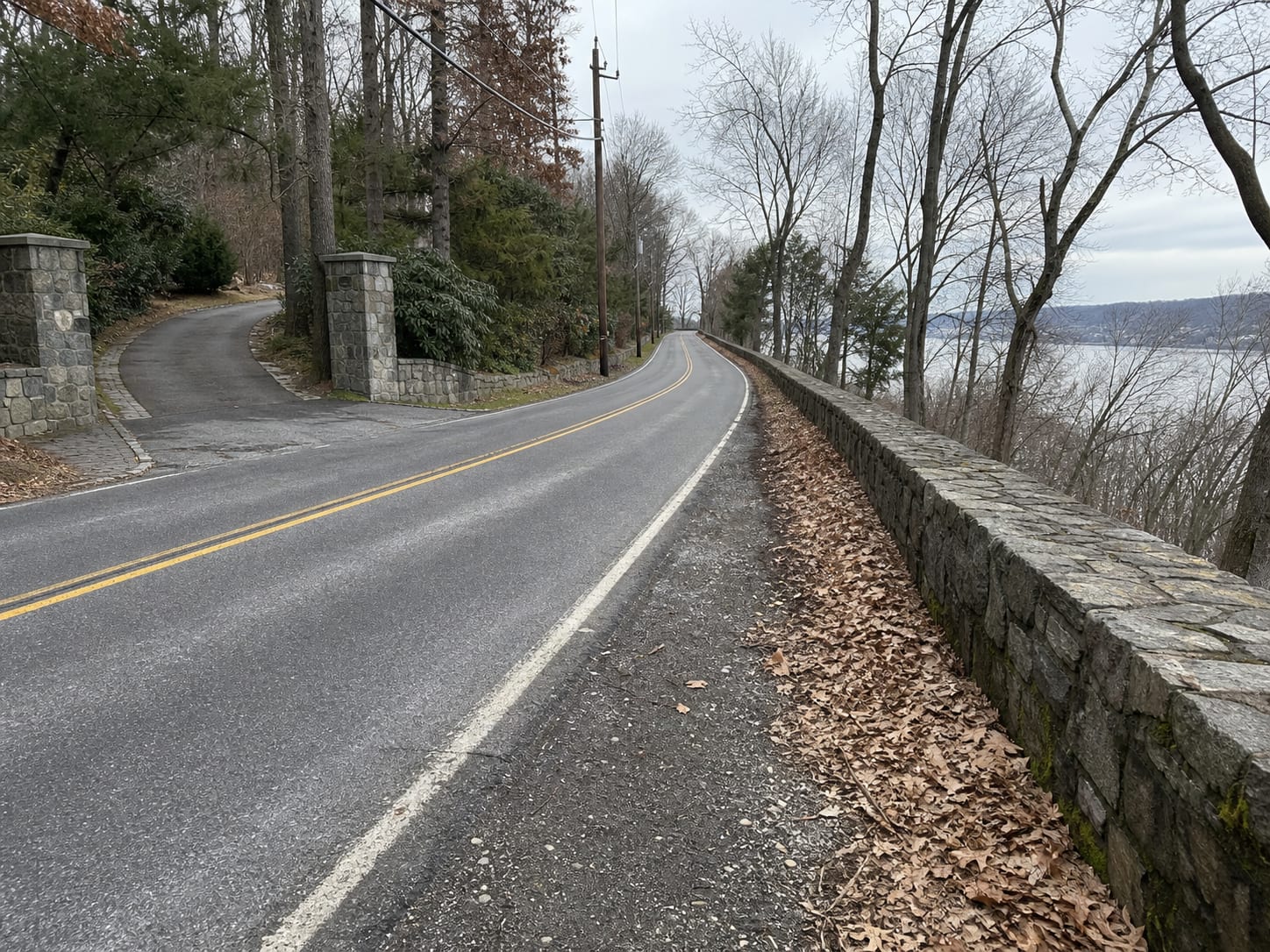
ExecPro Restoration & Cleaning serves Alpine, NJ 07620 and the surrounding northeastern Bergen County area. The borough was incorporated in 1903 and sits on the Palisades above the Hudson at the New York state line, with U.S. Route 9W running its length and Closter Dock Road, County Route 502, dropping east toward the river. Palisades Interstate Park occupies much of the borough's land, taking in the Alpine Boat Basin, the Alpine Lookout and the Closter Dock Trail, and the county's own trail guide records 400 feet of elevation change on the Closter Dock and Huyler's Landing trails and 500 feet on Forest View. Rockleigh, Norwood, Closter, Demarest and Cresskill are named along the borough boundary, and we work across the wider service area in North Jersey, including Livingston in Essex County.
Getting equipment to the affected part of an Alpine property is its own planning question, and it is worth settling before a crew is scheduled rather than on the morning. Long private drives, sloped approaches, gated entries and parking that sits well away from the house all change how material and drying equipment reach the work. What we confirm in advance is the entry point, the affected level, stair access, where the utilities shut off, and whether the route to the space can take what the job needs.
Reach ExecPro Restoration & Cleaning About a Damp Alpine Property
If you are dealing with a water event, a musty odor, visible growth, or a leak nobody has been able to trace in Alpine, NJ, ExecPro Restoration & Cleaning is ready to help. Call (888) 300-3772 or email hello@execprorc.com to schedule an assessment. Emergency services are available 24/7.
About Alpine, NJ
Alpine is a borough in Bergen County, in North Jersey, on the Palisades above the Hudson at the New York state line. It was incorporated as a borough in 1903 and its Borough Hall publishes an Alpine, NJ 07620 address. The U.S. Census Bureau's 2020 Census counted 1,762 residents, a decennial count rather than a current estimate, and the American Community Survey's five-year table reports 593 housing units give or take 72, which is a survey estimate carrying its own sampling uncertainty. The borough's own zoning tells you more about the buildings than any average would: the current code principally permits one-family detached dwellings across its residence zones, with minimum lot areas of 87,120 square feet in the R-A and R-R districts, 65,340 in R-AA and 40,000 in R-1. That is a regulated pattern of large-lot detached houses, and it is a different starting point from the attached and multi-unit housing that shapes restoration work elsewhere in the state.
The moisture story in Alpine is about the ground a house sits on rather than the weather over it. The borough code names slope and rocky soil in its R-A, R-AA, R-1 and R-R zones and requires new construction and additions there to carry drainage, erosion, sediment and stormwater plans designed for a 50-year storm. Steep-slope standards apply where a property falls in a 15 percent or greater slope area, and the code treats wetlands and floodplains as environmentally sensitive features present on numerous sites. The Palisades setting is not abstract either: the county's own trail guide documents 400 feet of elevation change on the Closter Dock and Huyler's Landing trails and 500 feet on Forest View. So the questions that matter on an Alpine property are where uphill runoff goes, how site drainage was designed, and where water actually entered, rather than any townwide generalization. No source establishes a flood-zone share, a water-table depth, basement or crawl-space prevalence, or a local mold rate for the borough, and those remain open questions to be answered parcel by parcel rather than on a page.
Around Alpine
Do not see your neighborhood? We serve all of Alpine and the surrounding area. Reach out and we will confirm coverage.
Guides for Alpine
The Fourth Track in the Claim File: Insurance Restoration Services in Alpine, NJ
A restoration claim runs on four separate tracks, and the one that gets forgotten on an Alpine property is the site itself, which can carry its own review before permanent work starts.
A Borough With No Commercial District: Commercial Mold Remediation in Alpine, NJ
Alpine's nonresidential buildings are clubs, legacy small lot businesses and civic and utility sites, which changes both the intake and the approval path for a mold job.
Clean, Retain, Reinforce, Replace: Structural Mold Repair in Alpine, NJ
Once growth is on a joist rather than on drywall, an Alpine job has four possible answers, and the one you pick changes how the state classifies the work.
Two Gates Before the Wall Closes: Post Mold Remediation Rebuild in Alpine, NJ
Dry enough to rebuild is the first gate. The second is whether the work is still interior finish restoration, or has quietly become site work the borough reviews.
Where the Water Went: Air Quality Testing in Alpine, NJ
A sample is read against that day's outdoor air, and on a sloped Alpine lot the more useful question is usually where the water got in.
Above the Hudson, Below the Roof: Attic Mold Remediation in Alpine, NJ
An Alpine attic problem is a moisture source question and an access question. The Palisades setting changes how you get to the roof, not what wet the wood.
Two Elevations, One Question: Mold Remediation in Alpine, NJ
A house on the ridge and a structure at the river edge are different problems wearing the same word, and neither location tells you where the water in a particular wall came from.
Before You Pay for a Sample: Mold Testing in Alpine, NJ
Four situations bring an Alpine owner to the idea of a mold test, and only two of them are improved by one. Knowing which you are in is worth more than the sample.
A Map of the Water: Mold Inspection in Alpine, NJ
An inspection here is worth what it establishes about where water enters and travels, which on a large Alpine lot with shallow rock and a septic field is a longer list than most people expect.
The Address Answers It, Not the Town: Flood Damage Cleanup in Alpine, NJ
Flood cleanup in Alpine turns on three separate findings: what the parcel actually shows, what the water actually was, and what the rebuild will actually need.
Elevation Is Not Dryness: Emergency Water Extraction in Alpine, NJ
Emergency water extraction in Alpine, NJ: what the first hour is actually spent on, why the power situation is settled before any pumping starts, and what follows.
Downstream of the Hatch: Crawl Space Mold Remediation in Alpine, NJ
What grows on the joists under an Alpine house is usually the last event in a chain that began somewhere uphill of it, which is why the fix so often sits outside.
The Lot Decides the Repair: Basement Mold Remediation in Alpine, NJ
Cleaning a lower level in Alpine is the straightforward half. Whether the source correction stays indoors, and whether the paperwork lands before a closing, is the half that sets the schedule.
Classify the Water First: Water Damage Restoration in Alpine, NJ
What the water is decides what can be saved. On an Alpine lot with septic and high groundwater, that question is harder and more important than usual.
Black Mold Removal in Alpine, NJ: What Happens Next
Dark growth on a wall in an Alpine home is a job with a known sequence: find the water, contain the area, remove what cannot be saved, dry it and prove it.