Above the Hudson, Below the Roof: Attic Mold Remediation in Alpine, NJ
Cal HewittPublished
- attic mold remediation
- condensation
- palisades
- alpine nj
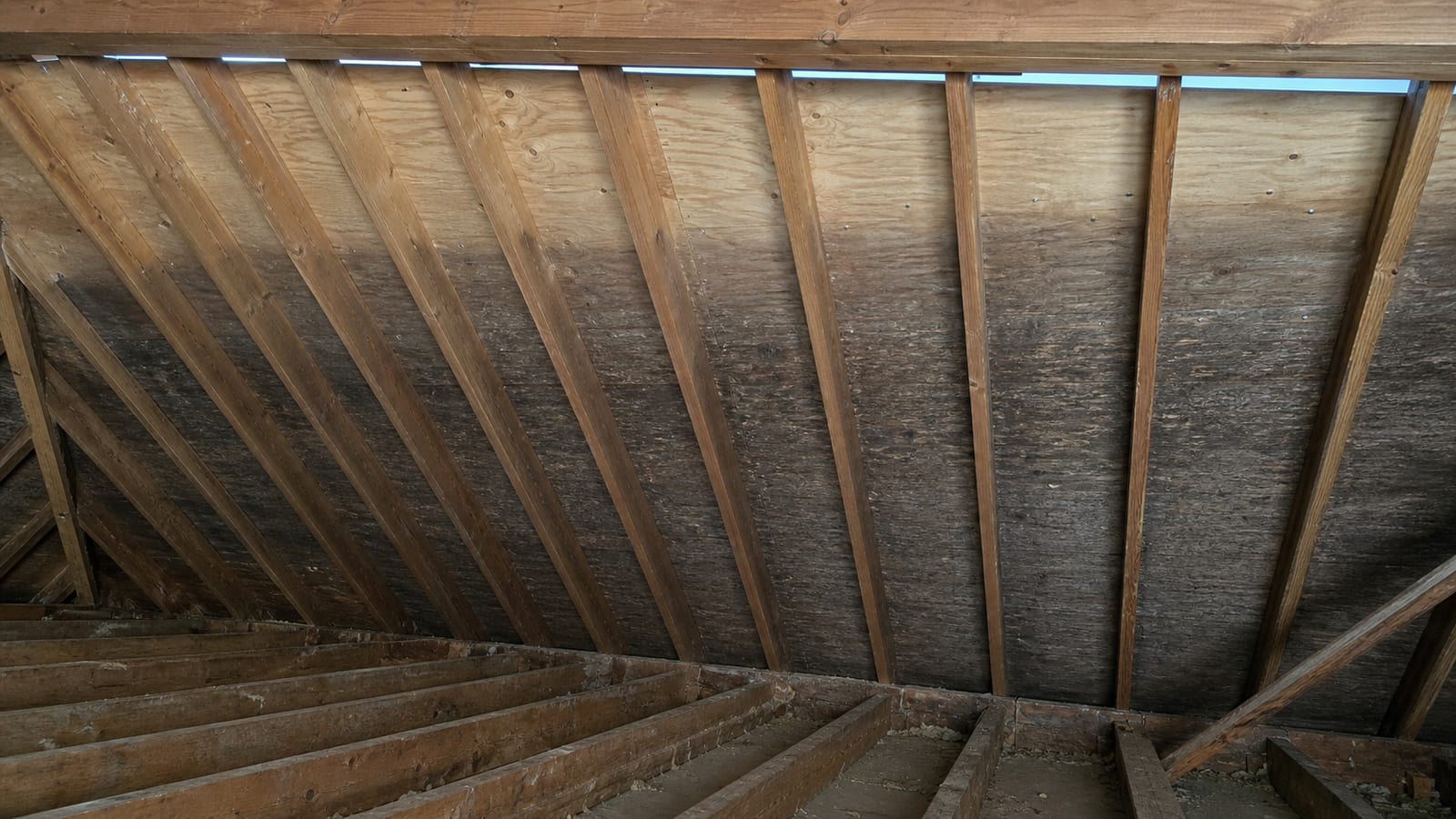
There are only two ways water reaches the underside of a roof in Alpine. It comes in from outside, through a flashing, a penetration, a roof covering or a ventilation opening. Or it arrives from inside the house, carried upward as vapor in warm air that meets cold sheathing and gives its moisture back to the wood. Everything else is detail. The general method is covered on our attic mold remediation service page; this is about what changes in Alpine.
That sounds simple, and the diagnosis usually is. What makes Alpine different, and what our Alpine service area page covers more broadly, is not the physics above the ceiling. It is the ground the house sits on, the way the roof gets reached, and a Building Department process that has to be asked about before a repair starts rather than after.
Key Takeaways
The question is always the source
Water entering from outside and vapor arriving from inside look different on the deck. Naming which one you have is the whole assessment.
Cleaning is not the job
Federal guidance is explicit that remediation is incomplete until the moisture problem is corrected. Dead mold can still cause an allergic response.
The Palisades change access, not physics
The state has documented heavy rain and snowmelt slope events in Alpine. That affects safe site access and timing, not what wet the sheathing.
Ask the Borough before the repair
Attic cleaning is not published as a standalone permit class, but sheathing, electrical, mechanical or exhaust work may need UCC review.
New Jersey does not certify mold companies
The Department of Health says no state certification program exists. Anyone advertising one is describing something else.
The Two Sources, and Why They Read Differently
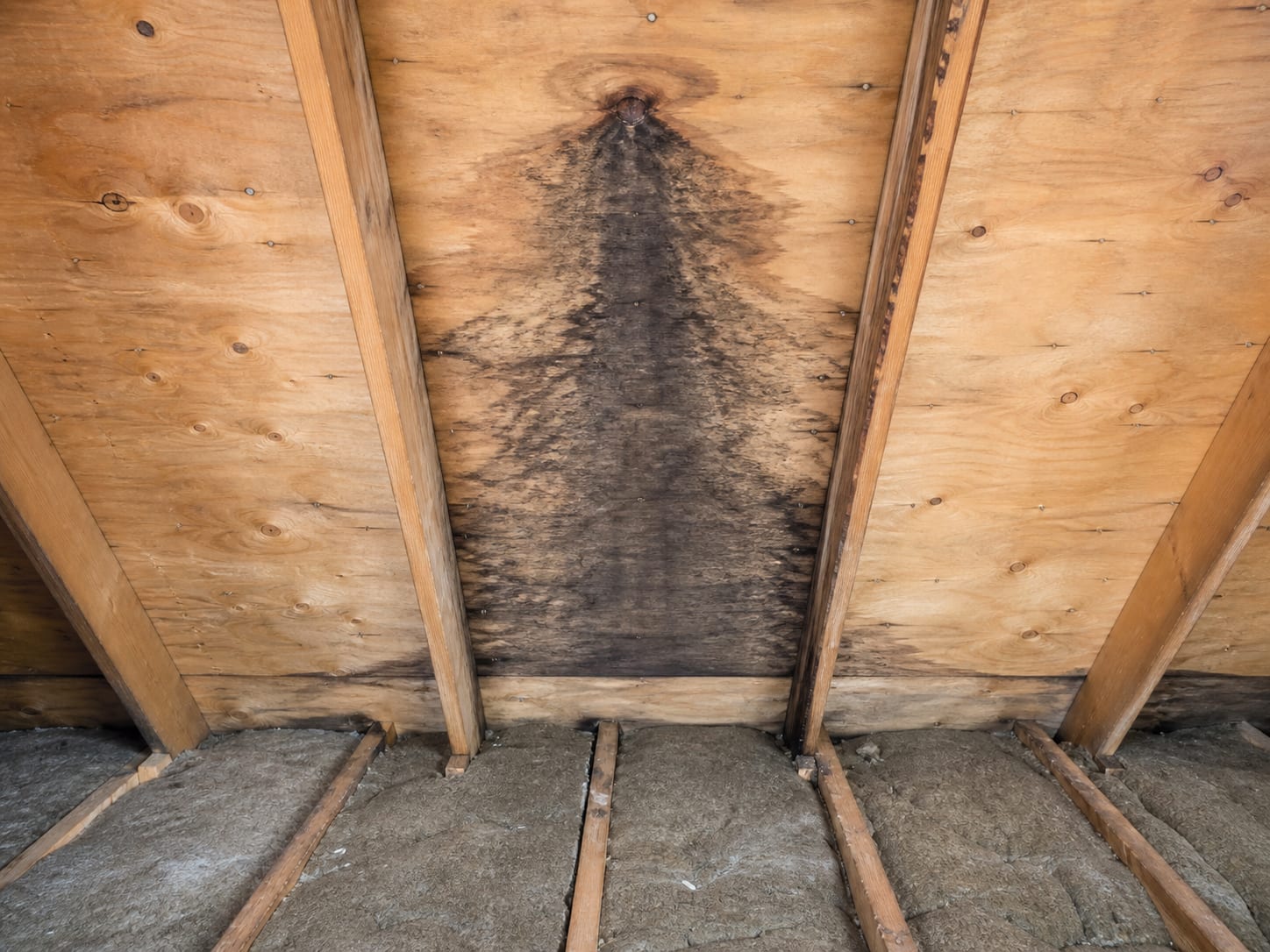
An attic gives up its history if you look at distribution before you look at severity. Water arriving from above tends to be local. It concentrates around the thing that let it in: a flashing, a vent boot, a fastener, a valley, a chimney. It runs, so it leaves directional staining and it often shows up on framing below the entry point rather than spread evenly across a plane.
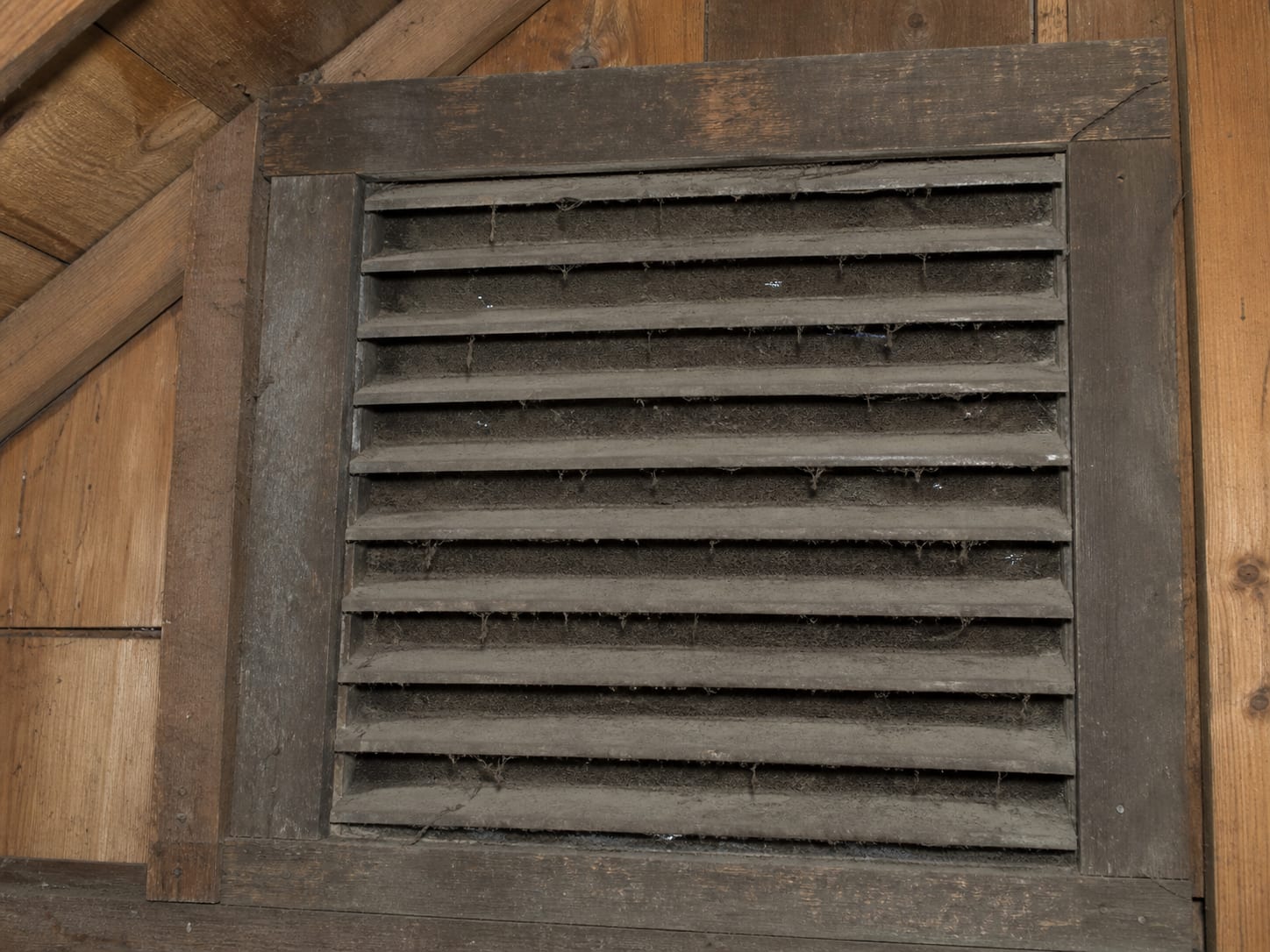
Moisture arriving from inside behaves the opposite way. It is delivered by air, so it goes where air goes, and it condenses on whatever surface is coldest. That produces broad discoloration across the sheathing rather than a defined patch, and it concentrates above the places where indoor air escapes the ceiling: bath fans, hatches, recessed fixtures, plumbing penetrations, the gap at an interior wall top plate.
Both are common. Both can be present at once. The reason the distinction matters so much is that the repairs have nothing in common. One is a roofing correction. The other is an air sealing and exhaust correction, and adding roof vents will not fix it if the supply of moist air is still arriving.
What the Palisades Setting Actually Changes
Alpine sits on top of the Palisades above the Hudson. New Jersey's own scenic byway material places the Palisades Interstate Parkway on the cliff top and Henry Hudson Drive between the Parkway and the river, and reports State Line Lookout at 532 feet. That is real relief, and it is not decoration on a service page. The state's 2014 hazard mitigation plan records multiple rockslide and debris flow events in Alpine, associated with heavy rain, rain falling on snowmelt, ordinary weathering and Tropical Storm Irene. On April 15, 2007, the plan records a heavy rain debris flow that closed Henry Hudson Drive for a month.
It is worth being careful about what that means. Terrain like this does not make an attic wetter. What it does is put two separate questions on the table after heavy rain or a fast thaw: whether water got into the roof assembly, and whether the site itself can be worked on safely. They have different answers, and the second one is about scheduling and access rather than about your sheathing. The attic diagnosis is unchanged by the view. Warm interior air reaching a cold deck supplies moisture whether the house is on a cliff or on a flat lot.
Reading the Pattern Before Anyone Opens Anything
That table is a starting hypothesis, not a conclusion. An attic with wet insulation, compromised sheathing or an exhaust duct discharging into the space can present as both at once, and that is exactly the case where guessing costs the most.
What the Federal Guidance Actually Requires
EPA's remediation guidance sets out a sequence rather than a product. Assess the size of the affected area and the materials involved. Identify the moisture cause. Plan protective equipment and containment. Remediate. Fix the moisture problem. Dry wet items that are not moldy within 48 hours. Then check for recurrence, which is where post remediation verification produces a written record rather than an assurance.
Two of those steps carry numbers worth knowing. For a contaminated area between 10 and 100 square feet, EPA generally recommends limited containment. Above 100 square feet, it generally calls for full containment. Those are the guide's own categories, published for schools and commercial buildings, and they are useful as a scale for scope rather than as an Alpine rule.
Naming that source is what a documented mold inspection is for, and it is the step people skip. EPA is direct that cleanup is not complete until the water problem is fixed, and that dead mold can still cause an allergic reaction. That single sentence disposes of a whole category of offers: fogging, biocide application, stain removal and paint, sold as the job rather than as a step within it. If the leak, the duct termination, the air path or the humidity condition is still in place, the attic will do the same thing next season.
Protective equipment has a floor too. EPA's minimum is an N95 respirator, gloves and eye protection. CDC guidance from February 2024 goes further on who should not be doing this at all: people with allergies, immune suppression, underlying lung disease, asthma or COPD should not take part in mold cleanup, and it specifies a NIOSH approved N95, gloves and goggles for those who do. Neither source supports running an HVAC system that is known or suspected to be contaminated.
The Order the Work Actually Goes In
- 1
Inspect
Attic, roof and penetrations, insulation, ventilation, and where every exhaust fan actually terminates.
- 2
Identify
The active moisture source, and map which materials are affected including what is hidden.
- 3
Plan
Containment and protective equipment sized to the area, and whether a sampling question exists at all.
- 4
Contain
Close the attic access before anything is disturbed, so the disturbance stays upstairs.
- 5
Remediate and dry
Clean or remove by material condition, dry the assembly, and correct the source.
- 6
Verify
Document completion, then revisit for recurrence rather than assuming it.
When Alpine's Building Department Needs to Be Asked
This is the part that is genuinely local, and it is procedural rather than technical. The Borough directs permit applicants to its Building Department for Uniform Construction Code work, and publishes that UCC inspections are by appointment. Building, plumbing and mechanical inspections are Tuesday and Thursday mornings. Electrical inspections are Tuesday and Thursday between 11:00 a.m. and 3:00 p.m. The Borough also publishes UCC application, zoning review, construction guideline and inspection materials on its forms page.
Attic cleaning itself is not published as a standalone Borough permit class. That is not the same as an exemption, and the Borough does not publish one. The moment the work extends into something code covered, which on an attic job it very often does, the picture changes. Structural sheathing repair, electrical work, mechanical or exhaust work, roofing work: any of these can pull the job into UCC review. The right move is to scope it with the Building Department before the work starts, not to discover it during an inspection. One more Alpine detail worth knowing in advance. The Borough states that construction related permits generating solid waste carry tonnage reporting, with reports due March 1 for the preceding calendar year. Whether that applies to a particular attic cleanup is a question for the Borough rather than an assumption to make either way.
Timelines are worth pinning down in writing rather than over the phone. How long the Borough takes to turn a scope around, and how long the work itself runs once it starts, both belong in the document you agree to, alongside who is booking the inspections and when.
The Certification Question, Answered Plainly
New Jersey's Department of Health, in material reviewed May 14, 2025, states that there are no state certification programs for companies performing mold or general indoor air and environmental health services, and that the Department does not endorse or qualify private firms. It also notes that code offices can address structural deficiencies such as unrepaired leaks, but generally do not have mold regulations.
That has a practical consequence. A company advertising itself as a New Jersey state certified mold remediator is describing a credential the state does not issue. There are real qualifications in this field, including trade certifications from private bodies and demonstrable experience, and a good contractor will name exactly which one they hold and who issued it. The red flag is not certification. It is the specific claim of a state certification that does not exist.
What Changes the Scope, and What It Costs
Attic jobs vary more than people expect, and the variation has less to do with square footage than with what is actually wrong. What moves a scope is the size of the affected area, whether the material can be cleaned or has to come out, how much moisture has reached places you cannot see, the level of containment the work needs, whether the HVAC system is involved, how hard the space is to get into, and whether sheathing or insulation has to be replaced rather than dried.
That is why a firm price before anyone has been up there is a quote for a category rather than for your house. The number worth having is a written scope after an inspection, dated, with the investigation, containment, removal, drying, source repair and any rebuild separated out so you can see which part is which and what you are agreeing to.
Alpine adds one wrinkle. This is a borough of individually built houses on large lots, around 593 homes in total, so there is no local pattern to lean on. Roof form, attic configuration, insulation arrangement and where the exhaust fans terminate all get established on the property, and the house next door will tell you very little about yours.
Frequently Asked Questions About Attic Mold Remediation in Alpine NJ
Do I need a mold species test before the work starts?
Usually not. EPA guidance is that sampling is unnecessary in most cases where mold is visible, because visible growth is already the finding and the remediation does not change based on which species it is. There is also no federal threshold that would let a sample determine whether a building passes or fails. Testing earns its place when the source is unclear, when there is a health or legal question, or when documentation is specifically needed, and in those cases the sampling question should be written down before anyone takes a sample.
Will more roof vents solve a condensation problem?
Ventilation helps an attic carry moisture away, so it is a supporting measure. It is not a cure for an ongoing supply. If a bath fan is discharging into the attic every morning, adding vents changes how fast the space clears and changes nothing about what keeps arriving. The order that works is to stop the supply first, then confirm the ventilation is adequate to handle what remains.
The stains are only on one side of the roof. Does that tell you anything?
It can. Condensation is often heaviest on the north facing plane, because that is the coldest surface for the longest part of the year. That is a hypothesis rather than a diagnosis, and it needs to be checked against where the air is escaping the ceiling and where any exhaust ducts terminate.
Does a debris flow or a heavy rain event mean my attic is at risk?
Not by itself, and the two questions should stay separate. The state hazard plan documents heavy rain and snowmelt related slope events in Alpine, which is a real access and timing consideration for getting to a property and working on a roof safely. Whether water entered your roof assembly is a separate question answered by looking at the assembly.
Do I need a permit to clean an attic in Alpine?
Attic cleaning is not published as its own Borough permit class. The associated repairs are where the answer changes: sheathing, roofing, electrical, mechanical and exhaust work can all fall under Uniform Construction Code review. Ask the Building Department about your exact scope before the work begins, and remember inspections are by appointment on published days.
Can I just clean the sheathing and leave it there?
Only if you are willing to do it again. Cleaning addresses what already happened. It does nothing about the flashing, the duct termination, the air path or the humidity condition that wet the wood in the first place, and EPA guidance treats correcting that source as part of the remediation rather than as an optional follow up.
Final Thoughts
An Alpine attic is not a mystery, and it is not a special case in the way marketing copy likes to suggest. It is the same two sources every attic has, on a site where getting to the roof and getting the paperwork right take more thought than usual.
What the Palisades setting genuinely adds is a documented reason to think about access, weather and timing as part of the job rather than as an afterthought. What the Borough adds is a real process with published inspection days that rewards asking early. What nobody has added is a local number for mold rates, humidity, prices or property values, and a page that supplies one is making it up.
If there is staining on your roof sheathing and you want to know which of the two sources actually put it there, ExecPro Restoration & Cleaning can trace the moisture route, document what is affected, and tell you plainly which repairs belong to the roof and which belong to the ceiling below it. Call (888) 300-3772 or get in touch through our contact page and we will start with the attic rather than with a quote.
Attic Moisture Terms
Tap a term to see what it means.
Roof deck. The sheathing that forms the underside of the roof, and the coldest large surface in most attics during a heating season.
Serving Alpine
ExecPro Restoration & Cleaning provides mold remediation services in Alpine, NJ, from inspection and testing through removal, drying, and post-remediation verification. Call (888) 300-3772 for 24/7 emergency response.
Related Articles
Where the Water Went: Air Quality Testing in Alpine, NJ
A sample is read against that day's outdoor air, and on a sloped Alpine lot the more useful question is usually where the water got in.
Two Elevations, One Question: Mold Remediation in Alpine, NJ
A house on the ridge and a structure at the river edge are different problems wearing the same word, and neither location tells you where the water in a particular wall came from.
Leak or Condensation: Attic Mold Remediation in Plainsboro, NJ
Dark staining on a Plainsboro roof deck is usually one of two things. How to tell which, what the work costs, and why paint over it is the wrong answer.