Air Purifier for Mold: What HEPA Captures and What It Misses
Cal HewittPublished
- basement mold remediation
- indoor air quality
- moisture control
- new jersey
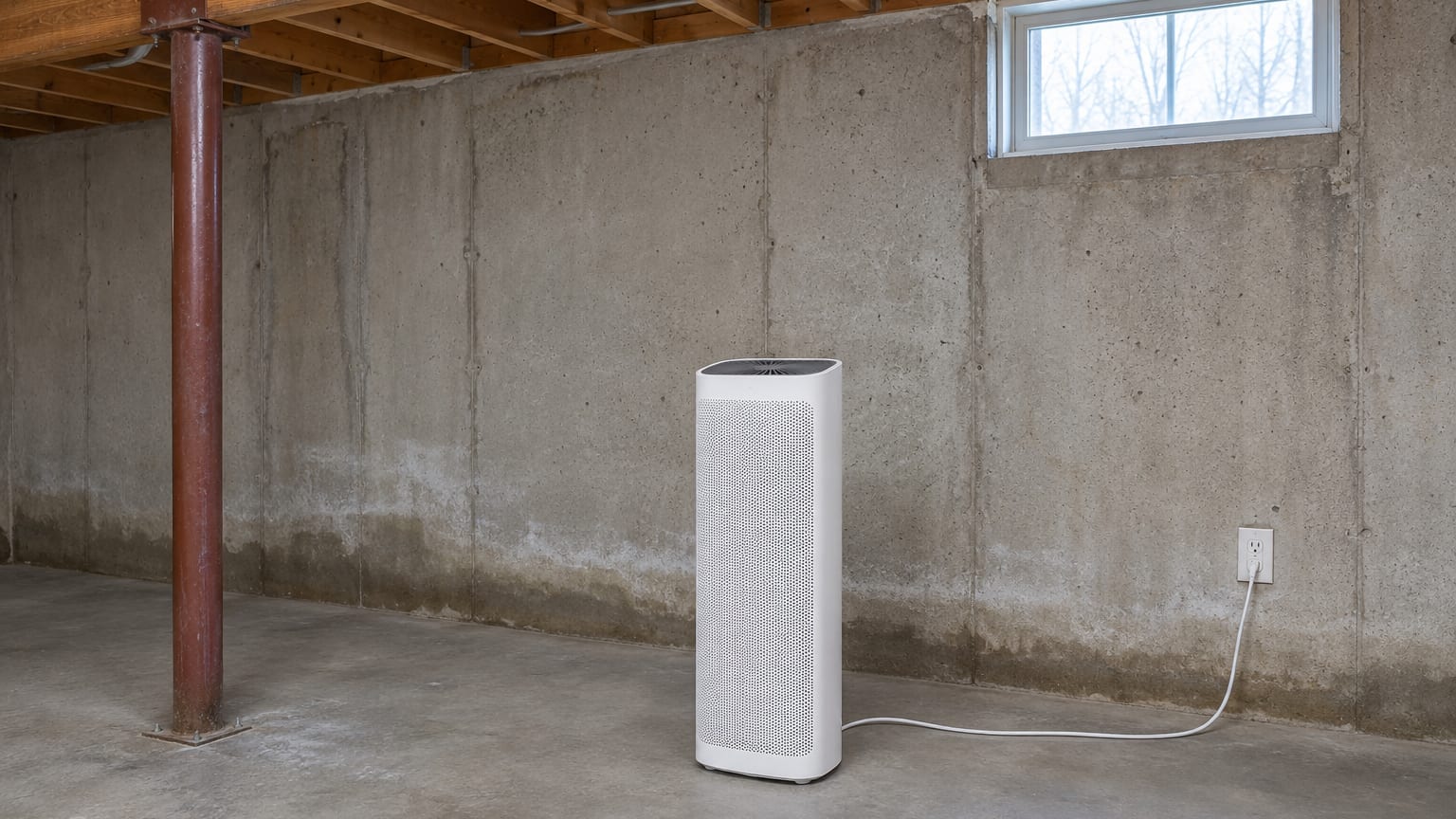
A musty basement makes an air purifier look like the quick fix. You plug it in, hear the fan, and hope the smell fades. A HEPA purifier can capture some of the mold particles floating in a room, so it earns a place in the plan. Whether it belongs first depends on what is keeping the basement damp.
EPA gives the order. Source control is the most effective approach, ventilation comes second, and air cleaning is a supplement. In a New Jersey basement that means a humidity reading, a search for the leak or the condensation, a dehumidifier if the air stays damp, and then a purifier sized for the room.
If you are standing in the basement now, take a humidity reading and photograph any staining, condensation or growth before you touch anything. Those two steps tell you which of the next moves you need.
Key Takeaways
What HEPA does
EPA says a HEPA filter can theoretically remove at least 99.97% of airborne particles measuring 0.3 microns, mold particles included.
Where a purifier fits
A portable air cleaner supplements moisture control and cleanup; it does not remove growth on surfaces or fix the water source.
Dehumidifier or purifier
Humidity control comes first, with EPA recommending relative humidity below 60% and ideally between 30% and 50%.
How to buy one
Match CADR and the manufacturer's room rating to the room, avoid ozone generators, and follow the manual for placement and filter changes.
The next step
Visible mold means moisture and cleanup come first; a musty odor with no visible source calls for a qualified inspection and possibly targeted sampling.
A HEPA Air Purifier Filters Mold Particles Out of the Air in Its Room
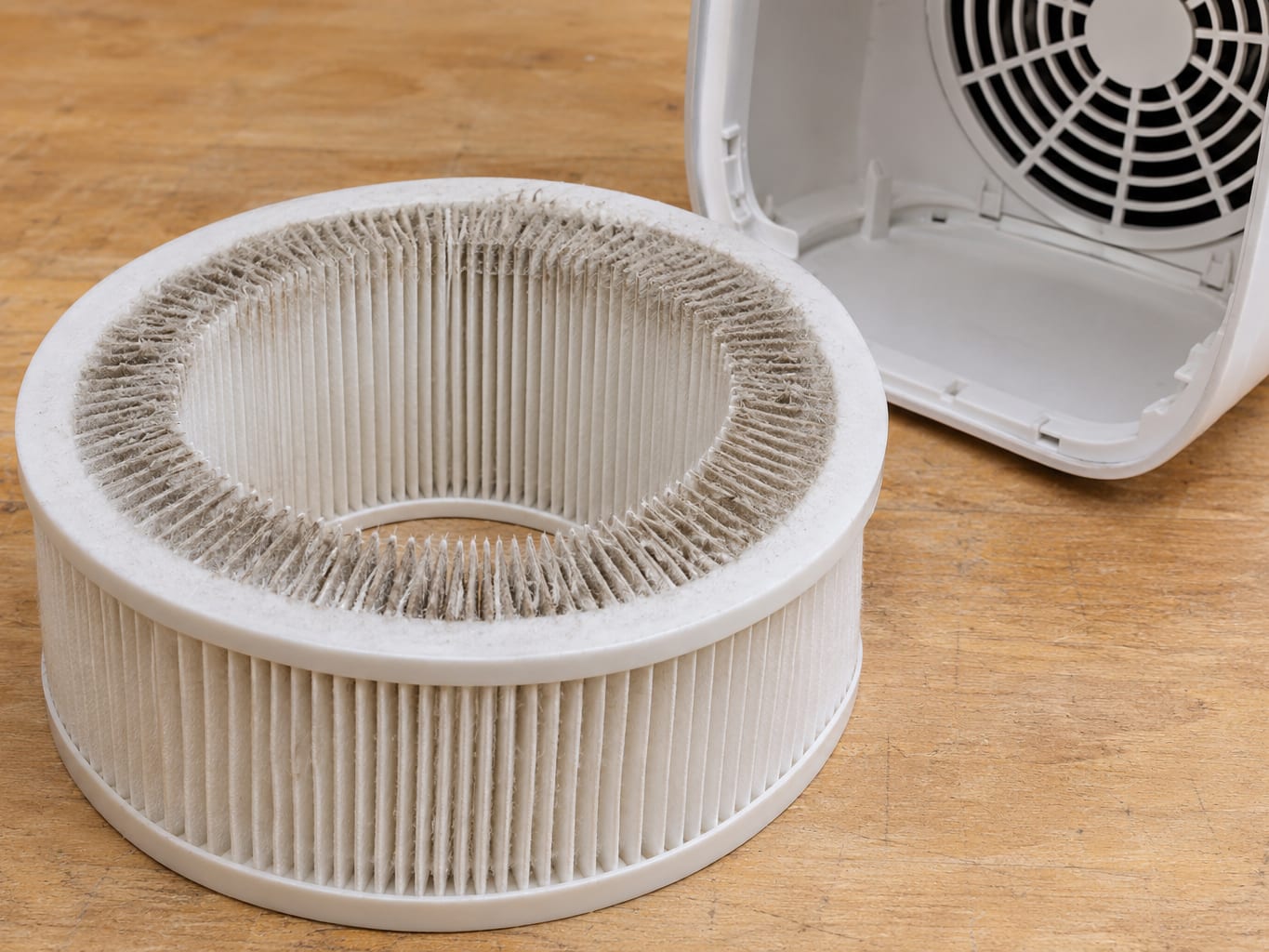
A portable air cleaner with a HEPA filter can reduce some of the airborne particles that mold produces. EPA defines a HEPA filter as a pleated mechanical filter that can theoretically remove at least 99.97% of dust, pollen, mold, bacteria and other airborne particles measuring 0.3 microns. That size is the most penetrating one, so particles larger and smaller than 0.3 microns may be captured at higher efficiency.
The filter works by catching particles as air passes through it. It traps them; it does not kill them. How much a real unit removes from a real room depends on airflow, the condition of the filter, the unit's clean air delivery rate, the size of the room and how the unit is run. EPA's guide to air cleaners adds a simple rule: the longer a cleaner runs, the more air it filters.
HEPA is a particle-capture specification. It describes what happens to particles that reach the filter, and it says nothing about where those particles came from. In a damp basement, the source is the question to answer next.
A Musty Basement Points to Moisture First
Mold grows where there is moisture, so a musty basement is telling you about water before it tells you about air. EPA says portable air cleaners do not address the cause of mold or musty odors. They do not remove mold growing on walls, framing, carpet or stored boxes, and they do not correct the leak, seepage or condensation that feeds it. A quieter room can feel like progress, but a fading smell is not proof that the mold is gone.
EPA recommends correcting leaks and visible moisture, cleaning visible mold and drying the area. Wet materials should be dried as soon as possible, ideally within 24 to 48 hours. Porous materials such as carpet and ceiling tile may need to be removed and replaced when they cannot be thoroughly cleaned and dried, and nothing wet or moldy should be painted over.
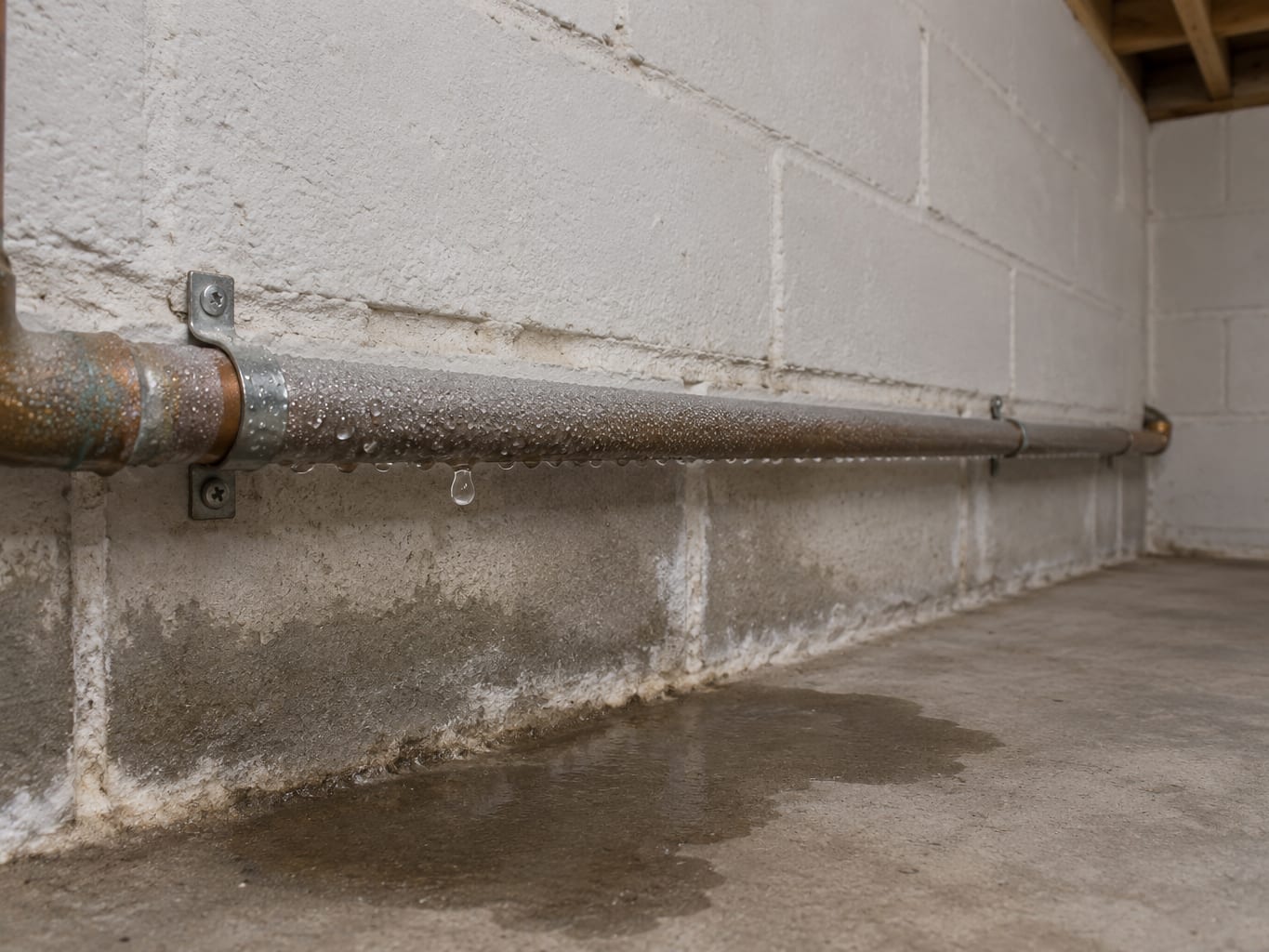
Not sure whether a dark patch is mold at all? Our post on what looks like mold on walls covers the common look-alikes. If the odor has no visible source, a qualified inspection is the way to find it, and our indoor air quality testing is built for that situation.
Which Is Better for Mold, a Dehumidifier or an Air Purifier?
They do different jobs, and in a damp basement the dehumidifier's job comes first. A dehumidifier removes water vapor from the air. EPA recommends keeping indoor relative humidity below 60%, ideally between 30% and 50%, and identifies dehumidifiers as useful in humid basements. For people managing asthma and mold exposure, CDC advises keeping humidity under 50% and checking it more than once a day with a hygrometer, the small meter that reads relative humidity.
An air purifier filters particles from the air that passes through it. It can reduce some airborne mold particles, but it cannot dry the building or stop a leak.
Hover or tap a row to highlight it.
| Device | What it handles | What it leaves for you |
|---|---|---|
| Dehumidifier | Removes water vapor from the air | The leak, seepage or condensation behind the dampness |
| HEPA air purifier | Filters some airborne particles, mold particles included | Surface growth, wet materials and the moisture source |
For a damp New Jersey basement, the order is simple.
1. Find and correct leaks, seepage, condensation or other moisture sources. 2. Run a dehumidifier while humidity stays elevated. 3. Add a HEPA air cleaner as a supplement for airborne particles. 4. Clean or remediate mold-affected materials according to the material and how far the mold has spread.
Our post on the basement humidity level that prevents mold covers meters, dehumidifier sizing and drainage in more detail.
Choose a Purifier by HEPA Filter, CADR and Room Rating
Clean air delivery rate, or CADR, is the number that lets you match a unit to a room. EPA explains that a higher CADR means more particle removal and a larger service area. EPA lists CADR values for tobacco smoke, dust and pollen, and the smoke value represents the smallest of those particles, so a higher smoke CADR points to stronger removal of small particles. CADR is generally measured at the highest fan speed, so a rating may not describe how the unit performs on a quiet setting.
For a mold-related purchase, these are the points that matter:
- Filter: HEPA, or clearly documented high-efficiency mechanical filtration.
- CADR: A rating that fits the room or area you want to treat.
- Room rating: A manufacturer room-size rating that matches the space.
- Ozone: No intentional ozone generation.
- Replacement filters: Filters you can buy again and change on the manufacturer's schedule.
What to Check Before You Buy a Purifier
The filter
HEPA, or clearly documented high-efficiency mechanical filtration.
The CADR
A rating that fits the room or area you want to treat.
The room rating
A manufacturer room-size rating that matches the space.
Ozone
No intentional ozone generation.
Replacement filters
Filters you can buy again and change on the manufacturer's schedule.
Where should I place an air purifier?
Put it in the room where you want the particle reduction, and size it for that room using CADR and the manufacturer's room rating. A unit rated for a smaller room will struggle in a larger one. Keep the air intake and exhaust paths clear of furniture, boxes and walls. The manual for your model sets the minimum clearances, the filter-change schedule and the operating modes, so follow it. Because a unit filters more air the longer it runs, run time is the other dial you control, within what the manual allows.
Is there a downside to using an air purifier?
There are a few. Fans make noise, replacement filters cost money, and a unit with too little CADR for the room will not do much. Some electronic technologies also produce ozone, which is covered next.
What Kills Mold Spores in the Air? EPA and CARB on Ozone and Ionizers
HEPA filtration captures particles rather than killing them. EPA says ozone generators should not be used in occupied spaces because ozone can irritate the airways. At concentrations that do not exceed public-health standards, ozone does not effectively remove mold or other biological pollutants, and EPA adds that ozone levels can exceed health standards even when the manufacturer's instructions are followed.
Ionizers charge airborne particles so they attach to nearby surfaces, to one another or settle out of the air. In experiments EPA describes, ionizers were less effective at removing fungal spores than high-efficiency particle filters or electrostatic precipitators. Settling particles are still in the room, now on your surfaces.
Hover or tap a row to highlight it.
| Technology | What the agencies say |
|---|---|
| HEPA filter | Theoretically removes at least 99.97% of 0.3-micron particles, mold particles included (EPA) |
| Ozone generator | Not for occupied spaces; does not effectively remove mold at concentrations within health standards (EPA) |
| Ionizer | Less effective than high-efficiency filters at removing fungal spores in the experiments EPA describes |
| Bipolar ionization | Limited research outside laboratories; may generate ozone or other by-products; EPA recommends UL 2998 certification for zero ozone emissions |
CARB requires air cleaners sold in California to meet electrical-safety requirements, and electronic devices must also stay under an ozone limit of 0.050 parts per million, or 50 parts per billion. CARB states that certification addresses ozone emissions and electrical safety, not overall effectiveness or health safety. Use it as an ozone reference, and look to filtration and moisture control for mold.
Visible Mold or a Stubborn Odor Decides Whether You Need Testing or Remediation
What you can see decides the next step. The New Jersey Department of Health says that when mold is visible, additional testing is generally unnecessary, and the priority is correcting moisture and cleaning up. If mold is suspected but cannot be seen, qualified sampling may help determine how far the contamination extends. Sampling can involve bulk, surface, dust or air samples, and it should follow an investigation and a defined sampling plan.
Air sampling or a professional evaluation makes the most sense with a persistent musty odor and no visible growth, suspected hidden contamination, a prior water event, or a need for documentation after remediation. New Jersey has no state certification program for companies doing residential mold or general indoor-air work, so ask whoever you hire which accredited laboratory they use and what the written report will contain. NJDOH also says local health departments may assist.
When Testing or Remediation Makes More Sense
A musty odor with no visible growth
A persistent smell with nothing to see calls for a qualified inspection.
Suspected hidden contamination
Sampling can show how far contamination extends when growth cannot be seen.
A prior water event
Past water intrusion is a reason to look beyond the air.
Documentation after remediation
Post-remediation verification uses air and surface sampling through accredited third-party laboratories.
Our residential mold testing combines sampling with a visual inspection and moisture readings. Indoor samples are compared with an outdoor baseline and analyzed by an accredited laboratory, and the report can document sample locations, laboratory findings, moisture conditions, photographs and next steps. Our post on home indoor air quality testing in New Jersey covers the process, and a residential mold inspection is the place to start when you need to know where growth is.
When growth is confirmed, mold remediation removes or cleans the affected materials and corrects the conditions behind the growth. Post-remediation verification then uses air and surface sampling through accredited third-party laboratories to document the result.
Can You Ever Fully Remove Mold From a House?
You can resolve a mold problem. That takes three things: correcting the moisture source, removing or cleaning the contaminated materials, and verifying the work when verification is appropriate. A purifier handles none of those on its own. The goal is a building where nothing is growing and nothing is staying wet.
NJDOH adds a caution about leaning on one test. Sampling alone does not usually provide all the information needed to evaluate the extent of a mold and moisture problem, so a single air sample is a poor way to decide that a house is finished.
New Jersey Insurance and Documentation Start With Your Policy
If the musty basement came from a water event, the insurance question comes before the purchase. The New Jersey Department of Banking and Insurance says homeowners policies commonly cover sudden and accidental water damage, while mold is commonly excluded unless it results from a covered loss. Flood damage is excluded from standard homeowners policies and from most renters policies, and flood insurance is separate. What your policy covers depends on its wording, so read it and ask the insurer directly.
NJDOBI's home insurance basics advise reporting a loss promptly, photographing damage before anything is thrown away, keeping damaged property when practical, asking what documentation is required, saving receipts and keeping written notes on every conversation. If groundwater or storm flooding is the cause, NJDOBI's flood guidance is the place to start, because flood insurance is the coverage built for it.
A useful file holds the policy, photographs, the dates of water intrusion, moisture readings, inspection and sampling reports, the remediation scope, invoices, receipts and any post-remediation verification. If you rent, tell your landlord promptly and keep copies of that message.
What to Do in the First Hour, Day and Week
In the first hour, photograph visible growth, water staining, condensation and damaged materials, and read the humidity with a hygrometer. Leave visible mold undisturbed. If water is still coming in, stop the source if you can do it safely and start drying what is wet. A portable HEPA cleaner can run while the problem is evaluated, since it supplements particle reduction.
By the next day, aim to keep humidity below 60%, ideally between 30% and 50%, and run a dehumidifier if the readings stay high. If a covered water loss may be involved, notify the insurer, keep damaged materials when practical and save receipts. Tell your landlord if you rent.
Over the following week, deal with the mold itself if you can see it. If the basement smells musty and you cannot find the source, arrange a qualified inspection and ask whether targeted sampling fits. Ask for written documentation of moisture conditions, affected materials and the remediation scope. Anyone with breathing difficulty or asthma symptoms around mold should talk with a physician, since CDC says breathing in mold can trigger an asthma attack whether or not a person is allergic to it.
The First Hour, Day and Week
- 1
In the first hour
Photograph visible growth, water staining, condensation and damaged materials, read the humidity with a hygrometer, and leave visible mold undisturbed.
- 2
By the next day
Aim to keep humidity below 60%, ideally between 30% and 50%, run a dehumidifier if readings stay high, and notify the insurer if a covered water loss may be involved.
- 3
Over the following week
Deal with visible mold, arrange a qualified inspection if the smell has no source, and ask for written documentation.
Keep the Next Basement Mold Problem From Starting
Once the basement is dry, the same measurements keep it that way. Check humidity on a schedule, treat condensation on cold surfaces as a signal even when the number looks fine, and dry any water event within 24 to 48 hours. If the basement floods or a pipe fails, our basement flood cleanup service handles the extraction and drying.
Frequently Asked Questions About Air Purifiers and Mold
Can an air purifier remove a musty smell?
A purifier can filter some airborne particles, but EPA says portable air cleaners do not address the cause of mold or musty odors. A lower odor is not proof that the mold is gone, so keep looking for the moisture and the growth behind it.
Is the device ozone-free?
Check the product literature before you buy. EPA advises against devices that intentionally produce ozone and recommends that a bipolar ionization device meet UL 2998 certification for zero ozone emissions. A HEPA mechanical filter with no ionizer is the simplest choice.
Air Purifier and Mold Quick Check
1. What can a HEPA filter theoretically remove, according to EPA?
2. What range does EPA recommend for indoor relative humidity?
3. What comes first in a damp basement?
4. What does CADR help you do?
5. What does EPA say about ozone generators in occupied spaces?
Pick an answer to begin.
The Bottom Line
A HEPA air purifier can capture mold particles from the air in one room, and a dehumidifier handles the humidity that lets mold grow. The order that works in a New Jersey basement is to read the humidity, fix the leak or the condensation, dry the air, clean or remove what mold is growing on, and let a purifier supplement all of that.
Following that order means you spend on equipment that fits the room, skip devices that add ozone to the air you breathe, and keep the photographs and reports an insurer may ask for.
If the basement is damp, the smell will not go away or you can see growth, call ExecPro Restoration & Cleaning at (888) 300-3772 or reach us through our contact page. We work with New Jersey homeowners on moisture, mold testing, remediation and rebuilding, and we can tell you what is behind the odor.
Air Purifier and Mold Terms
Tap a term to see what it means.
HEPA filter. A pleated mechanical filter that can theoretically remove at least 99.97% of airborne particles measuring 0.3 microns.
Related Articles
Basement Humidity Level to Prevent Mold: Aim for 30 to 50%
Keep your New Jersey basement between 30% and 50% humidity. Learn how to measure it, size a dehumidifier and fix the water source behind the damp.
Mold Risk in New Jersey by Season and What to Check
When is mold worst in New Jersey? Indoor mold follows moisture all year. Get a check for summer, fall, winter and spring, plus first-day steps and next calls.
Basement Mold Removal: What Comes Out, What Can Stay, and Why
Basement mold removal in NJ: see which materials usually come out, which can be cleaned and kept, when DIY stops and how to keep mold from coming back.