When the Framing Is Involved: Structural Mold Repair in Plainsboro, NJ
Cal HewittPublished
- structural mold repair
- framing
- rehabilitation subcode
- plainsboro nj
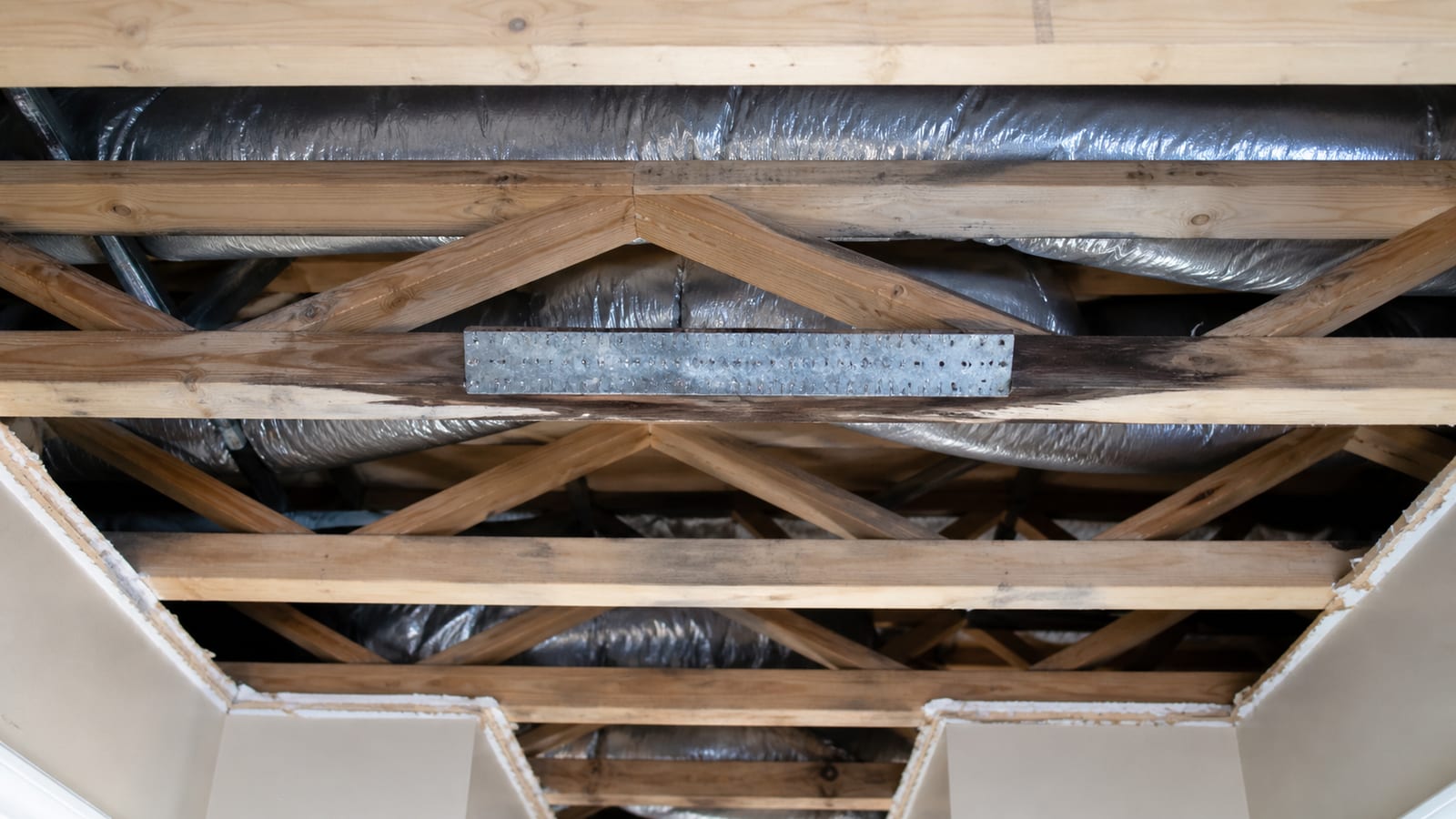
Somebody has opened a wall or a ceiling in your house, pointed at a dark joist, and used the word structural. In one sentence the job went from a cleaning bill to something that sounds like it involves engineers. That jump is frightening, and quite often it is premature.
Here is what actually separates stained wood from compromised wood, who is qualified to make that call, what changes if the answer really is structural, and the question most people want answered first: is it safe to be in the house tonight.
Key Takeaways
Stained is not the same as compromised
Surface growth on framing is common and frequently cleanable; loss of section is a different finding.
The assessment is cheap next to the repair
Establishing whether the wood is sound costs a fraction of replacing it.
A primary structural component changes the code identity
New Jersey treats work affecting one as an alteration rather than a simple repair.
A repair may not reduce what was there
The subcode says repairs must not reduce existing structural strength, system capacity or mechanical ventilation.
Engineered lumber is not sawn lumber
Trusses and I-joists are designed assemblies and are not repaired by nailing another board alongside.
Sequence is fixed
Correct the water, remove and clean, dry and verify, and only then repair the structure.
Is It Safe Tonight
Take this first, because it is usually the real question under the others.
Most mold findings on framing are not an immediate structural risk. Wood that has been wet and has surface growth is a very different condition from wood that has lost cross section to prolonged decay. The signs that warrant urgency are physical rather than visual: noticeable deflection or sag in a floor or ceiling, a springy floor that was not springy before, doors and windows that have recently stopped closing properly, visible crushing where a beam bears on a wall, or wood you can push a screwdriver into with light pressure.
If any of those are present, treat it as a same-day question for a qualified professional rather than something to research. If none are, you almost certainly have time to get a proper assessment before deciding anything, and that time is worth using.
How the Wood Is Actually Judged
The assessment is less mysterious than the word structural suggests. What matters is whether the member has lost section and whether it still does its job.
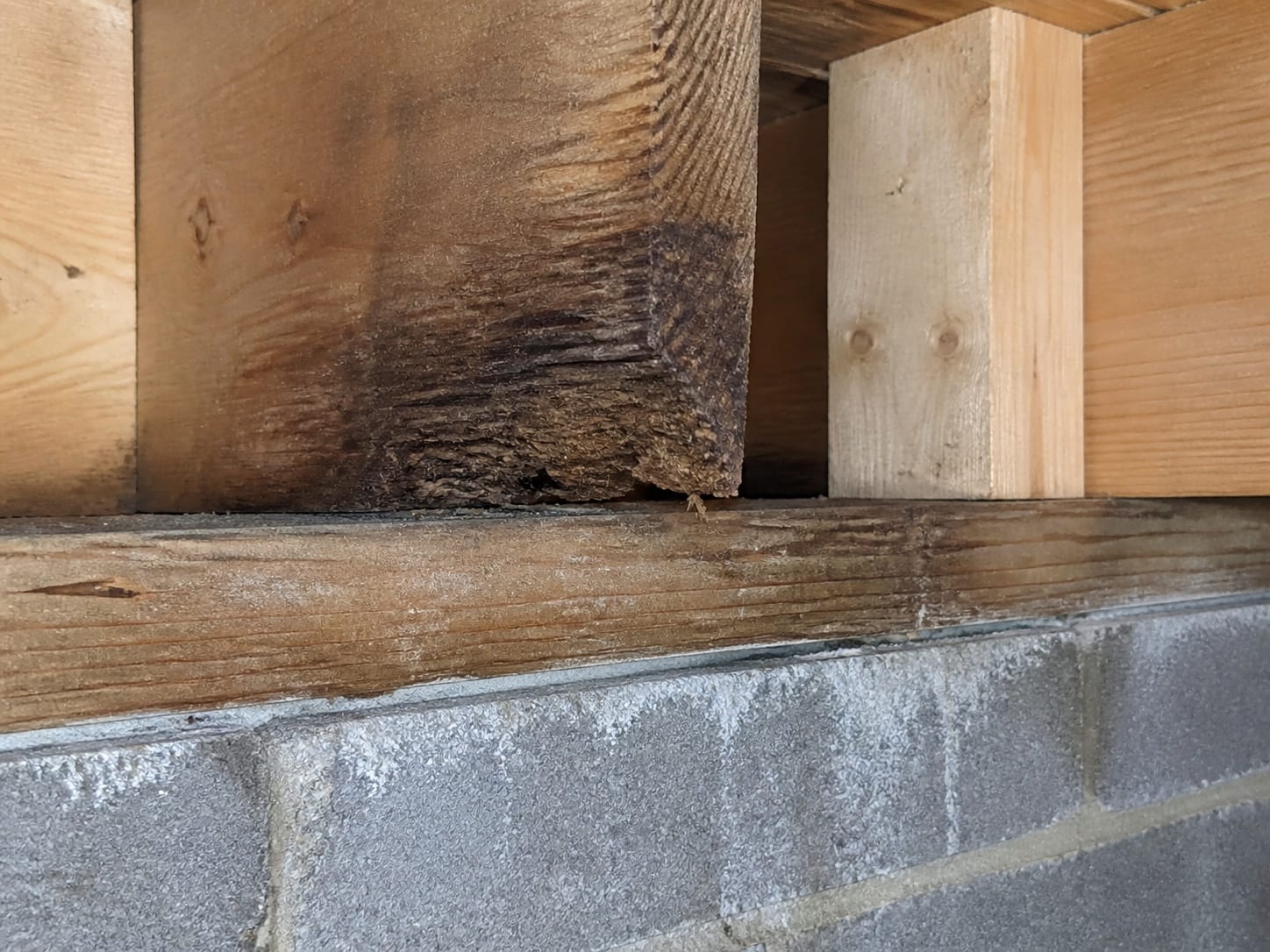
Probing is the core of it. Sound wood resists a probe; decayed wood gives. Working along a member finds where any softness starts and stops, which is usually a much smaller zone than the staining.
Moisture readings tell you whether the condition is active or historic. Decay needs sustained moisture, so dry wood with old staining is a different problem from wet wood with the same appearance.
Extent and location decide the significance. Softness at the end of a joist where it bears on a sill is more serious than the same area mid-span, because that is where the load transfers.
Species and member type change the options. Sawn lumber can often be reinforced. Engineered lumber cannot be treated the same way, which is its own section below.
What does not decide it: the colour of the growth, how alarming the photograph looks, or how much surface area is stained. Those are prompts to look properly, not findings in themselves.
Engineered Lumber Changes the Answer
This matters in Plainsboro more than in an older housing stock, because a great deal of local construction is late twentieth century and later, which is when engineered floor systems became normal.
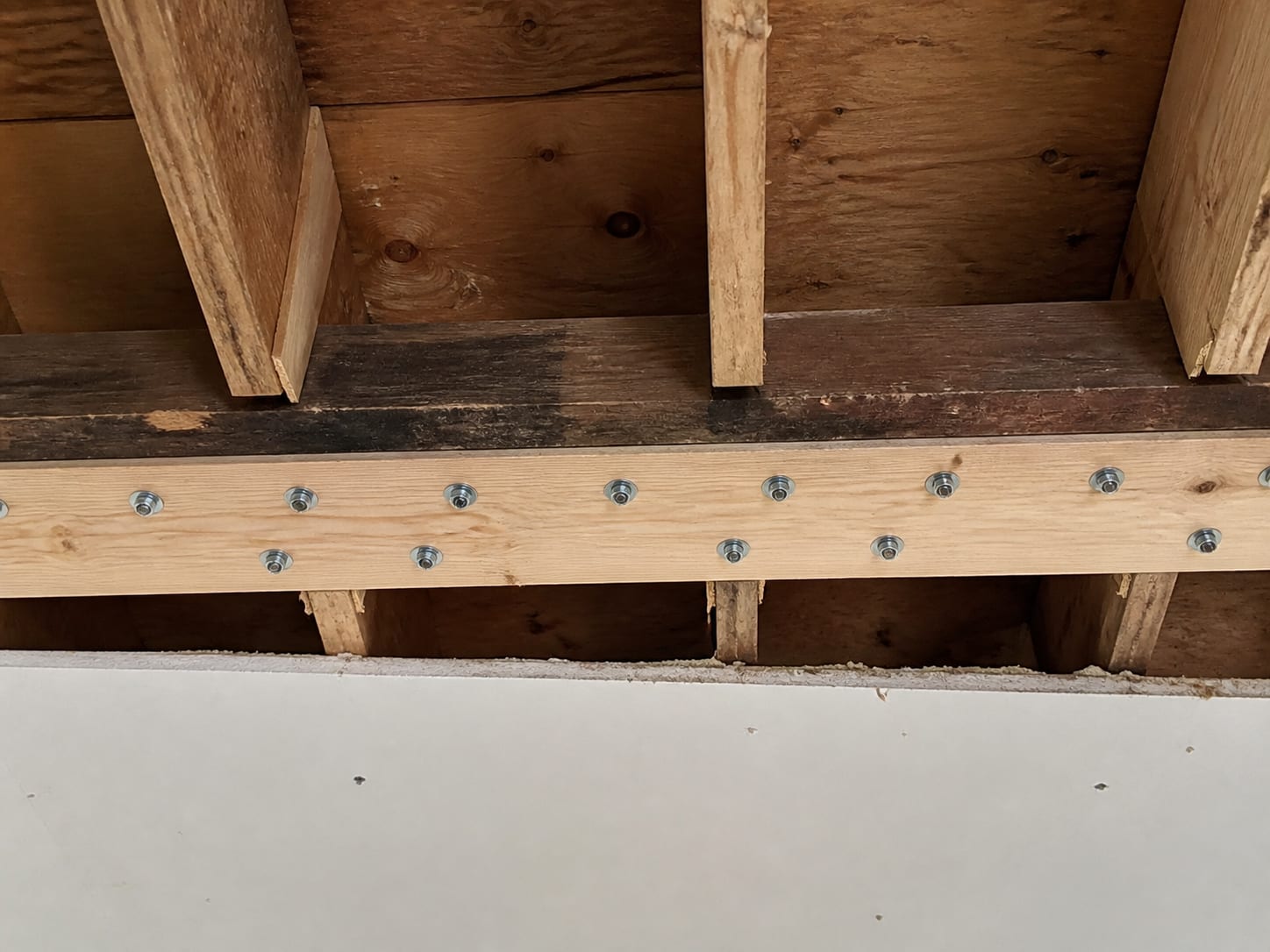
A traditional sawn joist can frequently be repaired by sistering: fastening a sound member alongside the damaged one so the new wood carries the load. It is a well understood repair with well understood limits.
Open web floor trusses and I-joists are not repaired that way. They are designed assemblies where each element is sized for a specific role, and cutting, notching or nailing to them changes behaviour that was calculated. A damaged web member or a compromised flange is repaired to a specification, typically with an engineered detail and manufacturer approved hardware, rather than by adding lumber alongside it.
The practical consequence for an owner: if your floor system is engineered, an assessment that proposes sistering is a signal to ask more questions. The correct answer usually involves the manufacturer's repair detail or an engineer's design, and that is not an upsell, it is the only defensible way to put it back.
The Sequence, and Why the Repair Comes Last
Order of Work
- 1
Correct the water source
Nothing further is worth doing while the wood is still being wetted, and EPA's guidance ties any cleanup to fixing the moisture problem.
- 2
Document and define the affected area
What is affected, how far it extends, and which members are involved.
- 3
Set containment and protection
EPA generally calls for limited containment at 10 to 100 square feet and full containment above 100, on professional judgment rather than as a bright line.
- 4
Clean or remove unsalvageable material
Porous mouldy items that cannot be cleaned are discarded; sound framing is usually cleaned rather than replaced.
- 5
Dry and verify
Wet non-mouldy material is dried within about 48 hours where possible, and drying finishes on readings.
- 6
Then repair the structure
To a specification, with the permit and inspections the scope requires.
- 7
Close the permitted work
The certificate at the end is what completes it.
The order is not a preference. Repairing framing before the space is dry traps moisture inside a repair that is now much harder to inspect, and doing it before the source is corrected guarantees a return visit to the same member.
When It Becomes Regulated Construction
This is the part that changes the shape of the job in Plainsboro.
New Jersey's Rehabilitation Subcode treats work affecting a primary structural component as an alteration rather than a simple repair. That is a meaningful reclassification, because Plainsboro requires permits generally for alterations affecting structure. The application package is the construction jacket, the applicable subcode technical sections, and two copies of the plans, with a zoning compliance form where exterior conditions or setbacks are affected.
There is a further step up. A rehabilitation project that cannot be occupied during the work and requires a new certificate before reoccupation is reconstruction, which carries its own requirements. If somebody tells you the house has to be vacated for the work, that is worth confirming in code terms rather than accepting as a logistics detail, because it changes what has to be produced at the end.
One rule inside the subcode is worth knowing verbatim, because it is a useful test to hold a proposal against: a repair must not reduce existing structural strength, system capacity or mechanical ventilation. A repair that leaves the framing weaker than it was, or that blocks a ventilation path to make the detail easier, is not a compliant repair regardless of how tidy it looks.
On scheduling, the only published local number is that inspections should be requested at least 24 hours ahead, subject to demand. That is an advance request rule, not a promise about when an inspector arrives or when a job finishes.
Finally, if the property sits in a mapped flood hazard area, Plainsboro's floodplain ordinance applies its rules to repair, reconstruction, rehabilitation and additions, including repairs to substantially damaged buildings. That is an address level check with Planning and Zoning rather than something to infer.
What Drives the Cost
There is no published Plainsboro price range for structural mold repair and any local average quoted at you is invented. The real drivers are these.
The affected area and the density of growth set the containment level, and containment is a genuine cost step: build-out, negative pressure, waste handling and protection of adjacent space. The material condition decides removal against cleaning, since porous material that cannot be cleaned is discarded while sound framing is normally cleaned and kept. The member type decides the repair method, and an engineered detail costs differently from sistering a sawn joist. Whether plans and an engineer are required is its own line. And access matters, particularly in a crawl space, an attic or a tight mechanical area.
In a multi-unit building there is an additional project management dimension. The Township's 2022 report puts the five to nineteen unit share of the housing stock at 37.2 percent, and work in one of those means isolating the job from adjacent occupants and scheduling access around them. That is a scheduling consequence of the local building mix rather than a published premium.
Ask any proposal to separate the assessment, the containment, the removal, the drying and its verification, the structural repair specification, and the closing work. If the structural line is a single number with no method named, ask what the method is before you compare it to anything.
What You Can Do Yourself
Very little of the repair, and that is the honest answer. Structural work is not a place for improvisation, and in Plainsboro much of it is permitted work with inspections attached.
What you can usefully do is everything around it. Photograph the open framing thoroughly before anything is covered, from several angles with something in frame for scale, because once it is closed up that record is gone. Keep the moisture readings. Ask for the repair method in writing rather than as a verbal reassurance. If the framing is engineered, ask specifically whether the manufacturer's repair detail or an engineer's design is being used. And do not close anything up, even temporarily, until the drying is verified and any inspection that applies has happened.
If you are between contractors and want a second opinion on whether the framing is actually compromised, that assessment is worth paying for on its own. It is a small fraction of a structural repair and it is the number that decides everything else.
Frequently Asked Questions About Structural Mold Repair in Plainsboro, NJ
The joists are stained. Do they have to be replaced?
Usually not. Staining records that the wood was wet and that something grew on the surface; it does not establish that the member has lost strength. Sound framing is normally cleaned and kept. Replacement is for wood that has actually lost section, and that is determined by probing and by where the softness sits rather than by appearance.
Can a mold company do the structural repair?
The remediation and the structural repair are different scopes and often different trades. What matters is that whoever does the structural work is doing it to a specification, under the permit the scope requires, and with the inspections that follow. Where a primary structural component is involved, New Jersey treats it as an alteration rather than a repair, which is a permit conversation with the Building Division rather than a judgement call on site.
Do I need a structural engineer?
Sometimes, and the honest test is whether the repair needs to be designed. Engineered lumber, a member at a bearing point, anything affecting a load path, or an extent that goes beyond a manufacturer's standard detail all point toward yes. A single sawn joist with localised softness mid-span often does not. If a proposal involves engineered floor trusses and no design, ask why.
Is my house unsafe?
Most mold findings on framing are not an immediate risk, and the warning signs are physical: deflection, a springy floor, doors that have recently stopped closing, crushing at a bearing point, or wood that takes a probe easily. If those are present, get a qualified opinion the same day. If they are not, you have time to assess properly, and using that time usually saves money.
Can I just treat the wood and close it up?
Not as a substitute for establishing whether it is sound, and not before the space is verified dry and the source corrected. Closing a wall over damp framing hides the one thing anyone would want to inspect later, and a repair that reduces existing structural strength or blocks mechanical ventilation is not compliant under the subcode regardless of how it looks.
How long does it take?
That comes from the assessment. The variables are the extent, the member type, whether a design is needed, the containment level, how long drying takes to reach a stable reading, and the permit and inspection sequence. There is no published Plainsboro average, and anybody offering a duration before seeing the framing is guessing.
Final Thoughts
The word structural does a lot of frightening work in this trade, and most of the time the correct response is to slow down rather than to spend. Stained framing is common. Compromised framing is a specific finding with specific evidence behind it, and the assessment that separates the two is inexpensive relative to everything that follows from it.
If it does turn out to be structural, the job changes character: it becomes regulated construction with a code identity, a permit, a specified repair method and a certificate at the end, and the sequence stops being negotiable. Correct the water, clean and remove, dry and verify, then repair. The wider local picture is on our Plainsboro service area page, and the service itself is on our structural mold repair page.
If somebody has pointed at your framing and you want to know whether it is actually compromised, ExecPro Restoration & Cleaning will assess it before quoting a repair. Call (888) 300-3772 or reach us through the contact page.
Structural Terms
Tap a term to see what it means.
Primary structural component. A member whose failure would affect the building's structural integrity; work affecting one is an alteration under the subcode.
Serving Plainsboro
ExecPro Restoration & Cleaning provides mold remediation services in Plainsboro, NJ, from inspection and testing through removal, drying, and post-remediation verification. Call (888) 300-3772 for 24/7 emergency response.
Related Articles
Structural Mold Repair in Warren, NJ: Where the Line Sits
Surface growth on a joist and loss of section are different jobs. Where that line sits in a Warren, NJ home, who decides it, and what the repair involves.
Clean, Retain, Reinforce, Replace: Structural Mold Repair in Alpine, NJ
Once growth is on a joist rather than on drywall, an Alpine job has four possible answers, and the one you pick changes how the state classifies the work.
Who Is the Result For: Mold Testing in Plainsboro, NJ
A landlord, board, buyer or insurer has asked for a mold test in Plainsboro, NJ. What kind of sample they need, who should collect it, and what makes it stick.