Property Management Mold Services in Princeton, NJ: A Portfolio Protocol for Mixed-Age Buildings and Occupied Units
Cal HewittPublished
- property management mold services
- property management
- mold remediation
- historic buildings
- new jersey
- princeton
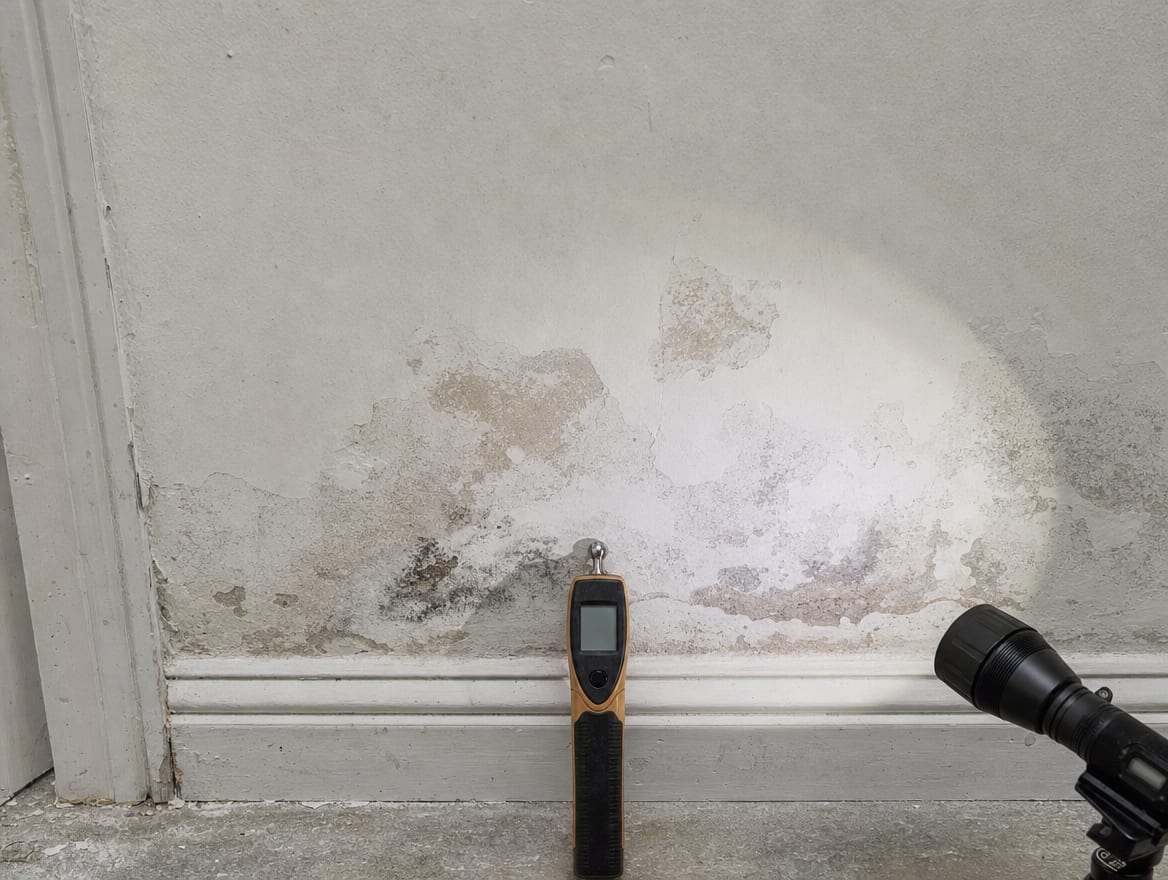
Managing a portfolio of Princeton buildings means no two addresses respond to a mold report the same way. One is an older masonry building with historic finishes and a preservation review to consider. Another is a mixed-use property with shops below and apartments above. A third is a newer multifamily building where a plumbing stack runs behind several units at once. When a tenant reports a damp wall, the underlying problem may be similar, but the constraints on how you inspect, contain, and repair are not. That is the real challenge of property management in a place with buildings of so many ages and uses.
The way to handle that spread is not to treat every job as a fresh emergency. It is to run one protocol that flexes to the building in front of you. A single home is a project. A portfolio is a process. This article lays out a repeatable protocol for mixed-age Princeton properties, one that builds in historic-building review, clear resident communication, containment that respects people who still live and work in the building, and a way to track whether the same problem keeps coming back across your holdings.
Managing Mold Risk Across Mixed Properties
Age-appropriate inspection cadence
Older masonry and wood-frame buildings hide moisture in concealed cavities, so inspection frequency and depth are matched to how each building is built rather than applied as one flat schedule.
Historic-material awareness
In older buildings, some materials may be regulated or worth preserving, so the scope accounts for what can be cleaned, what must be removed, and what needs review before it is disturbed.
Resident communication
Tenants and occupants get clear, consistent notice about what is happening, when access is needed, and what to expect, so the work does not become a surprise.
Occupied-building containment
Work areas are sealed so removal does not carry dust or spores into apartments, offices, or shared corridors that stay in use during the job.
Standardized documentation
Every job produces the same record set, so conditions, corrections, and results look the same on paper whether the property is a rowhouse or a modern complex.
Recurrence tracking
Closed jobs are reviewed across the portfolio so a leak point that keeps returning is treated as a pattern to fix, not a string of separate tickets.
Vendor coordination
The manager, the remediation crew, and any specialty trades work from one scope and one timeline, so responsibilities and access are clear.
Why a Portfolio Needs One Protocol
When you oversee several buildings, the largest risk is rarely a single leak. It is inconsistency. One property gets a fast, documented response and another waits days because a different person handled it a different way. One file holds photos, moisture readings, and drying records. Another holds a text thread and someone's memory. Across a portfolio, those gaps turn into disputes, missed carrier deadlines, and repairs that come back because the moisture source was never corrected.
A protocol solves this by making the response repeatable while still leaving room for the building's specifics. The same intake, the same triage questions, the same documentation, and the same completion criteria apply everywhere. What changes is the detail: an older building may need a preservation check that a modern one does not, and a multifamily unit may need cross-unit inspection that a standalone office does not. The frame stays constant so decisions and records stay comparable from one address to the next.
The protocol also keeps the boundary of each role clear. A remediation provider documents what is found, corrects the moisture source, and records the work. It does not decide who is financially responsible for a loss. Putting that line in writing keeps your operation focused on conditions and facts rather than blame, which matters when several parties, tenants, and sometimes a carrier are all looking at the same building.
Building Age Changes the Approach
Princeton holds older masonry and wood-frame buildings, historic finishes, additions built in different decades, institutional and multifamily settings, and newer construction. Age alone does not prove a specific property has damage, and it does not tell you the foundation type or whether a material can be saved. What age does tell you is which questions to ask first. In an older building, water can travel through concealed cavities before it shows on a surface, some finishes are worth preserving, and certain materials may be regulated and handled separately by qualified specialists.
For covered properties, historic-preservation review and permits should be confirmed with the municipality before work begins, not assumed. The same goes for flood-hazard rules and address-level flood mapping, which vary parcel by parcel rather than applying to every Princeton property the same way. Building those checkpoints into your protocol means a crew is not standing in a wet basement wondering whether a demolition step needs review first.
Hover or tap a row to highlight it.
| Building type | Recurring checks | Communication and record note |
|---|---|---|
| Historic or older masonry | Concealed cavities, porous versus cleanable finishes, whether regulated materials may be disturbed | Confirm preservation review and permits with the municipality first; keep source findings and pre-work photos |
| Mixed-use | Shared walls and utilities between commercial and residential space, HVAC condensation | Notify occupants of both uses; log unit and common-area conditions separately |
| Multifamily | Cross-unit migration paths, plumbing stacks, recurring bathroom moisture, vacant-unit humidity | Give residents advance notice and scheduled access; one consistent closeout file per unit |
| Modern or newer | Building envelope, HVAC condensation, appliance and supply-line leaks | Standard resident notice; the same standardized documentation as older buildings |
Historic and older buildings deserve special mention because the wrong move is expensive to undo. A finish that could have been preserved, or a regulated material disturbed without the right handling, turns a routine job into a problem. So the protocol treats older buildings as a slower, more deliberate lane: inspect concealed assemblies, confirm what needs review, and separate what can be cleaned from what must be removed before anyone opens a wall.
Talking to Residents While Work Happens
In an occupied building, communication is part of the work, not a courtesy after it. Tenants and occupants deserve to know what was found, what will happen, when access is needed, and what to expect while a crew is on site. Consistent notice across every property also protects you: a resident who was told in advance is far less likely to treat a sealed hallway or a running dehumidifier as a crisis.
Good resident communication is plain and repeatable. It names the affected area, gives an access window that accounts for people who leave early and return late, explains that containment is there to protect their space, and points them to who to contact with questions. It does not diagnose anyone's health. The most honest and useful stance is that damp, moldy environments may affect some people and not others, that anyone with symptoms should speak with a medical provider, and that the crew's job is to correct the moisture and conditions rather than to interpret a person's health.
Containment in Occupied Buildings
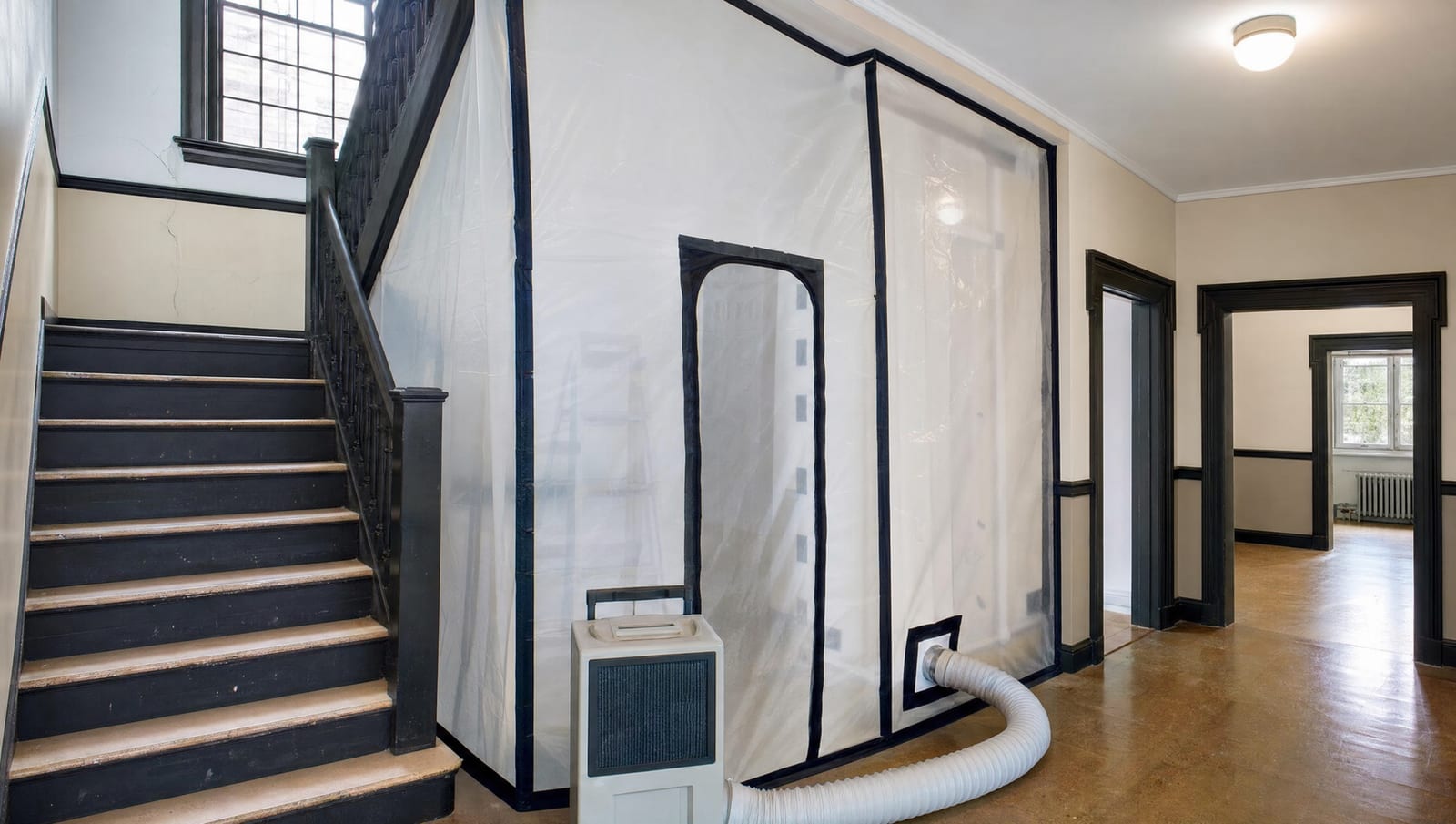
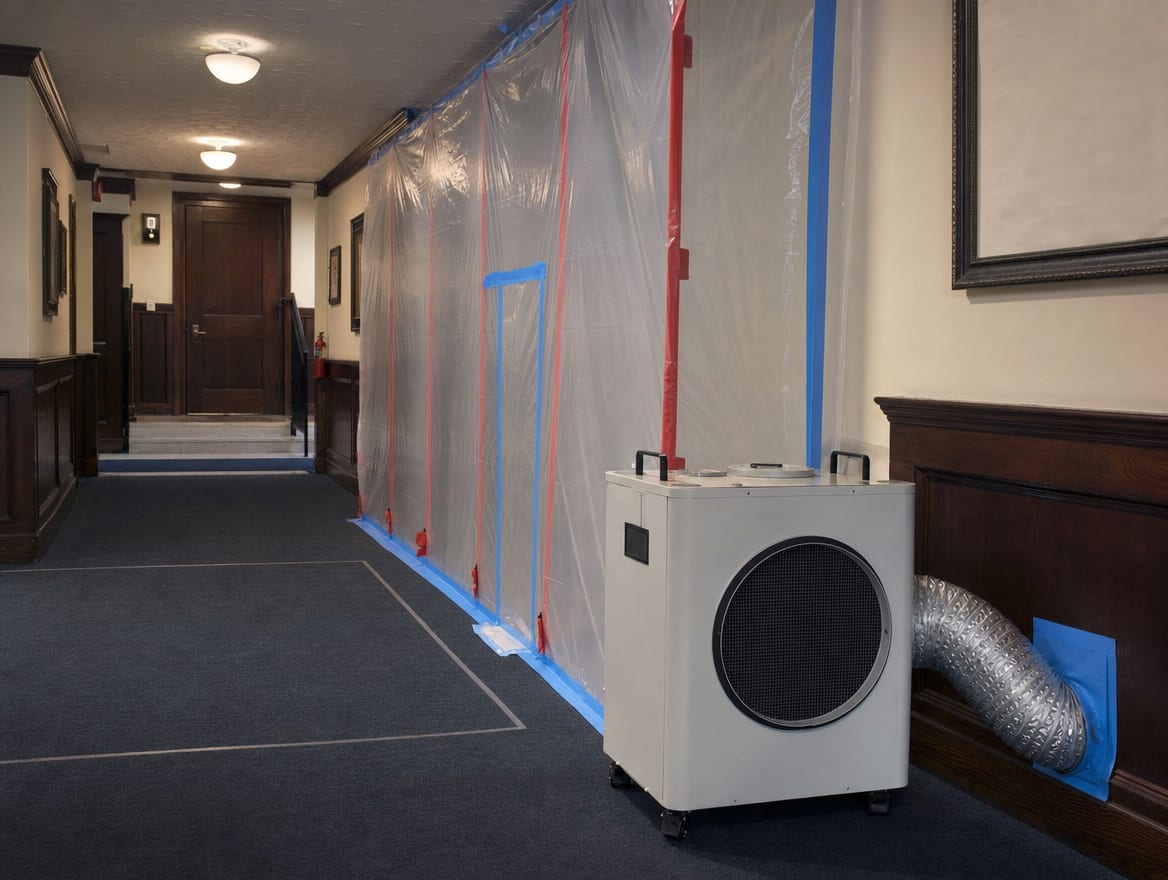
The building keeps running while the work happens, and that shapes how a crew sets up. Occupied-building containment means sealing the work area so the dust and spores stirred up during removal do not travel into apartments, offices, or shared corridors that stay in use. In a multifamily or mixed-use setting, that also means thinking about shared paths: an HVAC system, a plumbing chase, or a common wall can carry a problem from one unit toward the next if the area is not isolated first.
Containment pairs with fast moisture control. The EPA advises drying wet materials within 24 to 48 hours to reduce the chance mold takes hold, so the early hours of a response are about stopping the water safely and starting to dry, not debating who pays. Porous materials that cannot be dried and cleaned are removed rather than treated in place. Cleanable surfaces are handled and documented. The point is to keep the disturbance inside the sealed zone and out of the spaces people are still using.
The Portfolio Cycle, Step by Step
A well-run response is not complicated to follow, but the order matters, and the same order should apply across the portfolio. The sequence below is the spine of the protocol. It starts with finding the water, ends with a closed work order and a review, and treats verification as a defined step rather than an afterthought.
The Portfolio Cycle: Inspect, Contain, Communicate, Track
- 1
Inspect and identify the source
A technician looks past the visible stain for the active leak or moisture path, checks concealed assemblies where the building's age calls for it, and separates a plumbing leak from groundwater, rain entry, sewage, or condensation, because safety and next steps differ by category.
- 2
Classify safety and contamination
The water category and any safety concern are established first, so occupant protection, containment, and disposal decisions match the actual condition rather than a guess.
- 3
Document conditions and check constraints
Unit and common-area conditions are recorded with photos and moisture readings, and parcel and municipal constraints, such as preservation review, permits, and flood mapping, are confirmed with the authority having jurisdiction before work.
- 4
Contain, communicate, and remediate
The area is sealed, residents are notified with an access plan, the moisture source is corrected, and affected materials are removed or cleaned under containment.
- 5
Verify dryness or clearance
Drying is confirmed with readings, and post-remediation verification is used when a defined question needs a documented answer before repair begins.
- 6
Repair and close the work order
Reconstruction restores the space, and the job ends with the same record set every time, so the file is complete and comparable across properties.
- 7
Track recurrence across the portfolio
Closed jobs are reviewed together, so a repeating leak point in one building becomes a fix rather than another ticket.
Testing and verification are worth a note here, because more is not automatically better. Testing should answer a defined question and change a decision. If a reading or a clearance test would confirm that a space is ready for repair, or settle a disagreement about whether an area is truly dry, it earns its place in the scope. If it would not change what happens next, it is cost without a purpose. Post-remediation verification fits the protocol exactly when it gives you a documented answer you can act on.
Tracking Recurrence Across the Portfolio
The step that separates portfolio management from one-off repair is the last one. When every closed job produces the same record, you can look across all of them and see patterns a single ticket would hide. A basement that takes on groundwater every wet season, a bathroom stack that keeps feeding a wall, a vacant unit that grows humid every time it sits empty, these show up only when the files line up and someone reads them together.
Recurrence tracking turns that review into action. A leak point that returns is treated as a source to correct at the building level, not as a fresh emergency each time it reappears. That is where a manager saves the most money and the most disruption, because correcting a recurring source once is far cheaper than remediating its effects again and again. It also strengthens your records: a documented history of what was found, corrected, dried, verified, and rebuilt shows a clear pattern of care across the portfolio.
Documentation and the Limits of the Role
Records are the backbone of the whole protocol. A complete file for each job includes pre-work photos, moisture readings, source findings, the scope and its exclusions, any change orders, drying and equipment records, disposal records, permits, inspection results, post-work photos, verification reports where required, invoices, and any carrier correspondence. Kept the same way every time, that file lets you show exactly what happened at any address without reconstructing it from memory.
It is also worth being honest about what documentation cannot do. A thorough record helps demonstrate what was found and corrected, but remediation cannot guarantee an increase in a property's value, and no contractor can promise that insurance will cover a loss. Coverage depends on the policy language, the cause, exclusions, notice, and documentation, and only the carrier can decide it. Flood damage is generally handled under separate coverage from a standard policy. The remediator's role is to document conditions and correct the moisture, not to adjudicate the claim. Keeping that boundary clear, in writing, is part of running the operation well.
That clarity is also how you spot a bad actor. Be wary of pricing offered without an inspection, a single-product cure, a promise of permanent prevention without correcting the moisture source, a guarantee that insurance will pay, or a final scope set before anyone has looked at the building. Any of those is a signal to slow down. For a portfolio of varied Princeton properties, a provider who inspects first, scopes to the building, and documents everything is the one who fits this protocol.
Frequently Asked Questions
How do you manage mold across many buildings at once?
You run one protocol that flexes to each building. The intake, triage questions, documentation, and completion criteria stay the same across the portfolio, while the specifics, such as a preservation review for an older building or cross-unit inspection in a multifamily property, are added where the building calls for them. That consistency is what keeps responses comparable and records complete from one address to the next.
How are residents notified before work begins?
Residents get clear, consistent notice that names the affected area, gives an access window that accounts for people who are away during the day, explains that containment protects their space, and points them to who to contact. The same notice pattern applies across properties, so occupants in any building know what to expect and access is arranged rather than assumed.
Do historic or older buildings need special handling?
Often, yes. Older buildings can hide moisture in concealed cavities, may hold finishes worth preserving, and can contain materials that are regulated and handled separately by qualified specialists. For covered properties, historic-preservation review and permits should be confirmed with the municipality before work starts. The protocol treats these buildings as a more deliberate lane so nothing is disturbed before it has been reviewed.
How do you track whether mold keeps coming back?
Every closed job produces the same record set, and those records are reviewed across the portfolio together. That review surfaces repeating patterns, like a basement that takes on water each wet season or a stack that keeps feeding a wall, that a single ticket would miss. A recurring source is then corrected at the building level rather than remediated again each time it returns.
Will insurance cover the work?
That cannot be guaranteed. Coverage depends on the policy language, the cause of the loss, exclusions, notice, and documentation, and only the carrier can decide it. Flood damage is generally covered separately from a standard policy. The best thing a manager can do is keep thorough records of what was found and corrected, because good documentation supports a claim even though it cannot promise the outcome.
When you are ready to bring one consistent standard to mold response across your Princeton properties, ExecPro Restoration & Cleaning is here to help. Our team runs property management mold services built around inspection, containment, and complete records, backs the work with documented post-remediation verification when a defined question needs an answer, and supports managers across our broader commercial restoration and cleaning services and throughout the Princeton mold remediation service area. Call us at (888) 300-3772 or reach out through our contact page to set up a walkthrough of your portfolio.
Property Management Mold Terms
Tap a term to see what it means.
Portfolio protocol. One repeatable process for responding to mold across many buildings, with a constant frame for intake, triage, documentation, and completion, adjusted to each building's age and use.
Serving Princeton
ExecPro Restoration & Cleaning provides mold remediation services in Princeton, NJ, from inspection and testing through removal, drying, and post-remediation verification. Call (888) 300-3772 for 24/7 emergency response.
Related Articles
Property Management Mold Services in Deal NJ: A Seasonal-Home Protocol
A repeatable mold protocol for managers of seasonal Deal NJ homes: pre-arrival inspections, remote humidity monitoring, emergency access, and owner reporting.
Property Management Mold Services in Princeton Junction, NJ: A Repeatable Protocol for Managed Homes and Multifamily Units
How Princeton Junction property managers run mold response across managed units: pre-authorized access, a leak escalation path, and a consistent closeout file.
Insurance Restoration in Princeton, NJ: Coordinating a Claim on a Historic or Mixed-Use Property
Coordinating an insurance restoration claim on an older Princeton NJ property: documenting historic finishes, flood-zone questions, and municipal review.