
Mold in an Air Conditioner: Cleaning It or Calling an HVAC Pro
Cal HewittPublished
- hvac mold remediation
- moisture control
- indoor air quality
- new jersey
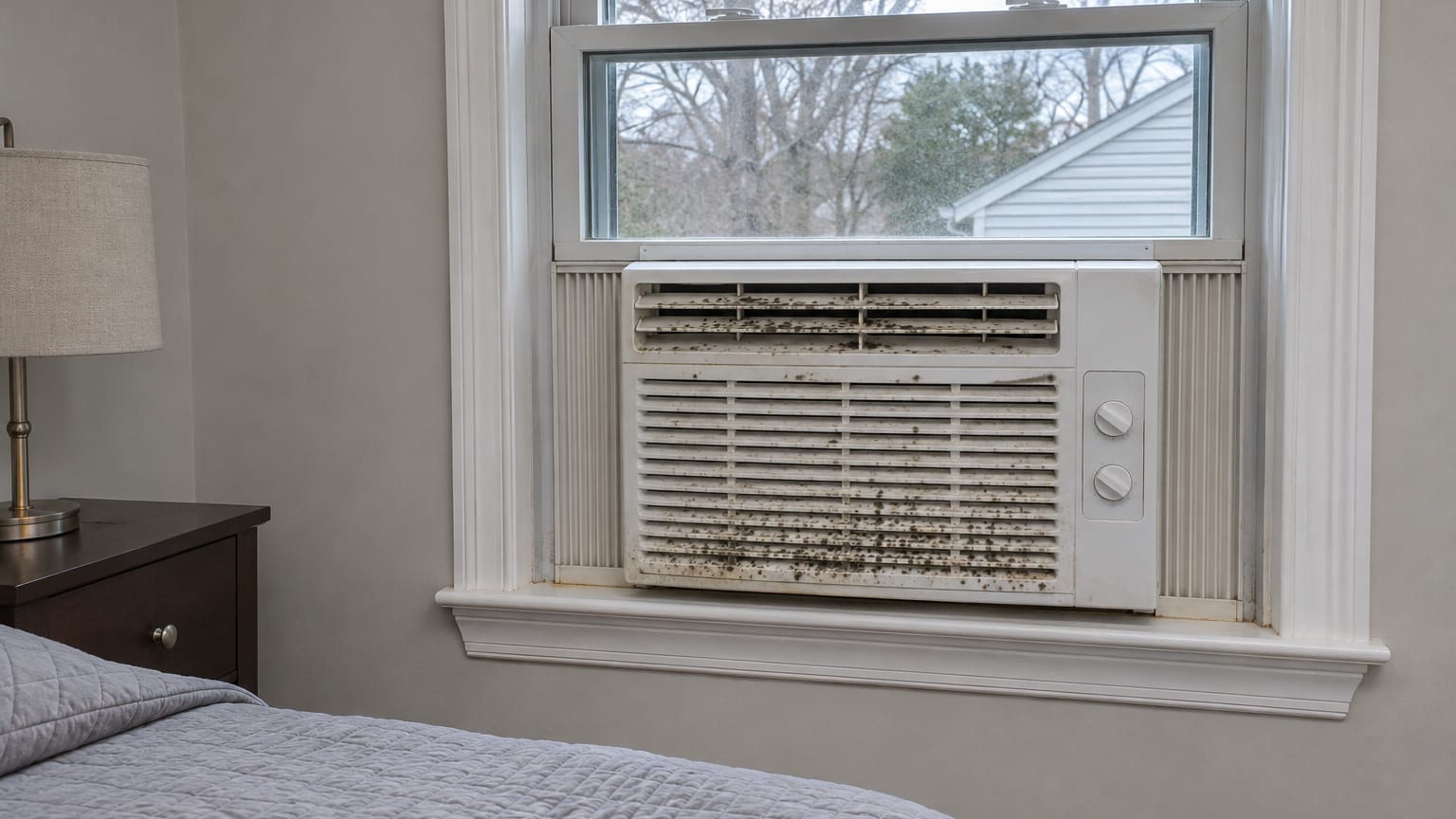
Mold in an air conditioner usually announces itself before you see much of it: a musty smell when the unit starts, dark specks on the vents of a window unit, or buildup around the louvers of a mini split. Because that air goes straight into the room where you sleep or work, you want it gone today.
The cause is usually simple to describe. Cooling coils sweat, drain pans hold water, and filters collect dust, so any part that stays damp can grow mold. Whether you can handle it yourself depends on where the growth sits and how far the moisture reaches.
A window unit, a ductless mini split and a central system each stay wet in different places. Each has a short list of parts you can clean and a longer list that belongs to a technician. Start with where you see the growth, and you will know your next step.
Key Takeaways
Moisture decides everything
Mold in an AC unit grows where condensation, a blocked drain pan or a damp filter keeps surfaces wet, so the fix starts with the water, not the spots.
Clean only what the manual allows
The filter and visible surfaces are yours to clean; growth inside the unit, a smell that keeps returning, several affected rooms or wet duct insulation calls for a technician.
Ask for the scope in writing
A useful estimate names the affected components, the moisture source, the cleaning or replacement method and the records you will receive afterward.
Should You Worry About Mold in an AC Unit?
The question that sorts most cases is whether the problem sits on a removable filter or an easy-to-reach surface, or whether moisture and growth may be inside the equipment or the ductwork. A grimy filter on a window unit is a cleaning job. Growth on the coil, the fan or the air handler is an inspection job. These signs point to the second kind, whenever mold in an HVAC system may be larger than one filter:
- Several rooms smell musty: Odor from multiple registers means the source is shared, not one grille.
- Growth in the air handler or ducts: Visible growth in the air handler, return plenum, supply ducts or duct insulation.
- Standing water keeps returning: Repeated water in the condensate pan, or moisture in the mechanical room, attic or crawl space.
- Wet or moldy insulation: EPA says wet or moldy insulated duct material cannot be cleaned effectively and should be removed and replaced.
- Growth that returns: Mold that comes back after a new filter or a surface cleaning.
On the health side, the CDC says damp and moldy places can cause symptoms in some people and none in others, and that people with asthma, mold allergies, chronic lung disease or weakened immune systems may react more strongly. If anyone in the home has breathing trouble, call a physician about the symptoms.
What Are the Odor, Spots and Moisture Telling You?
Every air conditioner moves air across a cold coil, and that coil pulls water out of humid indoor air. The water is supposed to drain away. When it does not, or when a damp filter and a film of dust stay in place, mold has what it needs: moisture, a food source and oxygen. The New Jersey Department of Health notes that mold can grow on almost any material when conditions are favorable.
Mold in a window AC unit
Black or discolored material around the front grille, filter, louvers or drain area is the usual sign. Humid air condenses on the cold coil, a dirty or damp filter restricts airflow and leaves moisture behind, and a blocked drain path or a unit set at the wrong slope can hold water inside the cabinet. Dust settles on those wet surfaces and gives growth something to feed on.
Mold in a mini split
A ductless mini split has an indoor head with filters, a coil, a fan assembly and a condensate collection area. You may notice a musty smell when it starts, buildup around the head or water leaking from it. Daikin says a dirty indoor-unit filter can contribute to condensate leaking from the air outlet. Blocked condensate drains, poor installation slope and too little drying time can also support growth.
Mold in a central system
On a central system, the evaporator coil and drain pan are wet on purpose while the system cools. Trouble starts when a blocked drain, standing pan water, poor pan slope, a dirty coil or wet insulation keeps the air handler damp afterward. Moisture can also come from duct condensation, high indoor humidity, plumbing leaks or a leaking humidifier. When contaminated components connect to the supply or return ducts, the system can carry particles into other rooms.
Hover or tap a row to highlight it.
| Unit | Where moisture collects | What is yours to clean |
|---|---|---|
| Window unit | The cold coil, a dirty or damp filter, and a blocked drain path or wrong slope | The filter, washed in lukewarm water below 104°F (40°C) and dried fully |
| Mini split | The indoor head's filters, coil, fan assembly and condensate collection area | The filters, exactly as the operation manual describes |
| Central system | The evaporator coil and drain pan, plus wet insulation or a blocked drain | Filters, per the equipment instructions; wet or moldy duct insulation is replaced |
Do HVAC Companies Get Rid of Mold, and What Does an Assessment Involve?
Qualified HVAC or remediation contractors can inspect the equipment, clean affected components, replace contaminated porous materials and correct the moisture that caused the problem. The assessment is where the job gets defined.
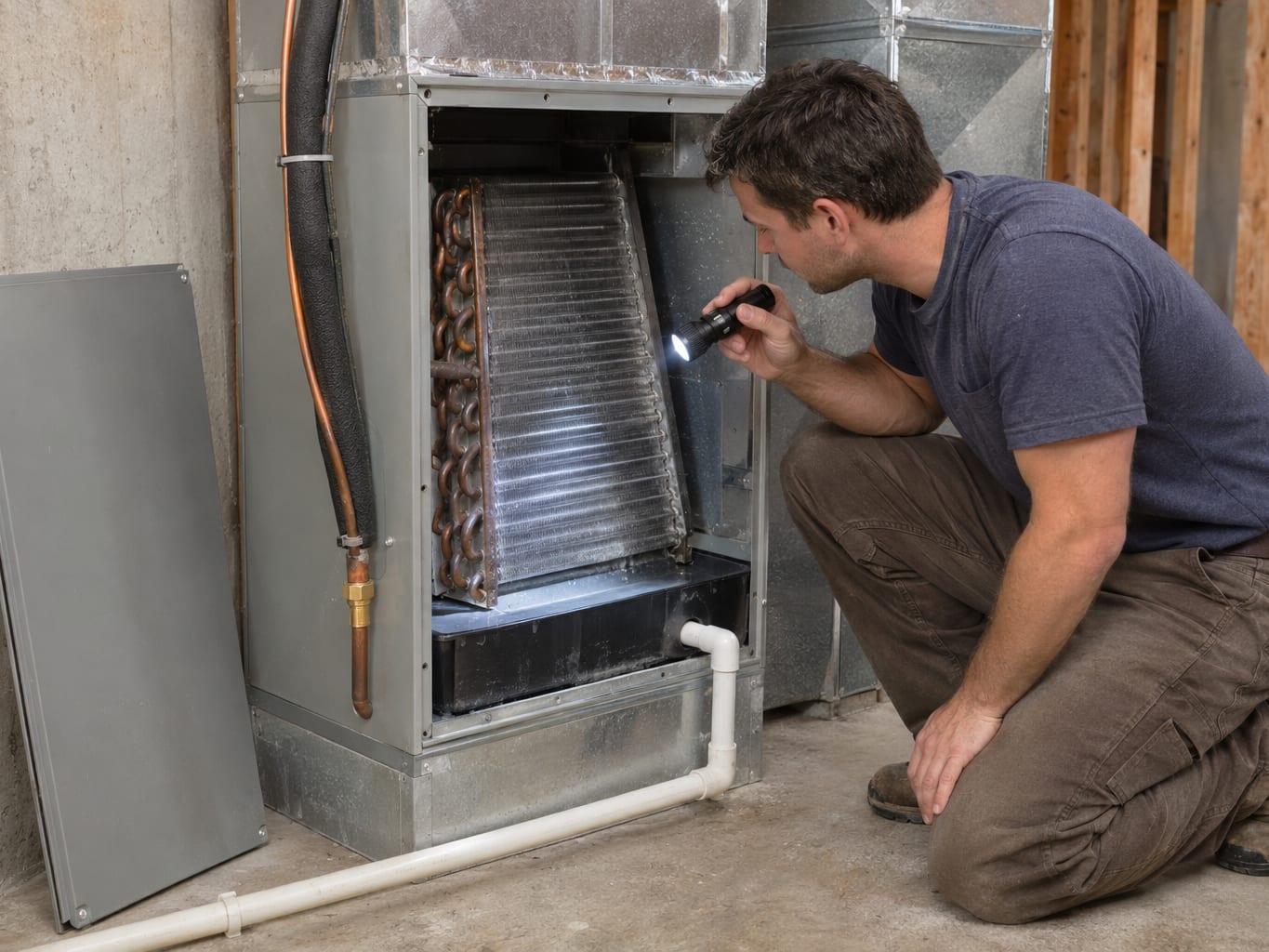
The 2021 NADCA ACR Standard lists what an air-handler inspection covers: filters, coils, condensate pans, drain lines, fans, fan compartments, dampers, gaskets and the general integrity of the unit. If suspect mold turns up there, the supply and return ducts get inspected during the same visit. New Jersey's residential guidelines call for a visual inspection, identification of the moisture source, assessment of the affected areas and a written final report.
What an HVAC Mold Assessment Covers
Air-handler parts
Filters, coils, condensate pans, drain lines, fans, fan compartments, dampers, gaskets and the general integrity of the unit.
Ducts, if suspect mold turns up
The supply and return ducts get inspected during the same visit.
New Jersey's residential steps
A visual inspection, identification of the moisture source, assessment of the affected areas and a written final report.
The work plan
Whether the equipment needs cleaning, restoration or replacement, and what containment or negative air pressure protects the rest of the home.
The work plan should then say whether the equipment needs cleaning, restoration or replacement, and what containment or negative air pressure protects the rest of the home. EPA suggests asking the contractor to show you the contamination being claimed, since much of a system is out of sight, and a substance that only looks like mold may need laboratory identification.
New Jersey has no state certification program for companies that do residential mold or general indoor-air work, according to the state health department, so your own questions do the screening. Ask about liability insurance and whether it covers mold work. The department also cautions that an assessor and a remediator from the same company can have a conflict of interest, and it strongly recommends considering separate parties.
How Do You Clean Mold From an AC, and What Kills It?
Cleaning should stay inside what the manufacturer allows. For a window unit or a mini split, that means the filter and the surfaces you can reach without taking the unit apart. Once the work reaches the coil, fan or drain pan, you are into technician territory or a replacement decision. Each type of unit has its own limits.
Cleaning a window unit
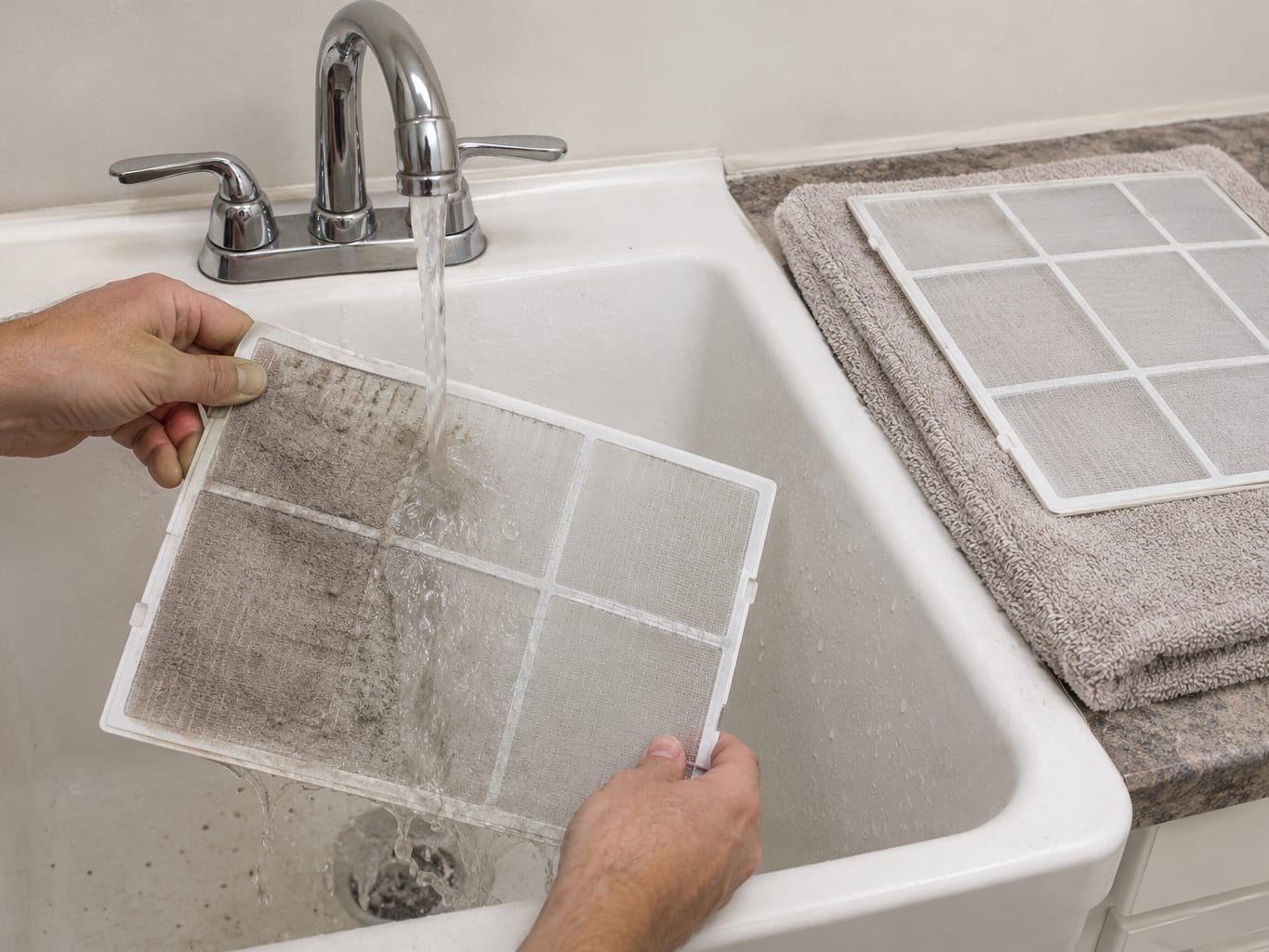
Follow the manual for your model. Turn the unit off and disconnect power before you open the cover or pull the filter. LG's April 2026 guidance says to wash the filter in lukewarm water below 104°F (40°C), replace a heavily soiled one, and dry it fully before reinstalling, because a wet filter can bring back the odor and the mold. LG also warns that exposed coils can be sharp. If the problem is past the filter, stop there.
Cleaning a mini split
Clean the indoor head's filters exactly as the operation manual describes. Daikin says not to use ordinary commercial cleaning agents inside the air conditioner, because they can damage resin parts and heat-exchanger components and cause water leaks. Persistent odor, visible growth inside the head, recurring leaks or contamination you cannot reach all call for a professional assessment.
What kills mold in an air conditioner?
Physical cleaning and moisture correction do most of the work. Chemical treatment is a narrow exception. EPA says biocides are regulated pesticides that must be registered for the specific HVAC use and applied as the label directs, and only after the system has been inspected, cleaned and repaired. Spraying into an operating system can carry material through it and into occupied rooms, which is why bleach, household disinfectant, fragrance, ozone and unregistered mold killers stay out of your unit. A contractor who proposes a biocide should show you the label and apply it only to approved surfaces.
EPA also advises against steam cleaning ductwork, and a sealant should never cover wet liner, active growth or debris.
When replacement makes more sense
For a window unit or mini split, replacing may be more practical when porous material inside is contaminated, the drain pan or coil cannot be reached safely, corrosion or water damage is extensive, or cleaning has not settled the odor and moisture. The decision turns on the model, the condition of the components, whether repairs are available and what the estimate says. In a central system, wet or moldy fiberglass duct liner or duct board gets removed and replaced.
What Can Homeowners and Renters Safely Do First?
Start with the unit itself. Turn it off if it is blowing visible debris, giving off a strong and lasting musty odor or leaking water. Photograph the unit, the filter, the drain pan, any visible growth, leaks and the registers that smell. Then check the indoor humidity with a hygrometer. EPA recommends keeping relative humidity below 60 percent, ideally between 30 and 50 percent.
By the next day, read the manual before you remove any panel, and clean or replace the filter only the way the manufacturer allows. Correct what you can see: standing water, a blocked drain, a leak. If you rent, tell your landlord or property manager in writing and keep a copy. If an insured water event may be involved, contact your insurer before you throw out a damaged unit.
Within the week, arrange an HVAC inspection if the odor returns, moisture persists, growth is inside the equipment, several rooms are affected or ductwork is involved. Ask for a written scope and keep your photographs, service records, receipts and reports in one folder.
What Homeowners and Renters Can Do First
- 1
Right away
Turn the unit off if it is blowing visible debris, giving off a strong and lasting musty odor or leaking water. Photograph the unit, the filter, the drain pan, any growth, leaks and the registers that smell, then check indoor humidity with a hygrometer.
- 2
By the next day
Read the manual before removing any panel, and clean or replace the filter only as the manufacturer allows. Correct standing water, a blocked drain or a leak. If you rent, tell your landlord or property manager in writing.
- 3
Within the week
Arrange an HVAC inspection if the odor returns, moisture persists, growth is inside the equipment, several rooms are affected or ductwork is involved. Ask for a written scope.
How Much Does It Cost to Have Mold Removed From HVAC?
The price depends on what the assessment finds. The main drivers are the type of system, the number of components involved, how easy each one is to reach, how far the contamination extends, whether containment is needed, which materials must be replaced, whether testing is part of the job and what repairs the moisture source requires. A single mini split head and a central system with connected ductwork sit at opposite ends of that range.
Ask for a written estimate that separates inspection, cleaning, replacement, repairs, testing and any chemical treatment into their own lines. For a window unit or mini split, ask for the cleaning figure and the replacement figure side by side, since that comparison is the decision itself.
Our HVAC mold remediation service starts with an assessment and a clear scope before work begins, and we work across central New Jersey.
Will Homeowners Insurance Cover Mold in an HVAC System?
Coverage depends on your policy and on what caused the damage. The New Jersey Department of Banking and Insurance's homeowners summary lists mold as excluded unless it results from a covered loss. It lists sudden and accidental water damage among commonly covered losses, and continuous or repeated seepage among commonly excluded ones. Flood damage is excluded from standard homeowners policies and generally needs separate flood insurance.
Hover or tap a row to highlight it.
| Situation | How it is listed |
|---|---|
| Mold | Excluded unless it results from a covered loss |
| Sudden and accidental water damage | Among commonly covered losses |
| Continuous or repeated seepage | Among commonly excluded losses |
| Flood damage | Excluded from standard homeowners policies; generally needs separate flood insurance |
If a covered event may have wet the system, report it promptly. The department's home insurance basics advise saving receipts, documenting damage with photographs and lists, and avoiding permanent repairs before the adjuster has reviewed the damage when possible. Photograph the unit and keep it until the insurer has looked at it.
Renters give the landlord written notice of the leak, odor or growth, with dates and photographs. The state health department says tenants should report unrepaired leaks to the local building-code office, and that local officials generally address the water leak rather than enforce a mold-specific rule.
Whoever you are dealing with, a short file saves time later:
- Photos and video: The unit, moisture, visible growth and damaged materials.
- Dates: When the odor, leak, overflow, storm or plumbing event happened.
- Service records: HVAC service history and filter receipts.
- Paperwork: Landlord notices, inspection reports, scopes, estimates and invoices.
- Policy details: Policy and claim numbers and adjuster messages.
How Do You Keep Mold From Coming Back in Your AC System?
Moisture control is the whole strategy. Keep indoor humidity below 60 percent, ideally 30 to 50 percent, and let a hygrometer tell you instead of guessing. EPA also recommends keeping air-conditioning drip pans clean and drain lines unobstructed, and repairing leaks and standing water promptly.
Filters come next. Clean window-AC filters on the manufacturer's schedule; LG's guidance for its product suggests every two weeks, though the right interval varies by model and use. Change or clean central-system filters according to the equipment instructions, maintain mini-split filters the way the manual describes, and let a washed filter dry fully before it goes back in.
Treat warning signs as repair calls. Recurring leaks, condensate overflow, a frozen coil or an odor that keeps returning each point to a moisture problem. When a central system will sit off for a long stretch, follow the manufacturer's drying or seasonal-shutdown steps. Running the fan moves air, but it does not replace fixing a wet system, and your manual is the best guide to what your equipment needs.
Frequently Asked Questions About Mold in an Air Conditioner
How common is mold in HVAC systems?
It depends on the system's moisture. Coils, drain pans, damp filters and wet insulation all allow growth, so the useful measure is your own system: visible conditions, odor, moisture and what an inspection finds.
Can mold grow back after remediation?
Yes, if the moisture condition remains. EPA says growth will recur when the conditions that caused it are not corrected, which is why the moisture source belongs in the written scope.
Do air purifiers help with mold?
A portable air cleaner or an HVAC filter may remove some airborne particles and sometimes reduce odor. EPA's guide to air cleaners says they do not address the moisture source or resolve a mold problem.
Should I keep running a unit that has mold on it?
Turn it off if it is blowing debris, smells strongly and persistently, or is leaking. Photograph it first so you have a record.
Test Your AC Mold Knowledge
1. What does mold in an AC unit need to grow?
2. What does EPA say should happen to wet or moldy insulated duct material?
3. What indoor humidity does EPA recommend?
4. What should you do before putting a washed filter back in?
5. What should you spray into a running unit?
Pick an answer to begin.
Wrapping Up
Mold in an air conditioner almost always traces back to a part that stays wet. The filter and visible surfaces are yours to clean within the manual. Growth inside the unit, a smell that returns, several affected rooms or wet duct insulation belongs to a technician, who should hand you a written scope naming the components, the moisture source, the method and the records.
Fixing the water is what keeps the unit clean afterward. Dry filters, a clear drain, steady humidity and a prompt call about leaks protect the equipment and the air in the rooms it serves. Photos, dates and receipts protect you with a landlord, an insurer or a buyer.
If the growth is past the filter, we can help. ExecPro Restoration & Cleaning serves central New Jersey, and our HVAC mold work covers coil cleaning, duct decontamination, drain-pan treatment and air-handler remediation where mold has established inside equipment or ductwork. Call us at (888) 300-3772 or use our contact page to talk through the unit in front of you.
Air Conditioner Mold Terms
Tap a term to see what it means.
Evaporator coil. The cold coil that pulls water out of humid indoor air and is wet on purpose while the system cools.
Related Articles
Air Purifier for Mold: What HEPA Captures and What It Misses
Does an air purifier help with mold? Learn what HEPA filters capture, how a dehumidifier differs, and what to do first in a damp New Jersey basement.
Mold Risk in New Jersey by Season and What to Check
When is mold worst in New Jersey? Indoor mold follows moisture all year. Get a check for summer, fall, winter and spring, plus first-day steps and next calls.
Basement Humidity Level to Prevent Mold: Aim for 30 to 50%
Keep your New Jersey basement between 30% and 50% humidity. Learn how to measure it, size a dehumidifier and fix the water source behind the damp.