
Flooded Basement Cleanup in New Jersey: The Order of Operations
Cal HewittPublished
- basement flood cleanup
- flood damage cleanup
- structural drying
- new jersey
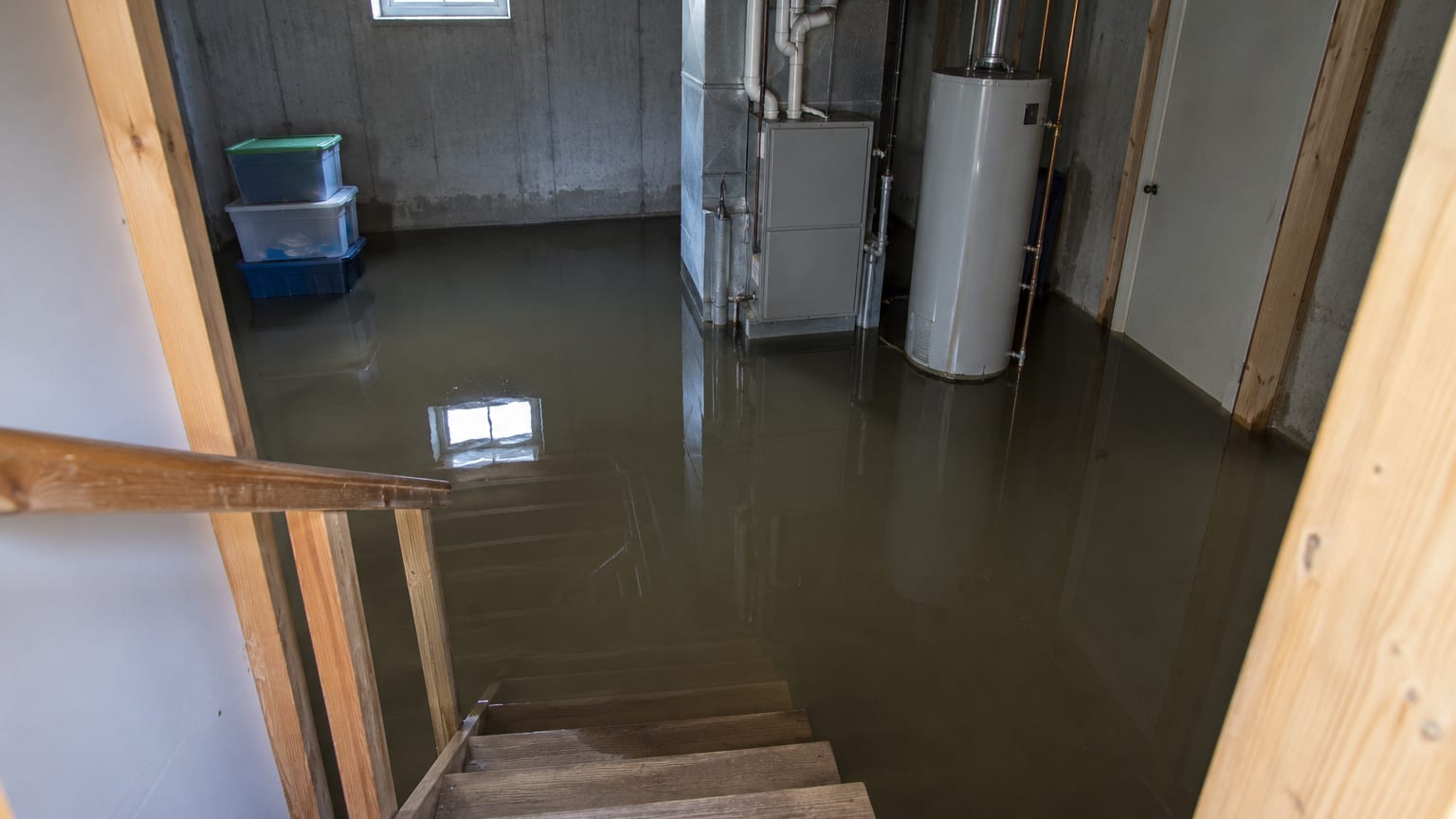
You are at the top of the basement stairs, there is water below, and the first decisions set the course for everything after. The first question is whether it is safe to go down at all, because water and electricity share many basements. After that, flooded basement cleanup in New Jersey follows a set order: make the space safe, stop the source, document the damage, find out what kind of water you have, remove it, sort what can be saved, take out the wet materials that cannot dry, dry the structure, prove that it is dry, and then fix the cause and rebuild. This post walks that order step by step, starting with the first hour. If the water came from a water main, our post on what to do when a water main break floods your basement covers that situation in detail, and our post on emergency basement drying goes deeper on the drying itself.
Key Takeaways
Safety decides the first move
Keep power off until an electrician inspects the system, reach a panel only from a dry spot, and keep gasoline equipment outdoors at least 20 feet from doors, windows and vents.
The order matters
Safety, source, photos, water type, extraction, sorting, removal, drying, proof of dry, then repairs and rebuild.
Drying is measured
EPA's 24 to 48 hour target for clean-water drying starts the clock, and recorded moisture readings tell you when the job is finished.
Flood and homeowners coverage differ
New Jersey homeowners policies exclude flood damage, so ask your agent about flood, sewer-backup and sump-pump coverage the same day.
Repeat flooding has a source
Grading, gutters, sump capacity, backup power, sewer connections and groundwater each call for a different fix.
Why Does the First Decision Matter So Much in a Flooded Basement?
Water finds the lowest point, and in many New Jersey homes that is a basement holding the furnace, the water heater, the electrical panel, the washer and years of stored belongings. The better habit is the same every time: check the hazards, stop the source, record what happened, and call people who can help.
A few simple facts frame everything that follows. The Environmental Protection Agency says a flooded home and its contents should be dried within 24 to 48 hours where possible, and that materials still wet after that window should be treated as having possible mold growth. The New Jersey Department of Health adds that mold spores need water to grow and recommends identifying and correcting the excess-water source before remediation. Speed and cause belong together: dry fast, and find out where the water came from.
What Should You Do in the First Hour and the First Day?
In the first hour, safety comes first. Stay out of the basement if water is near electrical equipment, the floor feels unstable, you smell gas, or the water may hold sewage or chemicals. OSHA says to turn power off at the main breaker or fuse when water has been near electrical circuits, and to avoid entering a flooded area or touching electrical equipment while standing on wet ground. If the main shutoff is reachable from a dry spot, use it. If it is not, leave it alone and call an electrician or your utility. The New Jersey Office of Emergency Management says to keep electricity off until an electrician inspects the home, and if you suspect gas, leave, call the gas company and let a professional restore service.
Skip candles and matches. Run gasoline-powered pumps, generators and pressure washers outdoors, at least 20 feet from doors, windows and vents, as the Centers for Disease Control and Prevention directs, because carbon monoxide from that equipment can be fatal indoors.
Then stop the source, if you can do it from a safe spot. Shut off a failed interior supply line. Call the plumber for a burst pipe. Call the utility for gas or electrical hazards. Contact the municipality or sewer authority if a public sewer problem is suspected. Arrange emergency water extraction early, so a crew can head your way while you make the other calls.
Photograph before anything is thrown out. When it is safe, take photos and video of the water line, the source, each affected room, the contents, the equipment and any visible damage. Then call your insurer, report the loss, and ask whether an adjuster must inspect before materials are discarded. The New Jersey Department of Banking and Insurance recommends photographing and listing damage, saving receipts for temporary repairs, and holding damaged property until the insurer has inspected it or released it.
By the end of the first day, work out what kind of water you have. Clean, grey and sewage-contaminated water each call for a different response (the next section covers them), and fans should wait until the water is known to be clean or sanitary. Keep children, pets and anyone with asthma, allergies, lung disease or a weakened immune system away from contaminated or moldy areas. Keep a flooded HVAC system turned off until it has been evaluated and cleaned, since running it can spread contamination through the house. Keep every receipt, invoice, claim number, photo and moisture reading.
Flooded Basement Cleanup, Step by Step
- 1
Make the space safe
Keep power off until an electrician inspects the system, and keep gasoline equipment outdoors at least 20 feet from doors, windows and vents.
- 2
Stop the source
Shut off a failed supply line, and call the plumber, the utility or the sewer authority as the source requires.
- 3
Document the damage
Photograph the water line, the source, each room and the contents before anything is thrown out, then report the loss.
- 4
Identify the water
Clean, grey and sewage-contaminated water each call for a different response.
- 5
Extract and sort
Remove standing water, then sort contents into what can be cleaned and what usually goes.
- 6
Remove what cannot dry
Wet materials that cannot dry come out.
- 7
Dry and prove it
Dry the structure and confirm with recorded moisture readings before anyone closes a wall.
- 8
Fix the cause and rebuild
Correct the source, then rebuild.
What Can Be Saved, What Comes Out, and How Do You Know It Is Dry?
The type of water sets the rules. Clean water from a supply line allows the most materials to be cleaned and dried, if the work starts promptly. Grey water may carry contamination and calls for more protective gear and selective removal. Sewage or other black-water contamination calls for containment, protective equipment, disinfection and professional handling, and EPA's clean-water guidance table says to bring in experienced professionals when the team lacks experience with contaminated water. If you are wading in, the CDC recommends rubber boots, rubber gloves and goggles, and a puncture wound or a wound contaminated with soil or feces deserves a call to your doctor about tetanus protection. Our sewage cleanup page covers that category.
Hover or tap a row to highlight it.
| Water type | Response |
|---|---|
| Clean water from a supply line | Allows the most materials to be cleaned and dried, if the work starts promptly |
| Grey water | May carry contamination and calls for more protective gear and selective removal |
| Sewage or other black water | Calls for containment, protective equipment, disinfection and professional handling |
Sort contents next. Hard, nonporous items such as plastic bins, metal tools and sealed glass can usually be cleaned and dried; wet cardboard, upholstered furniture, swollen items and anything touched by sewage usually go. Keep high-value items available for the adjuster when you can.
EPA's clean-water table lists several building materials by name:
- Carpet and backing: Dry within 24 to 48 hours using extraction vacuums, dehumidifiers and fans.
- Drywall: It can stay when it has no obvious swelling and the seams are intact.
- Ceiling tiles, cellulose insulation and fiberglass insulation: Discard and replace.
- Wood, framing and hard surfaces: Clean and dry them according to the material.
Dry is a measurement. Floors can feel dry while the wall cavity, the pad and the subfloor stay wet, so ask for recorded moisture readings and confirm that flooring, wall cavities, subflooring, framing and contents are dry before anyone closes a wall, lays new flooring or moves back in. Closing up early is how a one-week water loss turns into a mold project.
Hover or tap a row to highlight it.
| Material | EPA action |
|---|---|
| Carpet and backing | Dry within 24 to 48 hours using extraction vacuums, dehumidifiers and fans |
| Drywall | Can stay when it has no obvious swelling and the seams are intact |
| Ceiling tiles | Discard and replace |
| Cellulose insulation | Discard and replace |
| Fiberglass insulation | Discard and replace |
| Wood, framing and hard surfaces | Clean and dry according to the material |
How Does Professional Basement Flood Cleanup Proceed, and How Long Does Drying Take?
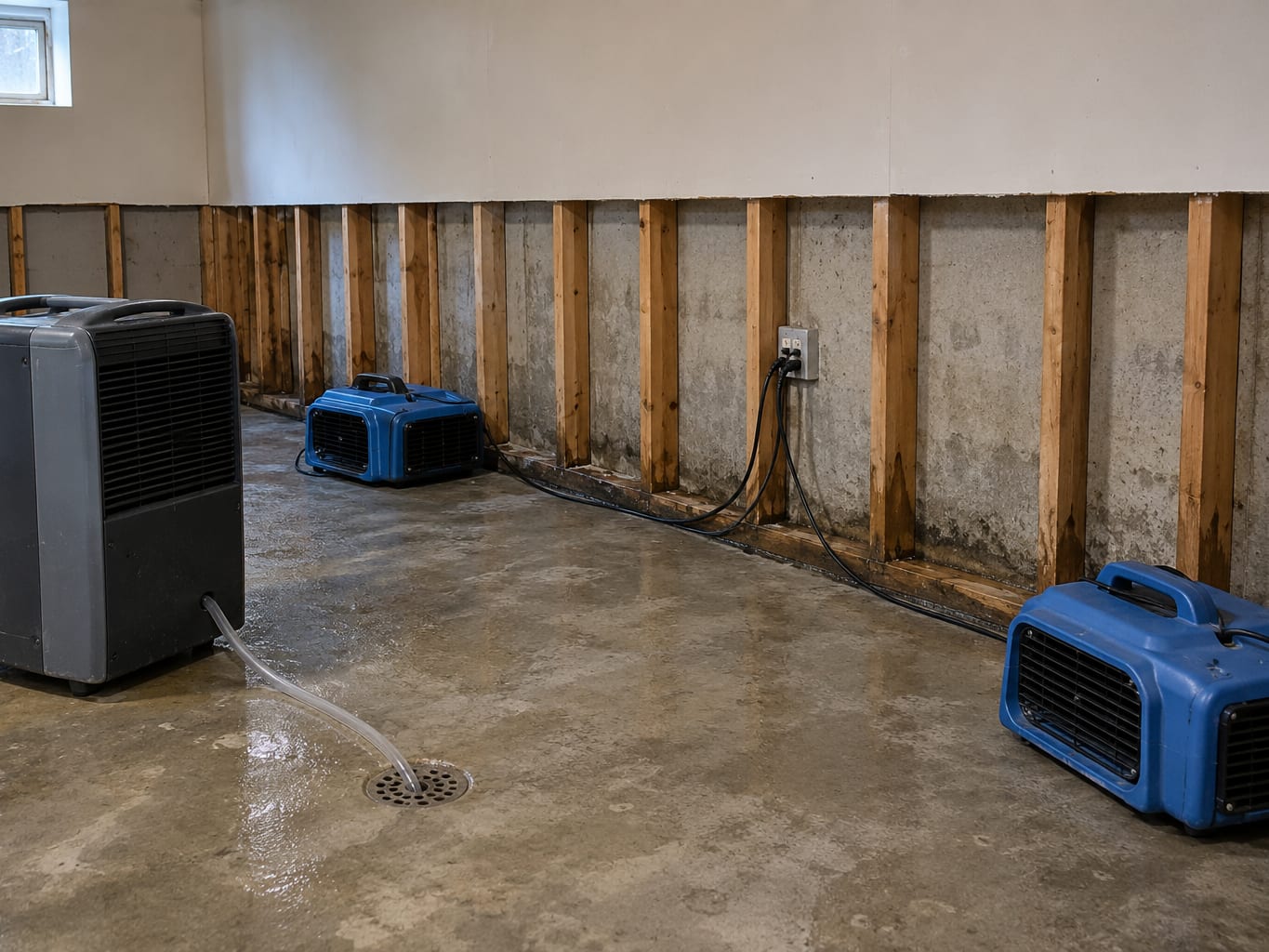
A professional job follows the same order you do, with equipment and records added. The industry reference, ANSI/IICRC S500, covers professional water-damage restoration, including safety, psychrometry (how heat and humidity behave in a building), drying technology, documentation, contents evaluation and structural restoration. In practice, that means a technician checks the hazards, classifies the water, extracts the standing water, removes the materials that cannot dry, places dehumidifiers, air movers and monitoring equipment, and records readings until the affected materials reach their dry standards. Our basement flood cleanup and structural drying pages describe how that applies to wall cavities and subfloors, where moisture hides.
How long does it take? Drying time depends on the volume of water, its category, temperature, humidity, the building materials, hidden cavities, the contents and the equipment. Square footage alone settles little. EPA's 24 to 48 hour target gives you the start line for clean-water drying, and the finish line is the day the moisture readings meet the project's dry standards. Ask for the paperwork that proves it: a written scope, a list of affected materials, an equipment log and dated moisture readings.
S500 treats correcting the cause of the water as generally the property owner's responsibility unless it is separately contracted, so ask each company whether its scope includes the source or only the cleanup.
What Do Flooded Basement Cleanup Costs Depend On?
The total follows the work, and the work follows the water. Volume and category set the extraction and the protective measures. Demolition adds labor and disposal. Drying time sets equipment days. Contents add cleaning or replacement, mold or sewage adds containment, and electrical or HVAC repairs, permits and reconstruction come last. Your best tool is a written estimate that separates emergency extraction, demolition, drying, cleaning, contents and rebuild work, so you can see which parts an insurer may review and which are yours to decide.
Read any contract before you sign it. Pay particular attention to an assignment of insurance benefits, which hands your claim rights to a contractor, and avoid paying the full project amount upfront. The state insurance regulator also tells consumers they may choose their own contractor rather than the one the insurer recommends. Judge a company by its written scope, its drying records and its references. When drying ends and rebuilding begins, our post-water-damage reconstruction page explains that phase.
Paperwork to Ask Every Company For
A written scope
Spells out the work before it starts.
A list of affected materials
Shows what is coming out and what is staying.
An equipment log
Records the dehumidifiers, air movers and monitoring equipment in place.
Dated moisture readings
Show when the affected materials meet the project's dry standards.
An itemized estimate
Separates emergency extraction, demolition, drying, cleaning, contents and rebuild work.
Will Homeowners Insurance Pay for a Flooded Basement?
It depends on the cause, and the cause decides which policy answers. The state insurance department says all homeowners policies exclude water damage caused by flood, and New Jersey's required flood notice defines flood to include general and temporary inundation of normally dry land, including the unusual and rapid accumulation or runoff of surface water. An interior plumbing failure is a different kind of loss that your policy may address, so have your insurer or agent review the policy and the cause of loss.
Flood insurance is its own product. The department's July 2025 storm guidance says most homeowners, business, condominium and renters policies leave flood out, that the National Flood Insurance Program (NFIP) and private flood insurance are available, and that flood coverage generally takes effect 30 days after purchase. Buy a policy well before the water rises. NFIP basement coverage is limited: certain installed, powered building items, such as furnaces, sump pumps, central air conditioners, light switches and outlets, may qualify, along with certain powered contents such as washers, dryers, window air conditioners and freezers. The NFIP claims page says to document as soon as it is safe, before the adjuster arrives.
Sewer backup and sump-pump failure carry their own wording. Ask your agent whether the policy includes water-backup or sewer-backup coverage, whether sump-pump failure is covered, which limits and exclusions apply, and whether the event is being treated as surface flood, groundwater seepage, sewer backup or plumbing discharge. Report the loss promptly to every insurer who might respond, and request a written explanation of coverage or exclusion; the state's storm-claim guidance says an insurer must explain exclusions when all or part of a loss is excluded.
Why Does My Basement Flood Every Time It Rains?
Repeat flooding usually follows one or more pathways, and the repair matches the pathway. Several often combine.
- Groundwater and saturated soil: Water pushes through foundation walls, slabs, joints and cracks. The fix starts with locating the entry route, then correcting drainage and foundation-water management.
- Grading: Soil that slopes toward the house sends rainwater to the foundation. NJOEM and the CDC both advise ground that slopes away from the house.
- Gutters and downspouts: Roof water that discharges beside the foundation soaks the soil there. Downspouts should carry water away from the building.
- The sump pump: A pump can be undersized, blocked or failed, and the system should be checked for basin location, capacity, discharge routing, check-valve function and backup operation.
- Power loss: The storms that bring the most water also knock out power, which stops a pump at the worst moment. Backup power may be a battery system, a generator run outdoors, or another properly installed arrangement.
- Sewer backup: Heavy rain can overload sewers. The New Jersey Department of Environmental Protection explains that combined sewer systems can be overwhelmed by rainfall or snowmelt. A backwater valve, a sewer plug, a plumbing correction or a municipal sewer investigation may be part of the answer.
- Septic systems: Saturated ground can stop a septic system from working. The CDC advises reducing water use, avoiding sewage-contaminated water and calling the health department or a septic professional.
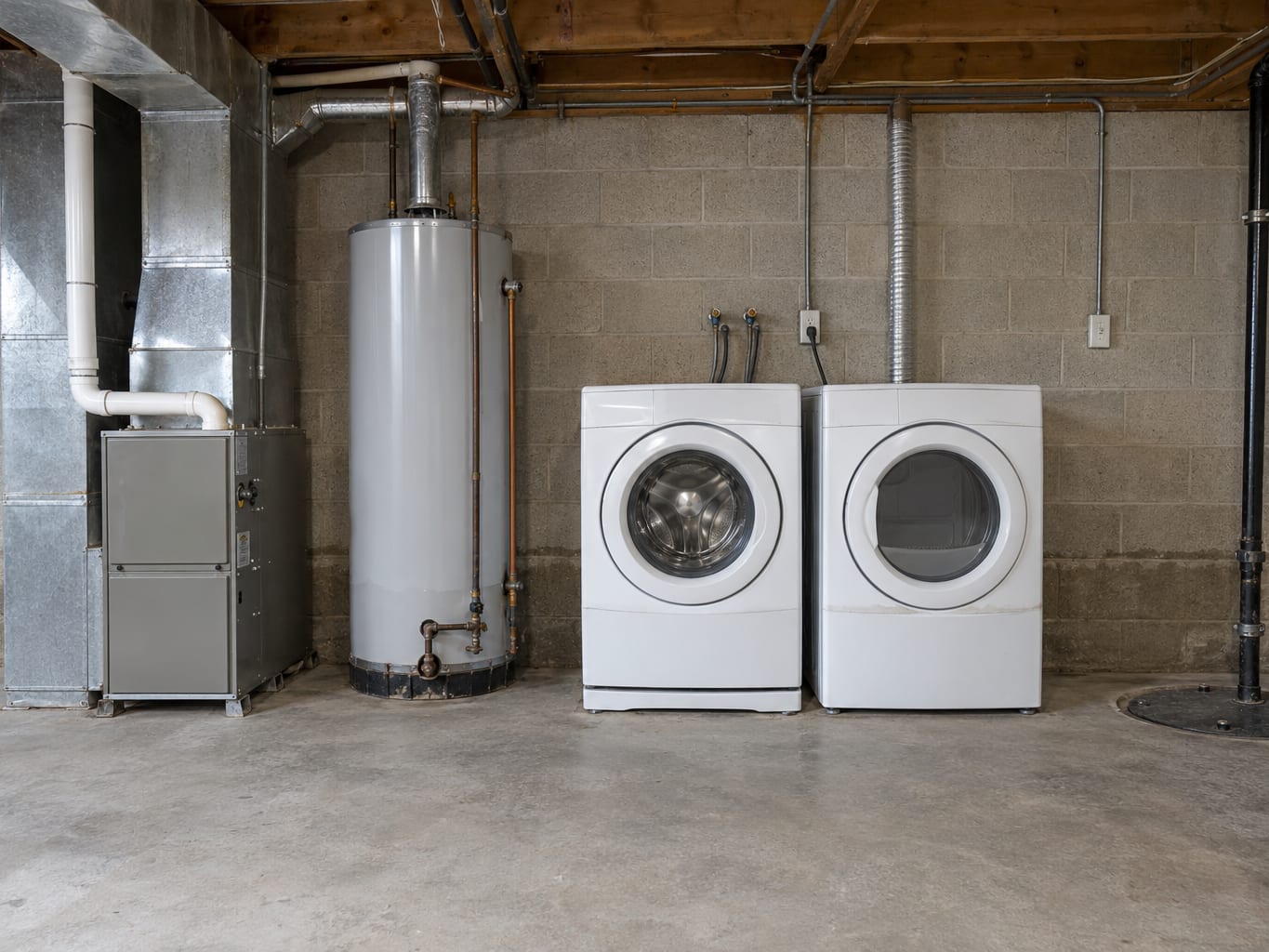
- Low equipment: A furnace or washer sitting on the slab turns a few inches of water into a large loss.
Extraction and drying settle the recent loss, while grading, drainage, sump, sewer, septic, foundation or utility work addresses recurrence. A property-specific look at your drainage, flood history and sewer connection is the way to learn which of these applies to your house.
Hover or tap a row to highlight it.
| Pathway | Where the fix starts |
|---|---|
| Groundwater and saturated soil | Locate the entry route, then correct drainage and foundation-water management |
| Grading | Ground that slopes away from the house |
| Gutters and downspouts | Carry roof water away from the building |
| The sump pump | Check basin location, capacity, discharge routing, check-valve function and backup operation |
| Power loss | Backup power such as a battery system or a generator run outdoors |
| Sewer backup | A backwater valve, a sewer plug, a plumbing correction or a municipal sewer investigation |
| Septic systems | Reduce water use, avoid contaminated water, call the health department or a septic professional |
| Low equipment | Keep the furnace and washer off the slab |
How Do You Prevent the Next Basement Flood?
Start outdoors: point downspouts away from the foundation and regrade soil so it slopes away from the house. Then look at the equipment inside. NJOEM recommends sump pumps with backup power, sewer plugs or backflow-prevention devices, and raising electrical equipment, washers, dryers, furnaces and water heaters at least 12 inches above projected flood elevation.Test the sump pump before storm season.
Bring in the right trade for each repair. A New Jersey licensed electrical contractor should inspect any water-damaged wiring, receptacles, switches or panels, and the state's Construction Code Communicator advises notifying your local construction-code office and obtaining permits for electrical and plumbing work after storm damage. In flood-hazard areas, floodplain administrators review improvement costs against substantial-improvement thresholds during permit review, so ask your local office before major interior work. When the flood followed a storm, our storm damage restoration page covers the cleanup side.
Frequently Asked Questions About Flooded Basement Cleanup in NJ
What should I do to clean up after my basement floods?
Make the area safe first: keep power off until an electrician approves it, leave if there is gas or structural danger, and stay out of sewage-contaminated water. Document the damage, notify your insurer, remove standing water and wet materials, and dry the building promptly.
How fast does mold grow after a basement flood?
EPA uses 24 to 48 hours as the clean-water drying target to help prevent mold, and treats materials still wet after that as possibly moldy. Start safe drying right away and check hidden moisture in flooring, wall cavities, insulation and contents.
How long does it take to dry out a basement after a flood?
It depends on the volume and category of water, temperature, humidity, materials, hidden cavities and equipment. The job ends when dated moisture readings show the affected materials meet their dry standards, so ask for a drying log.
Will homeowners insurance cover a flooded basement?
New Jersey homeowners policies exclude damage caused by flood, while an interior plumbing failure may fall under other coverage. Review the policy and the cause of loss with your agent, and ask about flood, sewer-backup and sump-pump coverage.
Flooded Basement Cleanup, Quick Check
1. What drying target does EPA give for clean-water drying?
2. How far from doors, windows and vents should gasoline-powered pumps and generators run?
3. How do New Jersey homeowners policies treat flood damage?
4. When is a flooded basement actually dry?
Pick an answer to begin.
What This Means for You
Flooded basement cleanup goes best in order: make the space safe, stop the source, document, identify the water, extract it, sort and remove what cannot dry, dry the structure with measurements, and correct the cause before rebuilding. The first hour protects your safety, the first day protects your claim and your drying window, and the first week decides whether the basement is truly dry and whether it floods again.
Dry materials stay mold-free, a documented claim gives your insurer clear records, and a fixed cause gives you an ordinary storm season. Ask every company for a written scope, a drying log with moisture readings, and an itemized estimate.
If you have water in a New Jersey basement right now, ExecPro Restoration & Cleaning can help you through each step, from extraction and drying to mold work and rebuild. Call us at (888) 300-3772 or use our contact page and tell us where the water came from, what it touched and what your insurer has said. Have your policy and claim information nearby, keep people away from unsafe water, and photograph conditions when it is safe.
Flooded Basement Terms
Tap a term to see what it means.
Psychrometry. How heat and humidity behave in a building.
Related Articles
Flood Damage Cleanup in Trenton, NJ: Backwater, Mud and Checking Your Parcel
After the river or the creek backs up into the street, cleanup starts with power, photos and what to throw out. Then check your parcel's flood status.
Tidal Flooding at the Jersey Shore: What Saltwater Does to a Home
Tidal water from the September nor'easter came into a Jersey Shore home? What saltwater does to wiring, HVAC and framing, and what to do first.
Water Got Into Your New Jersey Home in the Nor'easter: The First 48 Hours
Water got into your New Jersey home in the September nor'easter? What is safe to touch, what to photograph, and how to start drying in the first 48 hours.