One Wing at a Time: Phased Commercial Mold Remediation for Princeton Junction, NJ Buildings That Cannot Close
Cal HewittPublished
- commercial mold remediation
- commercial mold
- mold remediation
- business continuity
- new jersey
- princeton junction
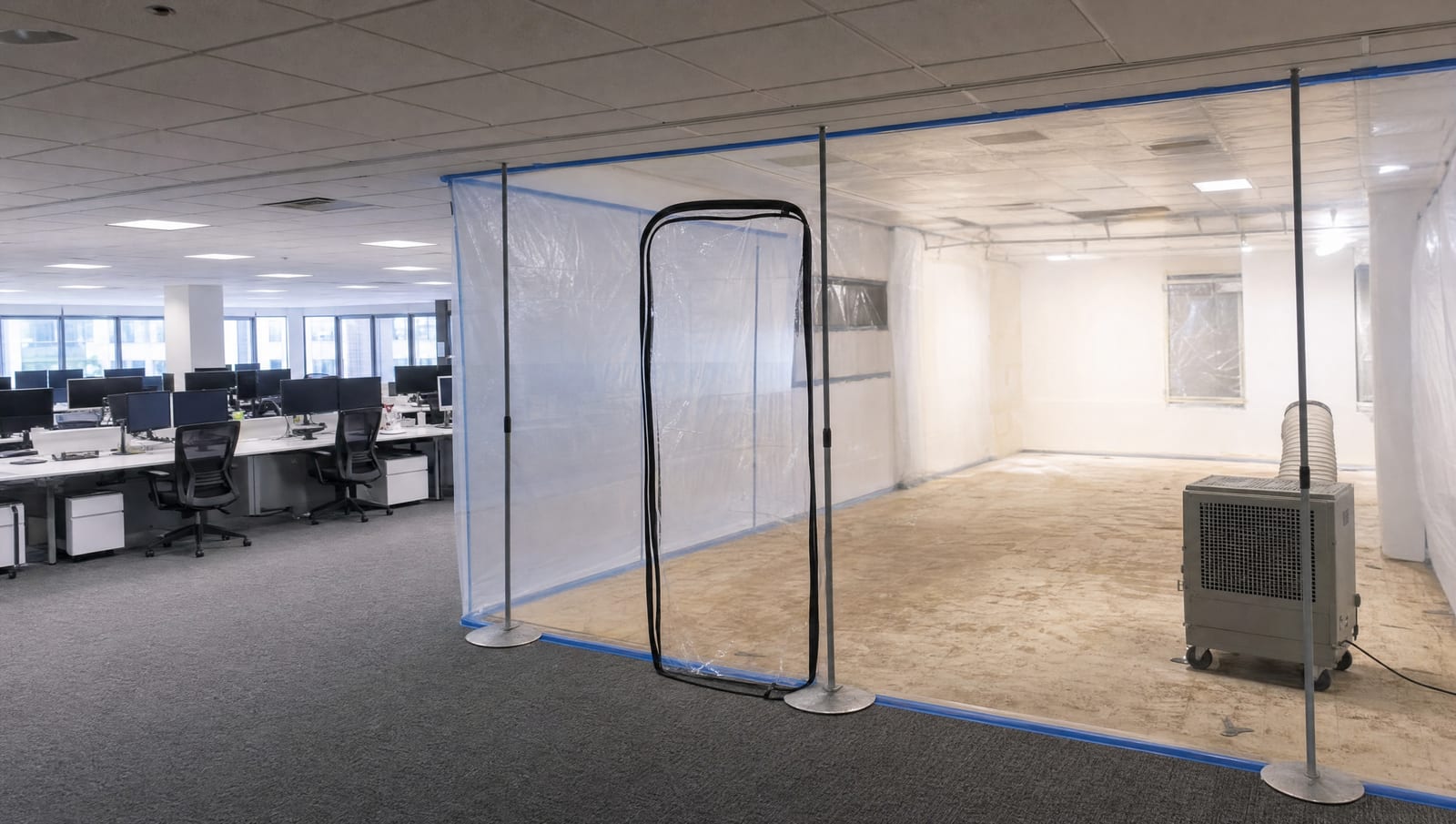
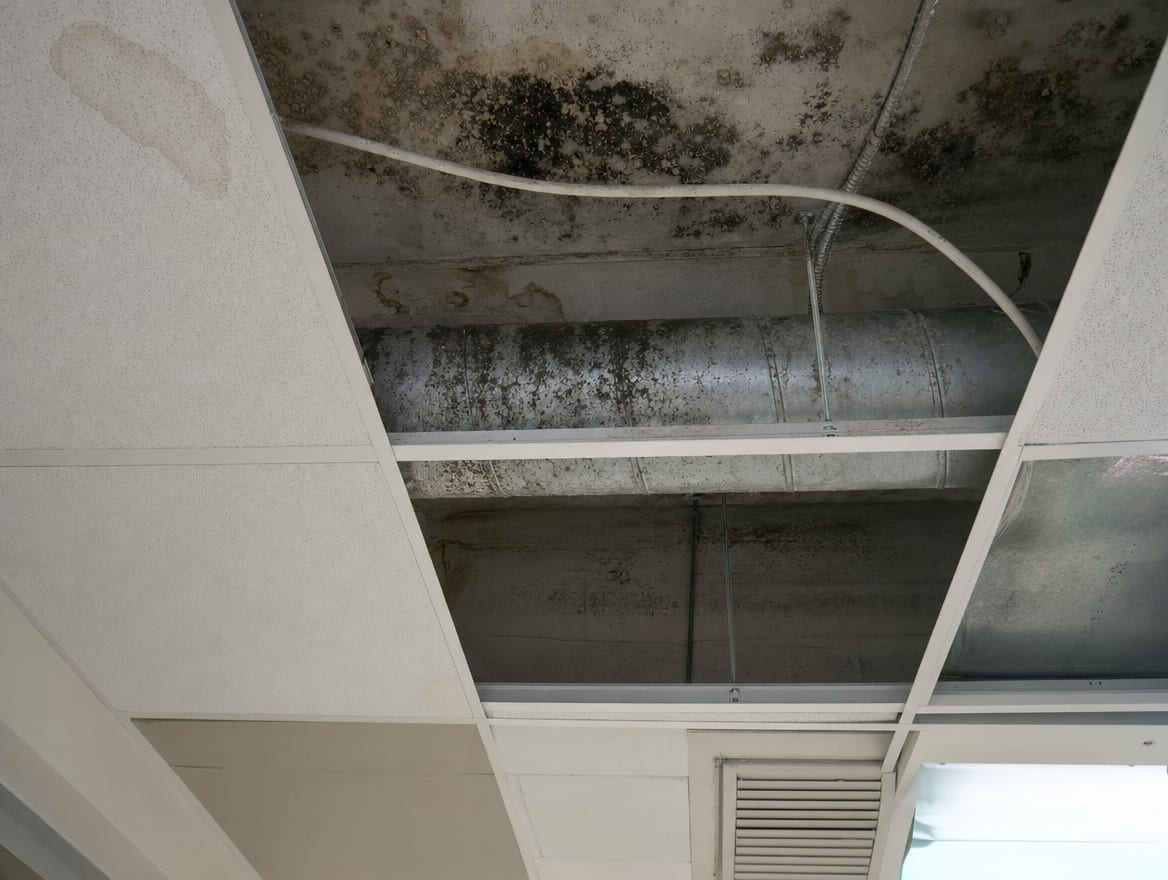
Picture a Princeton Junction office and managed residential building on a normal Monday. One wing has a slow roof leak that finally showed itself as staining across a suite of ceilings. A mechanical area on another floor has an HVAC condensate problem that has been feeding a musty smell into a corridor. The rest of the building is full of people who need to work, and a schedule that does not pause for a repair. The mold is real and it needs to be corrected. Closing the whole property is not an option anyone wants to reach for.
That is the situation most commercial mold work in this area is really about. The hard part is rarely the cleaning itself. The hard part is correcting the moisture, containing the affected space, drying the structure, and verifying the result while the building keeps operating around the work. This guide walks through how a phased approach lets a Princeton Junction office, school, or managed property answer three practical questions at once: which areas must close, which areas can stay occupied, and what evidence is needed before each zone reopens.
Why One Building Can Need Several Work Zones
A commercial building is rarely a single problem in a single room. A roof leak can travel along framing and show up in a suite far from where the water entered. A condensate line or a drain pan issue in a mechanical space can dampen materials nearby without ever becoming visible from the hallway. When two separate moisture sources appear in two separate parts of the building, treating the property as one big project usually closes more of it than necessary.
The alternative is to break the building into work zones. Each affected area becomes its own contained space with its own plan, while the unaffected areas keep running. This is the core idea behind keeping the doors open. Instead of shutting a floor because one suite has a problem, the team isolates the suite, controls the air around it, and leaves the rest of the floor working. The building is not one job. It is several smaller jobs happening under one roof, sequenced so that operations lose as little ground as possible.
Getting the zones right starts with an honest incident and building review. Before any wall is opened, the team gathers the building's use and operating schedule, the history of leaks, storms, plumbing, or HVAC trouble, where and when occupants have noticed odors or symptoms, and the roof and mechanical maintenance records. It also identifies the functions that cannot stop, the deadlines that matter, and any sensitive or regulated spaces. That picture is what tells the team where the lines between zones should fall.
Offices, Schools, and Managed Properties Are Not the Same
The right plan depends heavily on what kind of building it is, because occupancy changes everything about how work can be staged.
An office or office park often has strong weekday occupancy and lighter evenings and weekends. That pattern is an opportunity. Much of the loud, dusty, or disruptive work can be scheduled after hours, so tenants arrive to a contained, quiet zone rather than an active demolition. Shared central HVAC and suspended ceilings mean the team has to think about how air and materials move between suites that belong to different tenants.
A school or childcare facility adds children, staff, class schedules, and ventilation requirements to the plan. Work has to account for who is in the building and when, and communication with staff and parents becomes part of the job rather than an afterthought. The New Jersey Indoor Air Quality Standard, N.J.A.C. 12:100-13, applies to existing buildings occupied by public employees during regular working hours and covers maintenance, ventilation, renovation, records, and complaint response. It does not apply to every private property, but where it does apply it shapes how the work is documented and communicated.
A multifamily or managed residential building brings shared roofs, party walls, plumbing stacks, common corridors, and central mechanical systems. Water and odor can move beyond one unit through those shared systems, so the containment plan has to consider neighbors and common areas, not just the space where the mold was found. In every case, the remediator documents where the moisture is and where it came from. It does not decide who is responsible for a shared component. That is a matter for the building's owner, manager, or governing documents.
How HVAC Systems Affect Containment
In a commercial building, the mechanical system is often the reason a small problem becomes a building-wide one. Central HVAC moves air across floors and between suites. If a return pulls air through an affected zone, it can carry particles into spaces that were otherwise fine, and it can defeat the containment the team just built.
That is why HVAC strategy is part of the plan from the start. In the affected zone, the system may need to be isolated so it is not pulling from or pushing into the contained area. Drain pans, coils, and condensate lines get checked, because a mechanical space is a common hidden moisture source. Where the equipment itself has been affected, cleaning or isolation is planned deliberately rather than left running out of habit. Running HVAC through an affected zone is one of the most common mistakes in commercial work, and it is one of the easiest to avoid with a clear plan.
How Phased Work Protects Operations
Phasing is what turns a disruptive project into a manageable one. The point is simple: contain the affected zone, control the air inside it, do the loud work when the fewest people are present, and hand each finished zone back once it meets the criteria to reopen.
Hover or tap a row to highlight it.
| Phase | Areas that keep operating | Continuity measure |
|---|---|---|
| Inspection and source assessment | Nearly all of the building | Non-invasive checks during hours, invasive checks staged after hours |
| Containment setup | Everything outside the sealed zone | Sealed barriers and HEPA negative air isolate the work area |
| Removal and cleaning | Unaffected suites, floors, and common areas | After-hours or weekend work, protected access routes, dust and odor control |
| Structural drying | Occupied areas around the drying zone | Drying equipment runs inside containment, monitored between shifts |
| Source repair | The rest of the building | Roof, plumbing, or HVAC trade works within the same contained zone |
| Verification and reopening | Building fully in use as zones clear | Each zone reopens only after it meets written criteria |
The measures that make this possible are practical, not exotic. They come down to separating the work from the operation and keeping the two from interfering with each other.
Keeping Operations Running During Remediation
Zone-off containment
Physical barriers seal the affected area from occupied space so dust, debris, and spores stay inside the work zone.
Negative air
HEPA-filtered negative air keeps the contained zone at lower pressure than its surroundings, so air flows in rather than leaking out.
After-hours scheduling
Loud, dusty, or high-traffic tasks are staged for evenings, weekends, or low-occupancy windows to protect the working day.
Protecting IT, equipment, and records
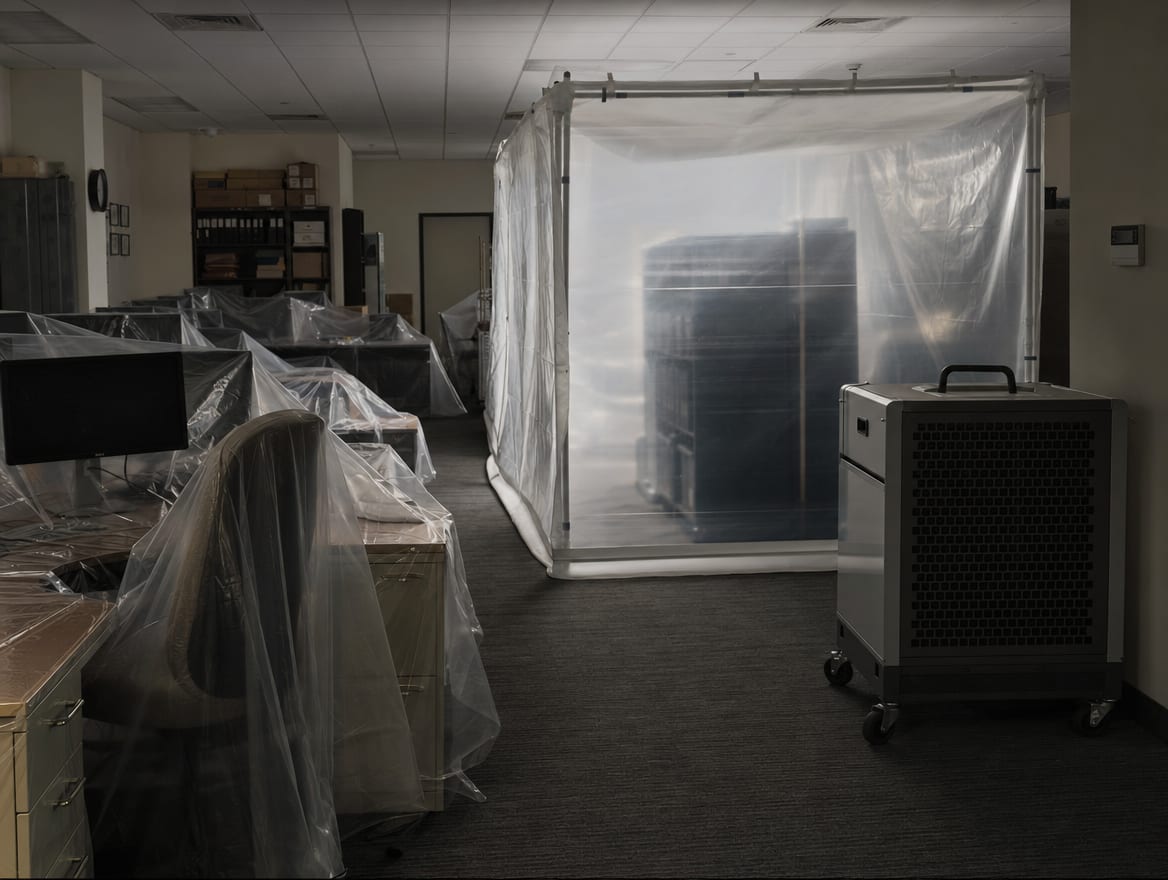
Computers, inventory, classroom materials, and files are covered, moved, or inventoried so the work does not damage what the operation depends on.
Dust and odor control
Filtration, sealed pathways, and careful material handling limit the dust and smell that reach occupied areas.
Staff and tenant notice
Clear, early communication tells occupants what to expect, which keeps concern, rumors, and complaints from growing.
Egress and signage
Barriers and routes are planned so exits stay clear and everyone can move through the building safely during the work.
Temporary relocation is a tool here, not a default. Depending on the scope, exposure pathways, access, and whether sensitive occupants are involved, a plan might move a handful of staff for a few shifts, or it might leave everyone in place behind good containment. That decision comes out of the assessment, not a script.
What Documentation Managers Need
For an owner, manager, or insurer, a commercial project is only as good as the record it leaves behind. Documentation is not paperwork for its own sake. It is what lets a manager show tenants the problem was handled, gives an insurer the chronology and evidence they ask for, and protects the building's standing when a space changes hands.
A strong commercial project file tends to include the incident chronology, occupancy and complaint records, photographs, moisture maps, any roof, plumbing, or HVAC reports, the remediation protocol, containment and equipment logs, daily progress notes, waste and disposal records, contents or inventory records, the communication sent to staff or tenants, the written reopening criteria, and the verification results. On coverage, the honest position is the plain one: whether a policy pays for the work and for any business interruption depends on the policy terms, the cause of loss, exclusions, notice, and mitigation. A contractor cannot guarantee coverage. Good documentation supports a claim. It does not decide it.
When Testing and Third-Party Verification Add Value
Testing is often assumed to be the first step. It usually is not. The EPA notes that sampling is generally unnecessary when mold is already visible, because you do not need a lab to confirm what you can see. Testing earns its place when it answers a defined question rather than replacing inspection.
In a commercial or institutional setting, there are real reasons to test. Hidden or disputed conditions, protocol development, baseline documentation, sensitive or institutional environments, and post-remediation verification are the common ones, along with requests tied to real estate, insurance, or regulatory needs. Verification at the end is where testing tends to matter most for a building that has to reopen with confidence. Independent post-remediation verification gives an owner or manager written evidence that a zone met its criteria before people came back into it, which is exactly the assurance a school or a multitenant property often needs.
Coordinating the Trades Around a Working Schedule
Mold remediation removes and cleans, but it does not fix the water. If the roof still leaks or the condensate line still drips, the moisture returns and the growth comes back with it. That is why source correction is part of the plan, and why several trades often share the same contained zone.
A phased project sequences that work so it happens inside the containment already built, on the schedule already set. A roofer addresses the leak, a plumber or HVAC contractor corrects the condensate or drainage issue, the remediator handles containment, removal, drying, and cleaning, and the rebuild trades follow once the space is dry and verified. Keeping all of that inside one contained zone, staged around the building's hours, is what prevents the work from spilling into occupied space. Some of this work may also require West Windsor Township permits, since demolition, plumbing, electrical, HVAC, roofing, structural repair, and reconstruction often need approvals that routine cleaning does not.
The order of operations is where phasing becomes concrete.
Phased Commercial Remediation Around a Working Schedule
- 1
Incident and building review
Gather use, schedule, leak and HVAC history, complaint locations, maintenance records, critical functions, and deadlines that shape the plan.
- 2
Inspection and source assessment
Find visible and hidden moisture, check roof, plumbing, HVAC, and airflow, and decide what can be cleaned versus removed.
- 3
Operational plan and zoning
Define work zones, occupied and unoccupied areas, access routes, after-hours windows, communication, and reopening criteria.
- 4
Containment and negative air
Seal the affected zone and set up HEPA-filtered negative air so the work area stays isolated from occupied space.
- 5
Removal and cleaning
Remove contaminated porous materials, HEPA vacuum, damp-clean salvageable surfaces, and control waste, staged for low-occupancy hours.
- 6
Structural drying and source repair
Dry the structure to target and complete the roof, plumbing, drainage, or HVAC repair that caused the moisture.
- 7
Verification
Confirm visual cleanliness, dry materials, no moldy odor, and completed source repair, with testing where written criteria call for it.
- 8
Zone-by-zone reopening
Hand each zone back to the authorized property representative once it meets its criteria, while other zones continue.
What a Realistic Zone-by-Zone Reopening Decision Requires
Reopening is a decision, not a moment when the equipment gets packed up. A visually clean space can still hold moisture inside materials, and reopening before the source is fixed and the structure is dry is a reliable way to end up doing the work twice.
A sound reopening standard for a zone usually rests on a short, honest checklist: the affected materials are visibly clean, the structure is dry to target rather than dry to the touch, there is no moldy odor, the moisture source has actually been repaired, adjacent areas are clean, and any testing the written criteria required has been completed. The final call belongs to the owner or authorized manager, using those criteria and the input of qualified professionals. Because each zone clears on its own, a building can bring its unaffected wing back first, then its second zone, then its mechanical area, rather than waiting for the entire property to finish before anyone returns. That is what keeping the building running looks like in practice.
Frequently Asked Questions
Can we stay open during remediation?
Often, yes, at least in part. Whether a building stays open depends on where the mold is, how well the area can be contained, how access and HVAC are managed, and how sensitive the occupants are. The whole point of a phased, zoned approach is to isolate the affected space so the rest of the building can keep operating. Some scopes allow near-normal operations behind good containment, while others call for temporarily relocating a limited group. The assessment determines which applies.
How do you protect our equipment, records, and IT during the work?
Contents protection is part of the plan. Computers, inventory, classroom materials, medical equipment, files, and furniture can be covered in place, moved out of the work zone, or inventoried and relocated, depending on the scope. Containment and negative air keep dust and debris inside the sealed area, and access routes are planned so materials are not carried through occupied space. For a managed or institutional property, contents and inventory records also become part of the project file.
Can the disruptive work happen after hours?
Frequently, yes, and that is one of the biggest advantages in a commuter-oriented area like Princeton Junction, where many offices and schools have lighter evening and weekend occupancy. Loud, dusty, or high-traffic tasks can be staged for those windows so the working day is protected. After-hours and phased work does add labor and coordination, which is one reason written scopes vary, so it is worth comparing what each proposal actually includes.
Do we need mold testing before remediation?
Not automatically. The EPA notes that sampling is usually unnecessary when mold is already visible. Testing is most useful when it answers a defined question, such as documenting hidden or disputed conditions, developing a protocol, establishing a baseline, or verifying the result after the work. In an occupied or institutional building, post-remediation verification is often the point where testing adds the most value, because it gives written evidence that a zone met its criteria before people returned.
Will insurance cover the project and our lost operating time?
It depends. Coverage for the remediation and for any business interruption comes down to your policy terms, the cause of loss, exclusions, endorsements, notice, and mitigation. A contractor cannot guarantee coverage. What a well-documented project does is give you the incident chronology, photographs, moisture maps, protocols, and daily records that support a claim and let your insurer evaluate it. The documentation strengthens your position. It does not decide the outcome.
If your Princeton Junction office, school, or managed property has a mold problem and cannot afford to go dark, the team at ExecPro Restoration & Cleaning can plan the work in zones so the building keeps running. We handle commercial mold remediation with containment, negative air, and after-hours scheduling, coordinate the source repairs, and back the result with independent post-remediation verification before any zone reopens. To see how we serve the area, visit our Princeton Junction mold remediation page. When you are ready to talk through your building, reach out online or call (888) 300-3772.
Commercial Mold Terms
Tap a term to see what it means.
Containment. A sealed barrier around the work area that keeps dust, debris, and spores inside the affected zone so they do not reach occupied space.
Serving Princeton Junction
ExecPro Restoration & Cleaning provides mold remediation services in Princeton Junction, NJ, from inspection and testing through removal, drying, and post-remediation verification. Call (888) 300-3772 for 24/7 emergency response.
Related Articles
Open, Closed, or Sectioned Off: Commercial Mold Remediation in Livingston, NJ
Which suites close, which stay open, who authorizes the work, and when crews can be on site. Commercial mold jobs in Livingston, NJ turn on those calls.
Open on Time: Commercial Mold Remediation in Deal NJ Before the Season Starts
Commercial mold remediation in Deal NJ, planned around a seasonal reopening. Phased containment, documentation, and the source repairs that keep your doors open.
Mold Behind the Storefront: Commercial Mold Remediation in Princeton NJ Historic Mixed-Use Buildings
Commercial mold remediation in Princeton NJ historic mixed-use buildings: phased containment that protects tenants, historic finishes, and a public-facing storefront.