Commercial Dryer Vent Cleaning in Trenton, NJ: Shared Exhaust in Apartment Buildings and Conversions
Cal HewittPublished Updated
- commercial dryer vent cleaning
- property management
- documentation
- trenton nj
- new jersey
Residents are telling you the dryers take two cycles to finish a load, or that the laundry room smells hot, and you are the one who has to find out why. If you own, manage or sit on the board of an apartment building or a converted rowhouse, commercial dryer vent cleaning in Trenton, NJ usually starts with one question: is this one bad machine, or is it the exhaust run that several machines share? The answer decides who you call, what the visit needs to cover and how you keep the laundry room running while the work happens. It also decides what paperwork you will want to hand the fire inspector, your insurer and the owners afterward. Start with the machines and the routes they use.
Key Takeaways
Map the run before you book
When several dryers are slow at once, a shared manifold, common vertical run, roof termination or restriction downstream can be the cause, and cleaning one short connection leaves it in place.
New Jersey's fire code puts maintenance on the owner
Dryer exhaust must be installed to the International Mechanical Code or International Fuel Gas Code and the manufacturer's instructions, and the lint trap and duct must be kept clear.
Ask for phased work
A provider can often clean in stages so the laundry room never loses every machine at once, if access to rooms, roofs and chases is confirmed ahead of time.
Cleaning and alteration are different jobs
Replacing ducts, rerouting, adding openings or changing the exterior termination goes through Trenton Technical Services first.
Which Machines Are Slow, and Which Exhaust Runs They Share
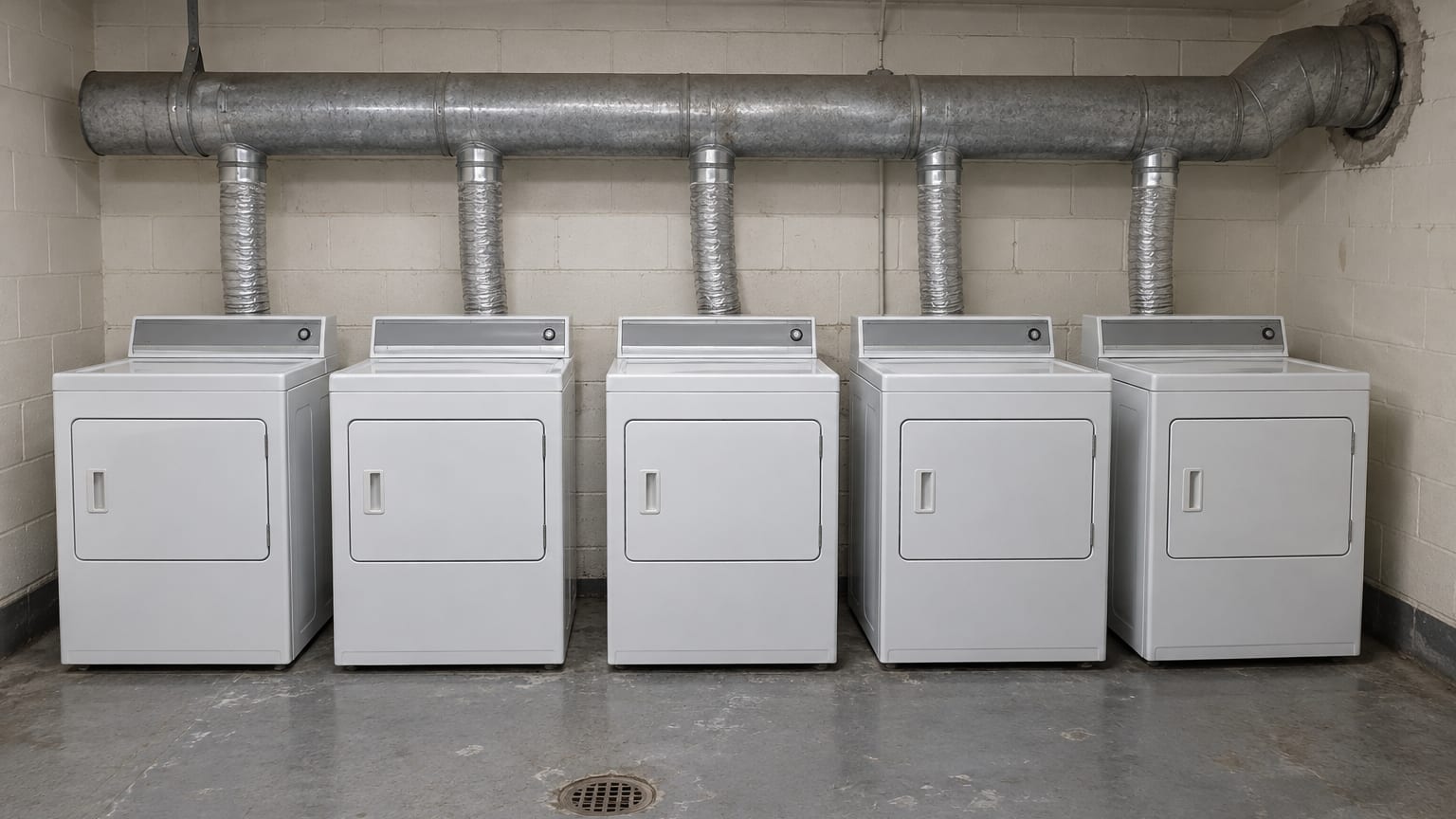
Start with a simple list: which dryers are slow, which ones smell hot and which ones are fine. Then find out which of them share a duct. In a small apartment building or a rowhouse converted to units, several machines may feed one vertical run that climbs to the roof. In a laundromat or senior housing, a common manifold, which is a shared collection duct, may join many machines into one line. When several dryers slow down together, the restriction is often somewhere they all share.
That is why cleaning only the short connection behind one machine can leave the real problem behind. A shared manifold, a common vertical run, a clogged roof termination (the cap where the exhaust leaves the building) or a restriction downstream can hold back every dryer that feeds it. A full route inspection should separate a vent restriction from an appliance, electrical, gas, control or make-up air fault. Make-up air is the outside air a room needs to draw in to replace what the dryers push out. If the room is starved for air, dryers can run slowly even with a clean duct.
Hover or tap a row to highlight it.
| What you see | Where to look | Who handles it |
|---|---|---|
| Several dryers slow at once | A shared manifold, common vertical run, roof termination or downstream restriction | A full route cleaning, not one short connection |
| A clean duct and a slow dryer | A worn heating element, a failing blower, a control problem or too little make-up air | The appliance, mechanical or electrical professional |
| Damaged or unsuitable ductwork | The repairs the service report identifies | The mechanical, building or fire-safety professional |
Write these down before you call anyone:
- Which machines are affected: The symptoms, and how long they have lasted.
- Which machines share a line: Whether each dryer has its own duct or several join one run.
- The last known cleaning date: Or the fact that no one knows it.
- Where the exhaust ends: A wall termination, a roof cap or a discharge into a chase or mechanical space.
- Who controls access: The people who hold keys to locked rooms, the roof and the exterior discharge points.
Shared laundry in Trenton shows up in small multifamily buildings, rowhouse conversions, apartment buildings, senior or supportive housing and laundromats, and each has its own routes. Every building is different, so the provider needs to inspect the actual duct route, access points, terminations and any shared manifold before pricing or scheduling anything.
A Burning Smell or Smoke Means Stop the Dryer First
If a machine is producing smoke, a burning odor, abnormal heat or visible lint at the discharge, stop using it. If there is an active fire or smoke emergency, call 911 and follow the building's emergency procedures. Then tell the owner, property manager, facilities lead or board representative, and keep the affected equipment and any alarm, maintenance or incident records as they are.
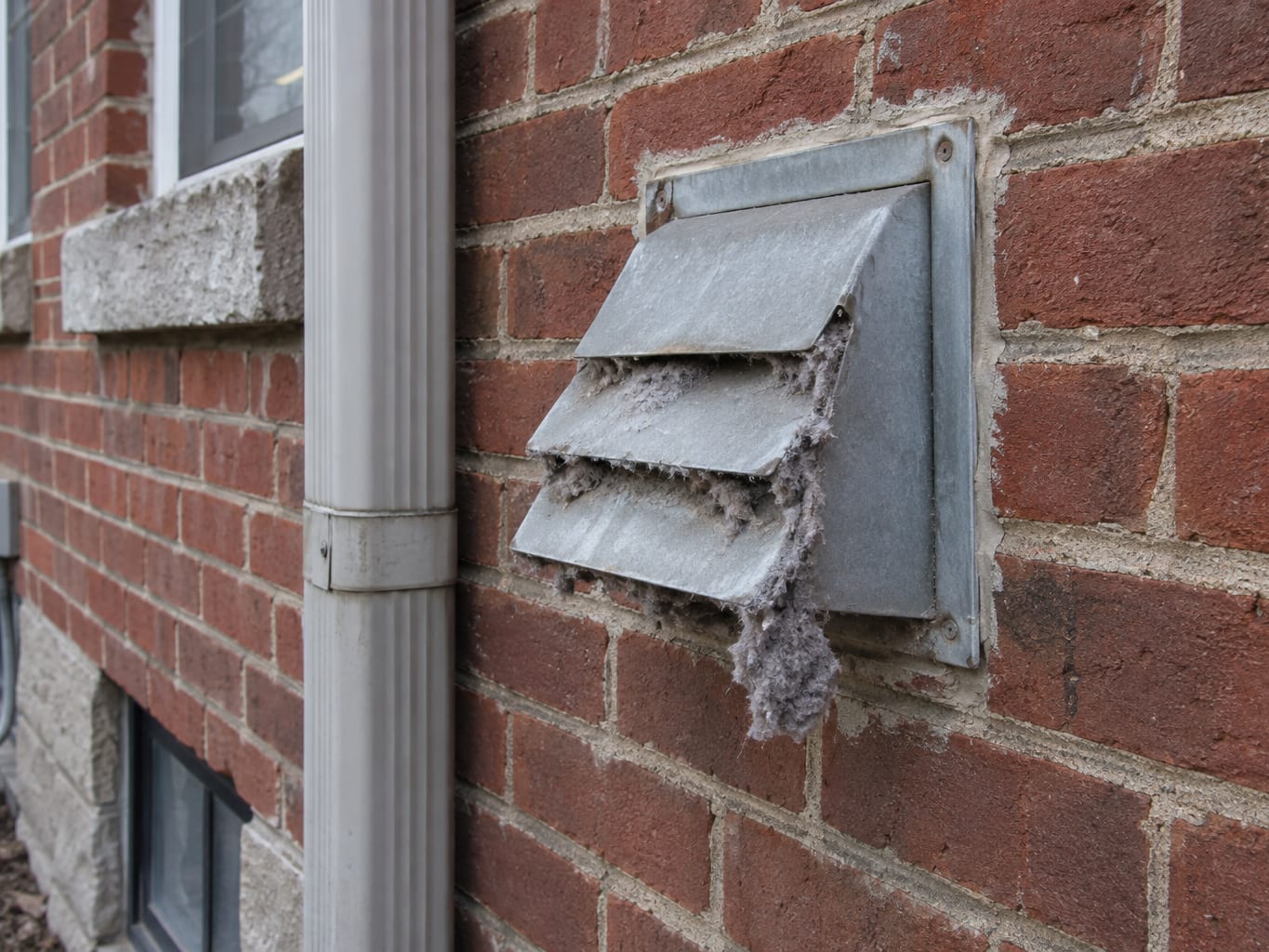
Lint is the reason to act early. NFPA's national home-fire research for 2014 to 2018 reports that 32 percent of dryer fires involved a failure to clean and that 27 percent began with dust, fiber or lint. Those are national figures about home fires and do not describe any particular Trenton building, but they explain why restricted exhaust is treated as a fire-safety matter and not only a slow-laundry annoyance.
When to Stop the Dryer
Smoke
Stop using the machine.
A burning odor
Stop using the machine.
Abnormal heat
Stop using the machine.
Visible lint at the discharge
Stop using the machine.
An active fire or smoke emergency
Call 911 and follow the building's emergency procedures.
Then tell the right people
Tell the owner, property manager, facilities lead or board representative, and keep the equipment and any alarm, maintenance or incident records as they are.
A Good Visit Follows the Whole Route, Not One Connection
A commercial visit is a walk along the whole exhaust path. In practice, a provider will typically do the following:
- Walk the building: Note the dryer count, the operating schedule, access, duct routing, whether lines are shared or separate and where each one ends.
- Inspect the route: Look at connections, elbows, vertical runs, manifolds, dampers and terminations.
- Remove lint mechanically: Clean the accessible run with brushes and vacuum equipment.
- Clean the termination: Confirm exhaust can discharge freely outdoors.
- Verify airflow: Test after cleaning to confirm the run is moving air.
- Write it up: Provide a report that lists areas cleaned, conditions observed, photographs or readings, and repair or maintenance recommendations.
Each step matters to a building manager. Without the walk-through, nobody knows which dryers share a line. Without the airflow check, you have no proof the run is clear. Without the written report, you have nothing to hand an inspector or an insurer.
A Full-Route Visit
- 1
Walk the building
Note the dryer count, the operating schedule, access, duct routing, whether lines are shared or separate and where each one ends.
- 2
Inspect the route
Look at connections, elbows, vertical runs, manifolds, dampers and terminations.
- 3
Remove lint mechanically
Clean the accessible run with brushes and vacuum equipment.
- 4
Clean the termination
Confirm exhaust can discharge freely outdoors.
- 5
Verify airflow
Test after cleaning to confirm the run is moving air.
- 6
Write it up
A report listing areas cleaned, conditions observed, photographs or readings, and repair or maintenance recommendations.
One limit is worth stating up front. A clean vent does not repair a defective dryer, a damaged duct, poor make-up air or incorrect installation, and it does not fix a fire-protection deficiency. Those need the appliance, mechanical, electrical, building or fire-safety professional who covers them. Complete the repairs the report identifies rather than treating cleaning as a substitute for damaged or unsuitable ductwork.
ExecPro Restoration & Cleaning offers commercial dryer vent cleaning for apartments and complexes, and for a single home our dryer duct cleaning covers the same idea on a smaller scale.
Phased Work Keeps the Laundry Room Open
Residents notice when every dryer goes down at once. Before you accept a schedule, ask whether the provider can work in phases, cleaning some machines and runs while others stay in service. Ask whether nights or weekends are an option, and what that changes on the quote.
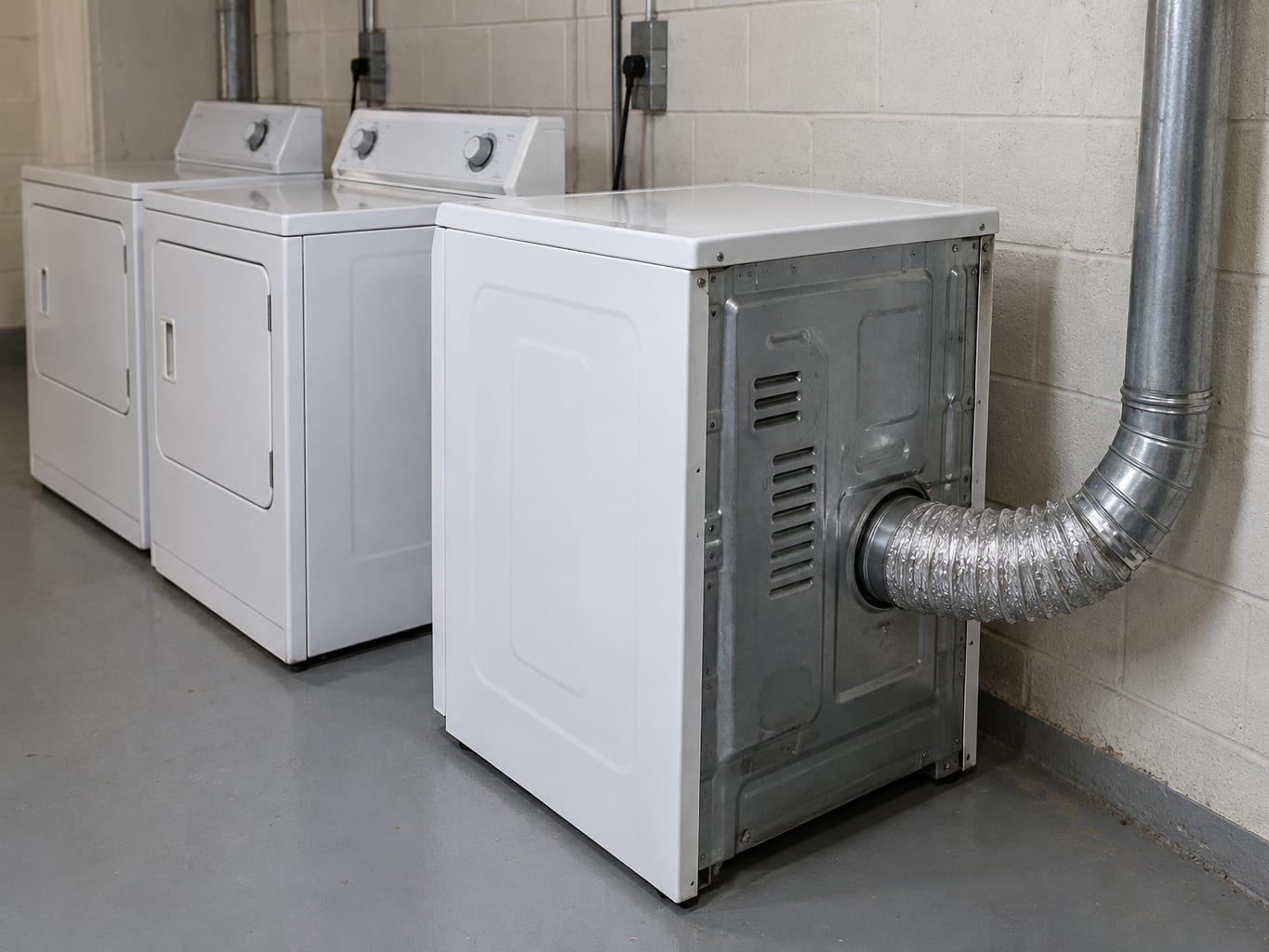
Confirm access early, because a locked door can cost a whole visit. The provider will need to reach every dryer, the full accessible duct route, shared sections, mechanical chases, the roof and every exterior discharge point. Tell the occupants and any tenants who use the room what day the work will happen and which machines will be out. In a building with a board or an association, confirm who signs off on roof access and who holds the keys. For a laundromat or other public-facing room, agree on signs at the door so customers know which machines are out of service and when they will return.
New Jersey's Fire Code Puts Dryer Exhaust Maintenance on the Owner
The state fire code sets the standard the building is held to. New Jersey's fire-code amendments say clothes dryer exhaust duct systems must be installed in accordance with the International Mechanical Code or the International Fuel Gas Code and with the manufacturer's installation instructions. They also require the lint trap, the mechanical and heating components and the exhaust duct to be maintained according to the manufacturer's operating instructions, so lint or debris does not block the exhaust of air and products of combustion.
For the building code itself, the Department of Community Affairs lists the Mechanical Subcode as the 2024 New Jersey edition of the International Mechanical Code, as listed on August 17, 2026. The practical meaning for an owner is short. The ducts must be built right, and they must be kept clear. A service report that shows a route was cleaned and checked is the record that shows you did the second part.
Trenton's Technical Services Division enforces the New Jersey Uniform Construction Code and Uniform Fire Code. The state's Fire Safety Service Portal holds property inspection reports and certificates for properties on file, so your dryer service records belong in the same file as those documents.
Cleaning Is Different From Altering the Duct
A cleaning-only visit is not the same as replacing ducts, rerouting them, adding a new penetration, installing equipment or changing the exterior termination. Alteration work goes through plan review, and you should raise it with Trenton Technical Services before approving any of it. Ask the division whether your planned scope needs a permit before the contractor begins, since a cleaning-only classification depends on the work actually performed.
If an alteration changes the outside of a designated historic property, such as a new termination on a street-facing wall, check with the Landmarks Commission as well, since that office reviews exterior improvements to designated properties. Older and converted buildings can have ducts that run through masonry walls, concealed chases, older framing or tight mechanical spaces, which is another reason to have the route inspected before anyone quotes a rebuild.
Hover or tap a row to highlight it.
| The work | Who to check with |
|---|---|
| A cleaning-only visit | Ask Trenton Technical Services whether your scope needs a permit; the classification depends on the work actually performed |
| Replacing ducts, rerouting, adding a new penetration, installing equipment or changing the exterior termination | Plan review through Trenton Technical Services, before you approve the work |
| A new termination on a street-facing wall of a designated historic property | The Landmarks Commission as well, since it reviews exterior improvements to designated properties |
Cost Follows the Route, Not Only the Machine Count
Nobody can responsibly quote a building they have not walked. These factors set the scope:
- Dryers and runs: The number of machines, and whether they have separate ducts or a shared manifold.
- Length and bends: Long runs and many elbows hold more lint and take more time.
- Difficult routes: Vertical runs, concealed chases and roof routes.
- Lint load: How restricted the run already is.
- Access panels: Installing or removing panels where none exist.
- Scheduling: Phased work, nights, weekends or restricted operating hours.
- Repairs: Rerouting, replacing damaged sections or correcting unsuitable materials.
- Access equipment: Lifts, fall protection or other roof and height requirements.
- Reporting: Photographs, airflow readings and per-unit documentation.
- One time or recurring: A single cleaning versus a maintenance program.
Ask for a site-specific written scope that separates cleaning, testing, repairs, access equipment, permits and recurring service. That lets you compare providers on the same terms. If one quote is far lower than another, check whether it covers the whole route to the termination or only the connections behind the machines, and whether a written report is included.
Records to Keep for the Inspector, the Insurer and the Owners
The paperwork is what turns a cleaning into proof. Keep these together in the building's maintenance and fire-safety files:
- The written scope and invoice: What was agreed and what was billed.
- The date and the areas cleaned: Which duct sections and which dryers.
- Dryer and route identification: A label or diagram that ties each machine to its run.
- Photographs: Before and after, when the provider supplies them.
- Airflow or performance readings: When they are supplied.
- Deficiencies and repair recommendations: With the date each was fixed.
- Permits and final inspections: When alteration work was done.
- Insurance certificates and credentials: The provider's, as delivered to you.
- Access and notice records: Tenant notices and who granted access.
Review the report with the owner, manager, board or insurer, and confirm with your insurer what documentation it wants. No one can promise how a record will affect a premium or a claim, so ask directly.
The Maintenance Interval Depends on Use, Lint and Route
There is no single interval that fits every building. A commercial dryer manufacturer's installation manual says a program for periodic inspection, cleaning and lint removal should be set up, with the frequency determined by experience at each location. In practice, that means using your own building's history: how heavily the machines are used, how much lint the last cleaning removed, how the airflow read and how complicated the route is.
After each service, set the next date in writing, and move it closer if the report shows heavy lint or a difficult route. Follow the manufacturer's guidance for the machines you have, and keep the report with the rest of the building's records.
Frequently Asked Questions About Commercial Dryer Vent Cleaning Trenton NJ
The dryers take longer than they used to. Is the vent the problem?
It may be. Restricted exhaust reduces airflow and leaves heat, moisture and lint in the system. A route inspection should separate a vent restriction from appliance, electrical, gas, control or make-up air problems.
Why are several dryers affected at once?
A shared manifold, common vertical run, roof termination or downstream restriction can affect every machine on it. Cleaning only the short connection behind one dryer can leave the main restriction in place.
Will a clean vent fix a dryer that is still slow?
Only if the vent was the cause. A worn heating element, a failing blower, a control problem or too little make-up air can slow a dryer with a spotless duct, so ask the provider to note what the airflow reading shows after cleaning and refer the rest to the right trade.
What should I do in the first day?
Arrange an inspection of every dryer, the full accessible route and the terminations. Ask whether the work can be phased, confirm access to locked rooms and roofs, and ask for a written scope and the records you will receive at completion.
Dryer Vent Quick Check
1. Several dryers slow down at the same time. Where is the restriction often found?
2. What should you do with a dryer that produces smoke or a burning odor?
3. What is make-up air?
4. Who does New Jersey's fire code put dryer exhaust maintenance on?
5. What sets the next cleaning date?
Pick an answer to begin.
Moving Forward
Slow or hot-smelling dryers in a shared building are best sorted out by tracing the route: which machines are affected, which run they share and where the exhaust ends. A full-route visit, phased so residents keep laundry service, followed by a written report gives you a clean vent and the paperwork to prove it.
Handled this way, the building gets shorter dry times, fewer complaints and a maintenance record that answers the fire inspector, the insurer and the owners. It also lets you set the next service date instead of waiting for the next complaint.
If you manage or own an apartment building or converted rowhouse in Trenton, NJ, ExecPro Restoration & Cleaning can look at the dryer exhaust route and tell you what a full visit should cover. We also handle water damage restoration and mold remediation when a laundry room has a moisture problem of its own. Call us at (888) 300-3772 or contact us to schedule a walkthrough.
Dryer Vent Terms
Tap a term to see what it means.
Manifold. A shared collection duct that joins many machines into one line.
Serving Trenton
ExecPro Restoration & Cleaning provides mold remediation services in Trenton, NJ, from inspection and testing through removal, drying, and post-remediation verification. Call (888) 300-3772 for 24/7 emergency response.
Related Articles
Commercial Dryer Vent Cleaning in Robbinsville, NJ: Shared Laundry Rooms in Hotels, Assisted-Living and Mixed-Use Buildings
Across a hotel, an assisted-living residence or a mixed-use building, commercial dryer vent cleaning in Robbinsville starts with a hot room and slow dryers.
Commercial Dryer Vent Cleaning in Bridgewater, NJ: Records for the Fire Inspector and the Board
For property managers and condo boards, commercial dryer vent cleaning in Bridgewater means finding the shared cause and keeping fire inspector records.
Mold Remediation in Trenton, NJ: Planning the Whole Job Around the People Living There
When tenants or family are still living in the house, mold remediation in Trenton, NJ has to be planned around them. See the steps, the scope and the records.