
The Closed-House Basement: Finding Hidden Mold in a Reopened Deal, NJ Home
Cal HewittPublished
- basement mold remediation
- basement mold
- mold remediation
- coastal
- new jersey
- deal
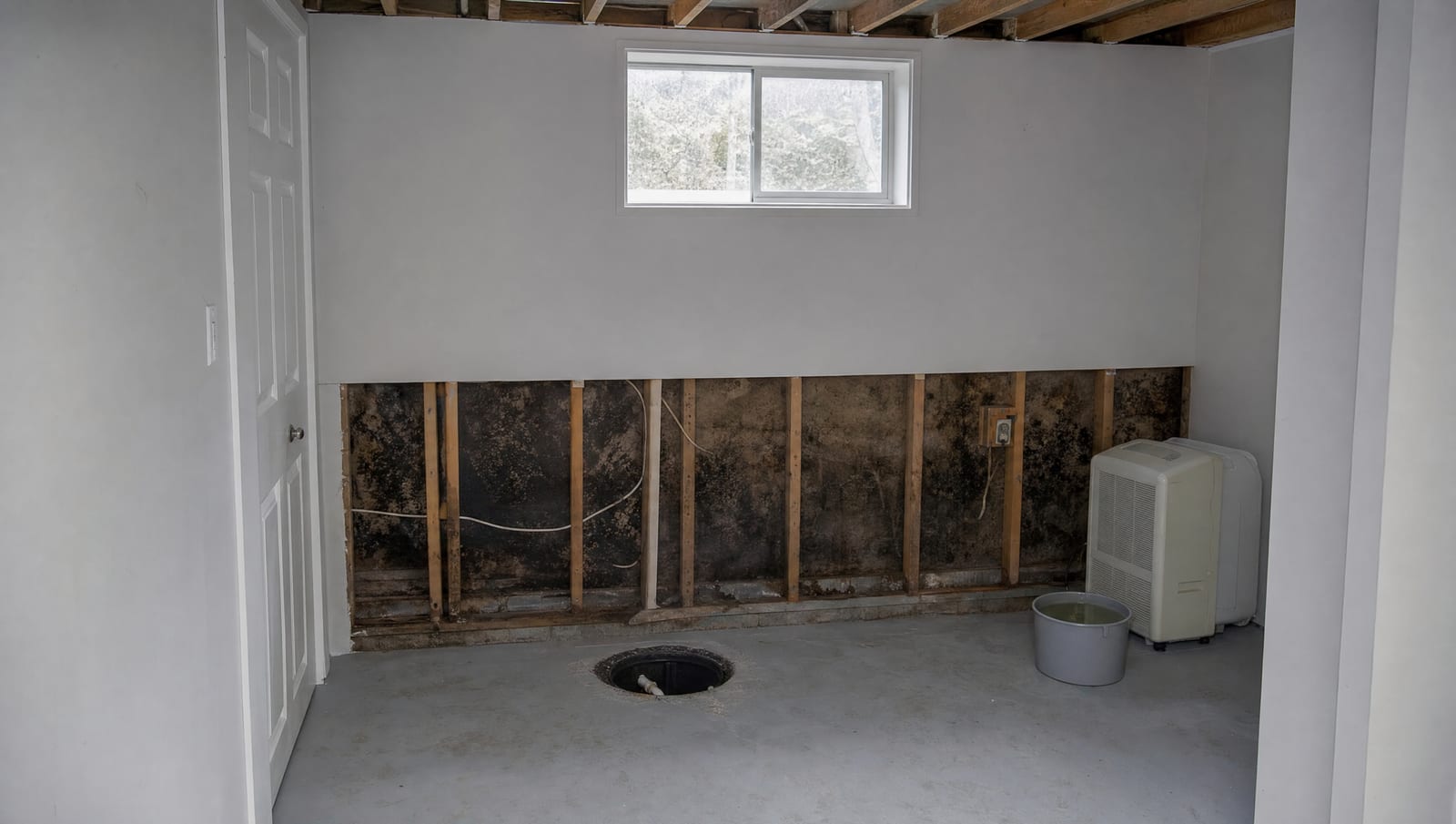
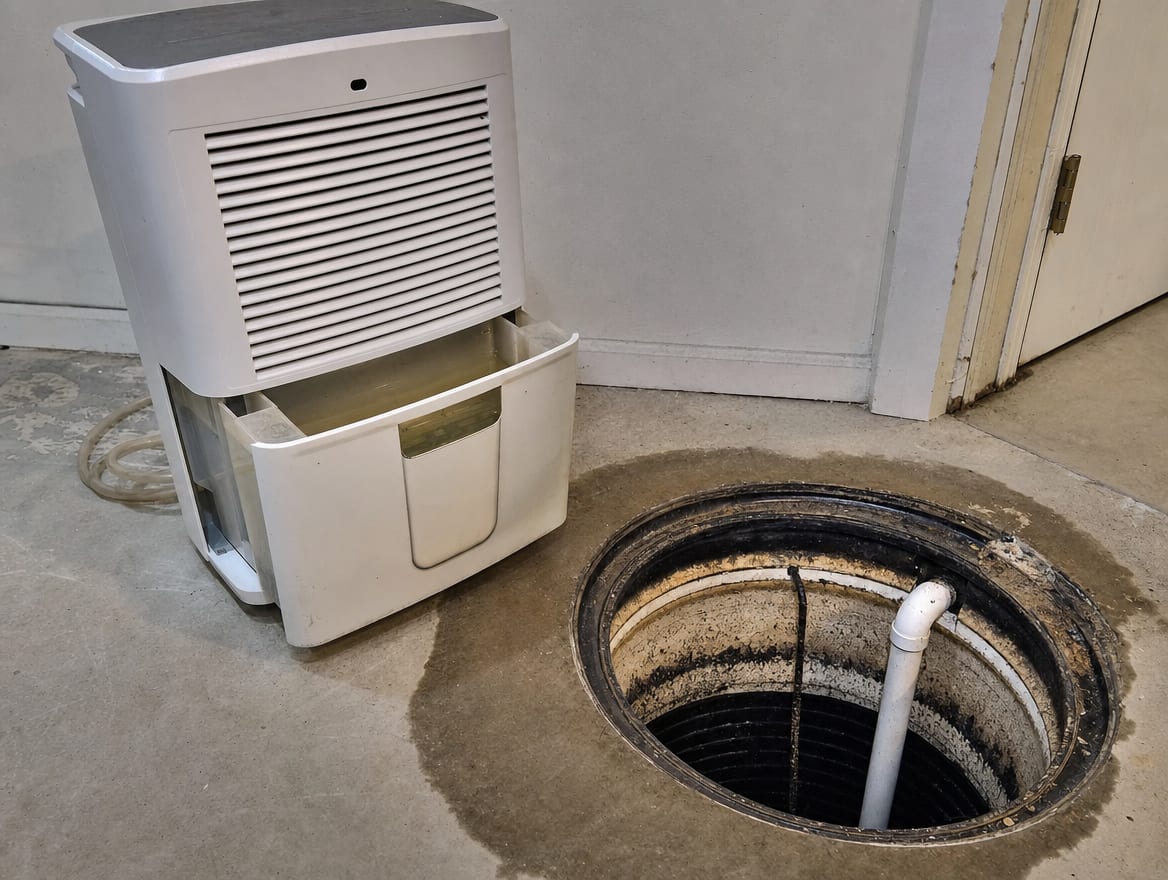
The family had closed the house in the fall and come back after months away. When they reopened the Deal shore home, the lower level looked fine at a glance. There was no standing water on the floor, no puddle near the utility room, nothing you would trip over in the dark. But the air in the finished basement carried a faint musty note, and two small clues told a different story. The dehumidifier in the corner had stopped running at some point over the winter, its tank full and its display dark. The sump pump control had logged an event, a high-water alarm that had come and gone with no one there to hear it. When a technician opened a section of finished wall, the framing and insulation behind it were damp, and mold had taken hold in the cavity where no one could see it.
This is the trap of the closed house. A basement floor that looks dry is not the same as a basement that is dry. In a home that sits empty for a season, the water event that started the problem may be long over by the time anyone returns, while the materials it soaked stay damp behind the finishes. The floor tells you almost nothing. What matters is the source history and where the moisture actually went. This post is about that specific situation: the finished basement in a seasonal Deal home, the four different ways it can get wet, and why moisture mapping and monitoring matter far more than the absence of water on the floor.
Why an Empty House Changes the Whole Picture
When a home is lived in, small problems get caught early. Someone notices the dehumidifier tank is full and empties it. Someone hears the sump alarm and checks the pit. Someone smells that the air downstairs has turned musty and goes looking. A person in the house is a monitoring system, and in a seasonal Deal home that system is switched off for months at a time.
Deal has a large share of housing that is used seasonally or occupied only part of the year, and its estates and large homes often have extensively finished lower levels. That combination is exactly where a quiet moisture problem can grow. A dehumidifier can fail and stop pulling water out of the air. A sump pump can lose power during a winter storm and let the pit rise. A small plumbing drip can keep going. HVAC settings turned down to save fuel can let indoor humidity climb. None of these is dramatic on its own. What makes them serious is time. A leak that a homeowner would have caught in a day can run for weeks or months in a closed house, and damp building materials that stay damp long enough will support mold. By the time the owner returns, the water may be gone, but the growth it started is still there behind the wall.
Four Ways a Closed Basement Gets Wet
The single most useful question in a reopened basement is not "is there water on the floor" but "what put moisture into this space, and when." There are four different answers, and they call for different work. Confusing one for another is how a basement gets a cosmetic cleanup that does not hold. Flood exposure in Deal also varies parcel by parcel, so the specific address should be checked against FEMA and New Jersey flood tools rather than assumed from the neighborhood.
Hover or tap a row to highlight it.
| Moisture state | How it shows up when you return | What it means for the scope |
|---|---|---|
| A current active water event | Standing water, an actively running or failed sump, or materials that are wet right now | Stop and remove the water first; extraction and drying come before any remediation |
| A past event that dried on the surface only | A dry-looking floor, but damp drywall, insulation, subfloor, or framing behind the finishes | Moisture mapping to find the hidden wet assemblies the surface hides |
| Chronic humidity without visible flooding | Musty odor, condensation, a damp feel, no flood at all | Correct the humidity source, such as a failed dehumidifier or reduced HVAC, and dry the space |
| Coastal storm or flood-related intrusion | Signs water entered from outside during a storm while the home was closed | Assess the water category, check flood requirements, and plan removal accordingly |
The first state is an emergency you can see. The other three are the ones that fool people, because the visible floor looks fine while the problem sits inside the walls, in the air, or in materials that were wet weeks ago. A closed home tends to produce the second and third states more than the first, precisely because the event has had time to end before anyone arrives.
What a Caretaker Should Check After a Storm
The best defense against a hidden basement loss is someone physically checking the lower level after weather events, not waiting for the reopening. A caretaker, property manager, or trusted neighbor doing a short, structured walk-through after a storm can catch a problem while it is still small. The point is to look past the floor and read the signs that moisture leaves behind.
Post-Storm Caretaker Basement Check
Sump pump and alarm log
Confirm the pump has power and runs, check the pit level, and look at any alarm history for a high-water event that happened while no one was there.
Dehumidifier running
Make sure the unit is powered, draining, and actually pulling moisture, not sitting with a full tank and a dark display.
Leak sensors
Check any water sensors near the sump, water heater, mechanical room, and low points, and confirm they still have battery and signal.
Humidity reading
Note the relative humidity on a basement gauge; a high reading points to a moisture problem even with a dry floor.
HVAC settings
Verify the system is holding the intended temperature and any dehumidification is working, since settings turned too far down let humidity climb.
Visible and odor signs
Walk the finished areas for musty smells, staining, warped trim or baseboard, and any soft or damp spots on walls that hint at moisture behind them.
None of this replaces a professional assessment, but it shortens the two windows that make a closed-home loss so damaging: the time water sits before it is found, and the time damp materials stay damp before anyone dries them.
Why Finished Basements Hide the Damage
A finished lower level is built to look like living space, and that is exactly what makes it good at hiding moisture. Drywall, insulation, paneling, built-ins, flooring, and trim all sit between you and the framing and slab behind them. Water can travel into that cavity, saturate insulation, and wet the back of the drywall while the painted face you see stays dry to the touch. A finished basement can read as perfectly normal from the middle of the room while an assembly a few inches away holds enough moisture to support mold.
This is why the absence of water on the floor proves so little in a Deal home with custom finishes. The materials that got wet are usually the ones you cannot see, and the more finished and high-value the space, the more layers stand between the surface and the source. A quick visual check will pass a basement that has a real problem behind its walls. Reading that problem takes tools, not just eyes, which is where moisture mapping comes in. When the source or extent is uncertain, a professional mold inspection in a finished lower level is the step that looks behind the surface rather than guessing from it.
How Moisture Mapping Guides Selective Demolition
Moisture mapping is the process of measuring where moisture actually is, so that removal is targeted instead of guessed. Rather than opening every wall or opening none, a technician uses moisture meters and thermal imaging to find the wet assemblies, trace how far the moisture spread, and mark the boundary between what is damp and what is dry. That map is what turns a vague worry into a defined scope.
Selective demolition follows the map. Materials that are wet and contaminated and cannot be dried in place, such as saturated drywall, wet insulation, and soaked carpet pad, come out along the mapped boundary. Materials that are sound and dry stay. This matters in a finished Deal basement for two reasons. It protects custom finishes that do not need to be removed, and it makes sure hidden wet materials are not sealed back up behind a fresh wall. A cleanup that only treats the visible surface, or that relies on one dehumidifier to lower room air while wet assemblies sit untouched, leaves the moisture in place and invites the growth back. The map is what keeps the work honest.
What a Complete Basement Scope Includes
A complete basement remediation is a sequence, and each step depends on the one before it. The order is what separates a repair that holds from a cosmetic fix that fails in the same season.
Basement Mold: Inspection to Verified Dry
- 1
Put immediate controls in place
If there is active or standing water, stop the source and remove the water first, since remediation cannot proceed over materials that are still wet.
- 2
Map the moisture and find the source
Use moisture meters and thermal imaging to locate wet assemblies behind finishes, trace how far the moisture reached, and identify what put it there.
- 3
Define the scope
Set the affected rooms and materials, the containment boundary, the demolition limits, the cleaning methods, the drying targets, the source repairs, and the criteria for calling it done.
- 4
Contain, remove, and clean
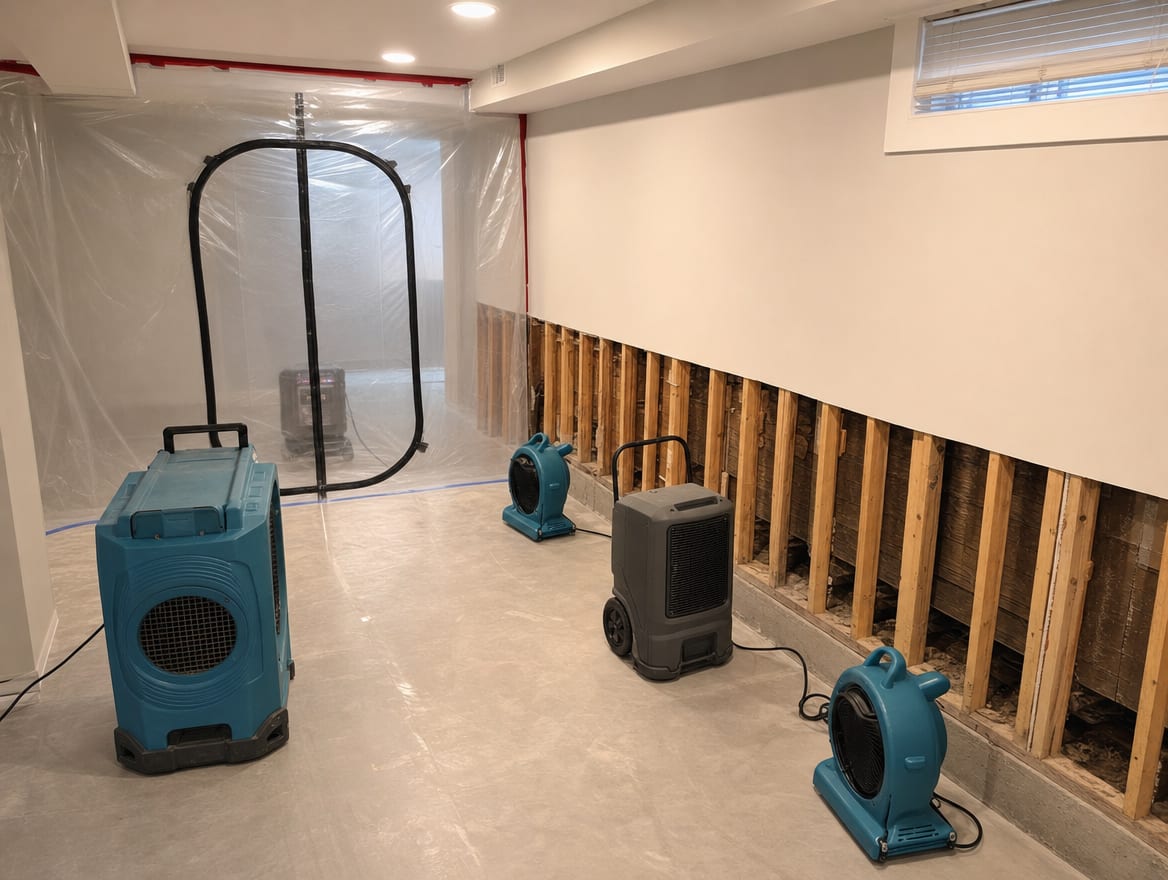
Seal the work area, remove unsalvageable porous materials along the mapped boundary, HEPA vacuum, and clean salvageable framing, masonry, and hard surfaces.
- 5
Dry the structure to a standard
Run air movers and dehumidifiers and dry the framing, subfloor, and wall cavities at depth, logging moisture readings until materials reach a dry standard, not just a dry feel.
- 6
Correct the source and bring in trades
Fix or formally assign the drainage, sump, plumbing, waterproofing, or HVAC issue that caused the moisture, so it does not return.
- 7
Verify, then rebuild
Confirm the space is clean and dry, with source repairs complete, before restoring drywall, flooring, trim, and finishes, so nothing damp gets sealed behind new work.
The two steps that carry the most weight are drying and verification. Drying has to be proven with readings because the moisture that matters is often inside walls and under floors, where touch tells you nothing. And verification is what confirms the basement is genuinely ready for rebuild. When a defined question needs an independent answer, post-remediation verification provides a documented check before finishes go back up.
When Other Trades Have to Get Involved
Remediation removes the contamination and dries the structure, but it does not always fix the reason the water arrived. That is a separate job, and in a closed Deal home it is often the difference between a one-time repair and a recurring one. Depending on what the inspection finds, the source correction may belong to another trade.
A failing sump pump or a pit that overwhelmed during a storm points to a pump, backup power, or drainage fix. Water entering at the foundation may call for waterproofing or exterior drainage work. A plumbing drip or appliance leak needs a plumber. Chronic humidity with no flood usually traces back to HVAC or dehumidification that could not keep up while the home was closed and set low. Some of this work, along with structural repair and interior reconstruction, may require Borough of Deal permits and inspections; requirements depend on the specific scope and property, so they are confirmed with the Building Department rather than assumed. The remediation team's job is to name the source clearly and coordinate the right trade, so the corrected basement stays corrected.
Monitoring the Basement Before You Close It Again
Because a closed house removes the person who would normally catch a problem, the fix is to leave monitoring in place before the home goes quiet. None of these tools removes every risk, and no sensor replaces a real plan built for the specific property with qualified plumbing, HVAC, and waterproofing professionals. What they do is shorten the time a problem can run undiscovered.
Keep the sump pump serviced and consider a battery or water-powered backup so a storm outage does not leave the pit unprotected, and use a sump alarm that logs and reports high-water events. Place leak sensors near the sump, water heater, mechanical room, and low points, and confirm their batteries before closing up. Run a dehumidifier that drains continuously rather than to a tank that can fill and stop, and pair it with a humidity monitor that a caretaker can read remotely. Set the HVAC to hold conditions that keep humidity in check rather than turning it off entirely. And arrange for a person to physically check the lower level after major storms. For the wider picture of how a coastal water loss is stabilized and rebuilt in stages, our guide to water damage restoration in Deal walks through both phases, and the Deal mold remediation service area page covers how we work in the borough.
Frequently Asked Questions
If there is no water on the floor, does that mean my basement is dry?
No. A dry-looking floor only tells you there is no standing water at that moment. In a closed home, the water event that caused the damage may be over by the time you return, while the drywall, insulation, subfloor, and framing behind the finishes stay damp. Moisture behind a finished wall does not show on the surface, which is why the floor is one of the least reliable signs. Measuring moisture in the assemblies is what actually answers the question.
How should I monitor a seasonal basement before I close the home?
The goal is to replace the person who would normally notice a problem. That usually means a serviced sump pump with backup power and an alarm that logs events, leak sensors at the sump and other low points, a continuously draining dehumidifier paired with a humidity monitor, and HVAC settings that keep humidity in check rather than off entirely. Just as important, arrange for someone to physically check the lower level after major storms. The right combination depends on the property and should be set with qualified professionals.
Is testing needed before materials are removed?
Not always. Testing is worth doing when it answers a defined question, such as confirming a source, mapping hidden contamination, or verifying that a completed job reached its goal. It is not an automatic first step. In many basements, a visual and moisture assessment defines the scope, and sampling is added only where it changes a decision. A clear plan drives the work; a test result on its own does not.
Will insurance cover basement mold in a closed home?
That depends entirely on the policy, the cause of loss, and the exclusions, and a contractor cannot guarantee coverage. Sudden events are often treated differently from long-term seepage, groundwater, repeated flooding, or deferred maintenance, and some policies limit mold specifically. What helps is documentation: the dates of any leak or storm, sump and alarm logs, photographs, moisture readings, drying records, and the remediation scope. Preserving that record gives a claim its best chance, whatever the outcome.
How fast does mold start after a wet event?
Guidance from the EPA is to dry water-damaged materials within about 24 to 48 hours where possible, because materials that stay damp can begin to support mold. That is a target to work toward, not a promise. It is also exactly why a closed home is at higher risk: a leak that runs unnoticed for weeks leaves materials wet far past that window, so growth may already be established by the time the house is reopened.
Does every finish in the basement have to come out?
No. Removal depends on the moisture, the contamination, the material, and whether an assembly can be reached and dried. Moisture mapping is what makes this selective: wet, contaminated materials that cannot be dried in place come out along the mapped boundary, while sound, dry materials stay. The aim is to remove what has to go and protect what does not, not to tear out everything on sight or save everything by default.
When a reopened Deal basement smells musty or an alarm logged an event no one heard, the answer is to read the source and map the moisture before anything gets sealed back up. ExecPro Restoration & Cleaning handles closed-home basement losses on the Jersey Shore from moisture mapping and containment through selective removal, structural drying to a documented standard, source coordination, and verification before rebuild. Call (888) 300-3772 or reach out through our contact page to get an assessment scheduled and move from a hidden problem to a dry, documented basement.
Basement Mold Terms
Tap a term to see what it means.
Sump pump. A pump set in a pit at the low point of a basement that removes water before it rises into the space, often paired with an alarm and, ideally, backup power.
Serving Deal
ExecPro Restoration & Cleaning provides mold remediation services in Deal, NJ, from inspection and testing through removal, drying, and post-remediation verification. Call (888) 300-3772 for 24/7 emergency response.
Related Articles
Reopening a Deal NJ Shore Home: When Air Quality Testing Answers a Real Question
Reopening a closed Deal NJ shore home? Learn when air quality testing helps after vacancy, humidity, a storm, or renovation, and what a test cannot tell you.
Property Management Mold Services in Deal NJ: A Seasonal-Home Protocol
A repeatable mold protocol for managers of seasonal Deal NJ homes: pre-arrival inspections, remote humidity monitoring, emergency access, and owner reporting.
Structural Mold Repair in Deal NJ: Clean, Reinforce, or Call an Engineer
Structural mold repair in Deal NJ starts with one decision: is framing cleanable, decayed, or a job for a licensed engineer. Here is how to tell.