Where the Roof Meets the Attic: Diagnosing Attic Mold in Princeton Junction, NJ Homes, Townhouses, and Condos
Cal HewittPublished
- attic mold remediation
- attic mold
- mold remediation
- hoa condo
- new jersey
- princeton junction
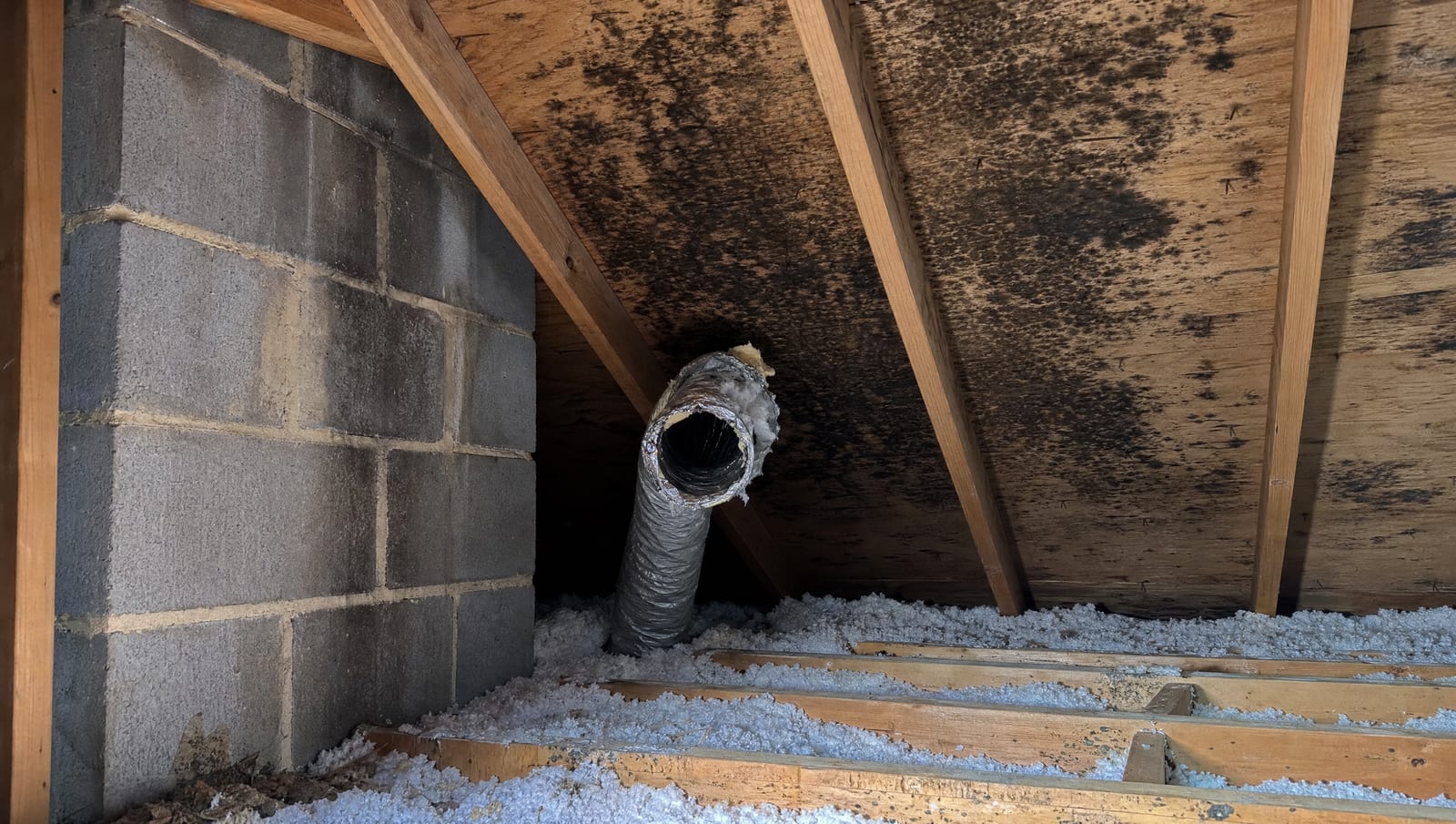
A homeowner in a Princeton Junction townhouse went up through the attic hatch to chase down a musty smell and found three problems at once. Dark growth ran across the roof sheathing near the ridge. A bathroom exhaust duct had come loose and was blowing warm, damp air straight into the insulation instead of outdoors. And the roof overhead, the one component most likely to be leaking, was maintained by the association, not by the unit. She could reach the exhaust duct. She could not touch the roof. And she could not tell, standing there with a flashlight, which of the three was actually feeding the mold.
That mix is what makes attic mold different from mold anywhere else in a home. The attic is the one space where the roof, the home's exhaust fans, and the warm air rising from the living space all meet on the same cold wooden surface. Any of them can wet the sheathing, and in a townhouse or condominium some of them sit on the other side of an ownership line the owner never drew. So the real work is not scrubbing a stain. It is figuring out where the water is coming from, and then figuring out who can even get to it. This guide walks through both, starting with the attic engineering and ending with the shared-roof access problem that trips up so many Princeton Junction owners.
Why the Attic Is Where Everything Collides
An attic is designed to stay cold and dry. Outside air moves in low at the eaves and out high at the ridge, carrying away any moisture before it settles. The trouble is that three separate systems all push moisture toward that same cold underside of the roof, and when the airflow cannot keep up, the sheathing stays wet long enough to grow mold.
The first system is the roof itself. A cracked shingle, failed flashing, or a worn valley lets rain in from above, and the water can travel along a rafter before it drips, so the stain rarely sits under the actual hole. The second is the home's own exhaust. Bathroom fans, and sometimes a dryer, are supposed to vent outdoors, but a duct that has come loose or was never run all the way out dumps humid indoor air directly into the attic. The third is plain air leakage. Every heating season, warm moist air slips up through attic hatches, recessed lights, and pipe chases, and when it hits cold sheathing it condenses, sometimes as frost. On top of all that, an attic in a larger home may hold HVAC equipment, and a sweating duct or an overflowing condensate pan adds a fourth wet spot. The reason a careful inspection matters is that more than one of these is often running at the same time.
Telling the Sources Apart
Because several sources can be active together, the diagnosis is really an exercise in reading the evidence rather than reacting to the growth. Each source leaves a slightly different signature on the wood and the insulation, and matching the pattern to the pathway is what points to the right fix and the right trade.
Hover or tap a row to highlight it.
| Moisture source | Telltale sign | Where it shows on the sheathing | Trade that corrects it |
|---|---|---|---|
| Roof or flashing leak | Water enters after rain or snow melt, often with a run mark | A localized dark patch below a penetration, valley, or nail line | Roofer, for shingles, flashing, or valleys |
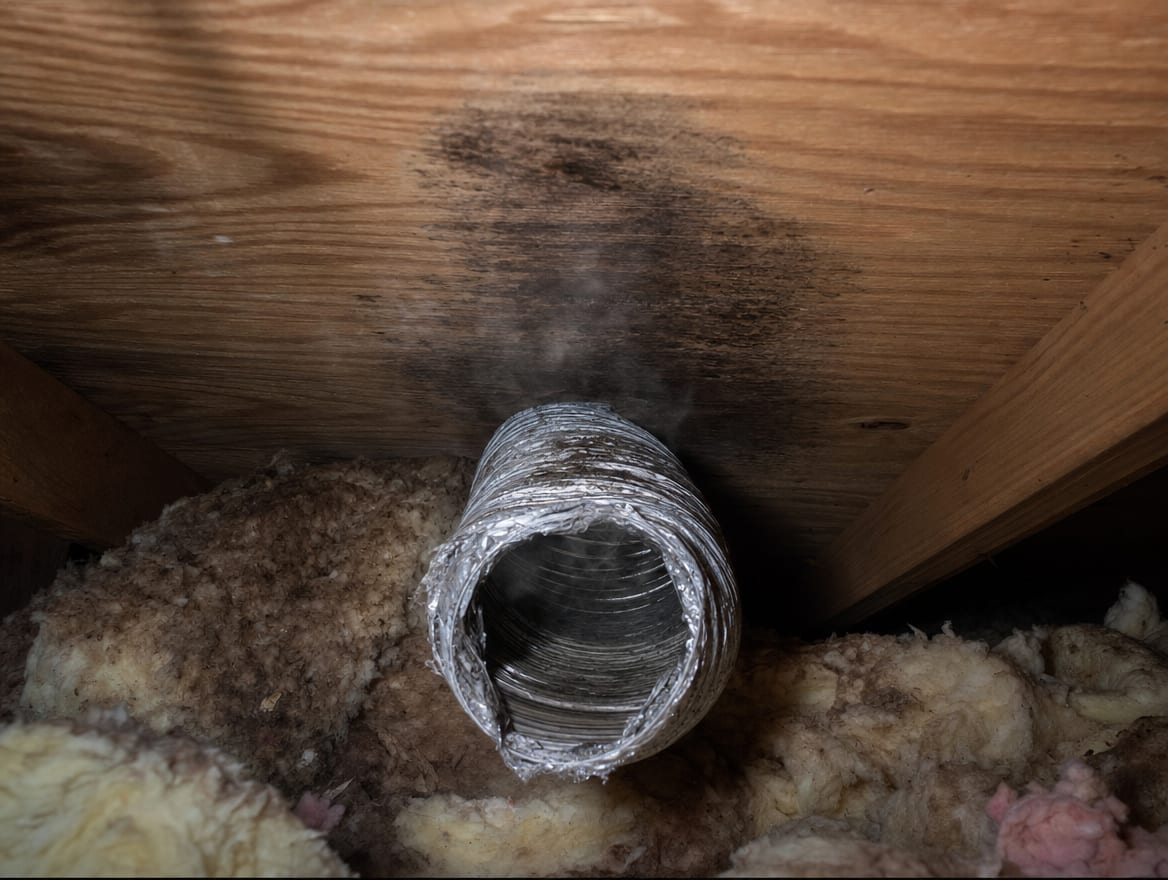
| Bathroom or dryer exhaust into the attic | Damp, matted insulation and a warm plume near a fan duct | Staining above and around the loose or short duct outlet | HVAC or ventilation trade, to route the duct outdoors |
| HVAC condensation | Water near an air handler, drips from ducts or a drain pan | Damp framing and lines close to the attic mechanical unit | HVAC contractor, for the pan, condensate line, or duct sealing |
| Warm ceiling air leakage | Frost or dark staining that spreads broadly, worse in winter | An even wash of staining high near the ridge and cold surfaces | Insulation and air-sealing trade, to close ceiling penetrations |
The signs overlap enough that guessing is risky. A single dark spot under a roof nail suggests a leak. A broad frost line near the ridge points to indoor air leaking upward. Wet insulation packed under a fan says the exhaust duct is the culprit. The point of sorting them out is not academic. Each pathway is fixed by a different trade, and adding roof vents to a problem that is really a disconnected bathroom fan just spends money without stopping the water.
Reading Attic Sheathing Stains
Localized stain under a penetration
A tight dark patch beneath a vent, skylight, chimney, or valley usually means water is entering the roof at that spot rather than condensing across the whole deck.
Frost or dark staining at the ridge
A broad wash of staining or winter frost high near the peak points to warm indoor air leaking up and condensing on the coldest wood.
Damp insulation under a bath fan
Matted, wet insulation directly below an exhaust outlet is a sign the fan is venting into the attic instead of outdoors.
Condensation on nails and HVAC lines
Beads or rust on nail tips and sweating on duct lines show humid attic air meeting cold metal, a condensation problem, not a roof hole.
Blocked soffit vents
Insulation pushed tight against the eaves cuts off intake air, so humidity builds and the deck cannot dry between wet spells.
Wet flashing lines
Staining that follows the metal around a chimney or wall step usually traces to failed flashing rather than the field of the roof.
How the Building Type Changes Access
Once the pathway is understood, the next question is a practical one that has nothing to do with mold science: who can actually reach the source to fix it. This is where the three kinds of Princeton Junction home diverge, and it is mostly a question of access, not blame.
In a large detached house, the whole roof and attic belong to the owner, but the attic may be broken into several disconnected sections with knee walls, dormers, and more than one HVAC zone. One section can have a roof leak while another has winter condensation, and a stain in a finished bonus room may trace back to a bay the owner has never crawled into. The access challenge here is internal. Every zone needs to be found and checked, because the visible problem may not be near the source.
A townhouse adds a shared roof and party walls. The sheathing you are looking at may sit under a roof plane the association maintains, and the wall at the edge of your attic may be shared with the neighbor. Water and even mold can cross that party-wall boundary inside the attic, so the source may be reachable only from a common area or an adjacent unit. The engineering question stays the same, but the repair path splits. The interior cleanup is the owner's to arrange, while a roof or common-ventilation fix runs through the association.
A condominium goes further, with common roofs, common attic spaces, and shared mechanical systems that serve more than one home. Here more of the possible sources are common elements from the start. Across all three, one rule holds: a remediator documents where the moisture is and where it came from, but does not decide who is legally responsible. That answer lives in the governing documents and the insurance policies, not in a moisture reading. Keeping those two things separate, the conditions on one hand and the responsibility on the other, is what keeps a shared-building project moving. You can read more about how attic mold remediation coordinates that interior work with an outside roof repair on the service page.
The Documents Worth Gathering First
Because access and coordination matter so much in attached housing, the paperwork does real work here, and pulling it together early keeps the project from stalling. Owners should gather their roof and maintenance history, any records of prior leaks or repairs, and, for a townhouse or condo, the governing documents that spell out who maintains the roof, the attic, exterior vents, and common systems. A quick sketch of how the bathroom and dryer exhaust are supposed to run helps too, since a disconnected duct is one of the most common and most fixable sources.
The rest of the file is the same evidence any moisture claim benefits from: dates of storms or leaks, photographs, moisture readings, inspection notes, the written remediation scope, and invoices. In a shared building, add your correspondence with the property manager or association. When the source turns out to be a common roof or vent, that record shows you reported it and asked for access in a timely way.
When Shared Access Becomes Necessary
Some attic sources simply cannot be reached from inside one unit. If the water is entering through a common roof plane, a shared ventilation path, or a party-wall boundary, the inspection or repair may need access to common areas or to a neighbor's attic, and that has to be arranged through the association rather than assumed. This is where early notice pays off, because moisture in a shared assembly keeps moving until the common component is reached and corrected. A professional documents that the source sits in a shared part of the building and shares those records so the association can coordinate the outside work. The remediator maps the conditions; the governing documents decide the access and the responsibility.
What a Complete Attic Scope Covers
A sound scope looks the same in a detached home and a shared building, with one addition in the townhouse or condo: it coordinates the parts of the work that cross into common property. Spray-only, fogging-only, or paint-over work is not a solution when wet materials and an active source remain, and in attached housing it also leaves the shared source untouched.
Attic Mold in a Shared Building: Access to Verified Fix
- 1
Inspect and identify the source
A professional inspects beyond the visible growth, takes moisture readings, and names whether the water is a roof leak, exhaust, condensation, or air leakage.
- 2
Confirm who controls the roof and attic, and arrange access
The assessment documents which components are the unit's and which are common, and access to shared areas is coordinated through the association.
- 3
Containment and HEPA air control
The attic access is isolated and HEPA-filtered air scrubbers run so spores do not spread into the living space during removal.
- 4
Remove and clean by material
Contaminated insulation is bagged and removed, and salvageable sheathing and framing are HEPA vacuumed and cleaned rather than painted over.
- 5
Correct the source through the right trade
The roofer, HVAC contractor, or air-sealing trade fixes the pathway, and for a common component the repair is formally assigned to the association's contractor.
- 6
Dry and verify
The attic is dried to a documented target confirmed by readings, and completion is checked against written criteria.
- 7
Document without adjudicating
The record states the conditions, the source, and the work performed, and stops short of deciding who is legally responsible.
Every step can involve a separate trade, and the shared-property step can involve a separate owner entirely. That is why comparing written scopes matters more than comparing bottom-line prices. A low quote that leaves out source correction, association coordination, drying, or insulation replacement is not cheaper. It is smaller, and the missing pieces come back as the next problem. No honest contractor states a fixed local price or duration without seeing the number of attic zones, the extent of the growth, and how long drying takes. When a project calls for it, independent post-remediation verification confirms the work met its stated criteria, which is often useful in a shared building where more than one party has a stake in the result.
Preventing a Return Without Starting a Dispute
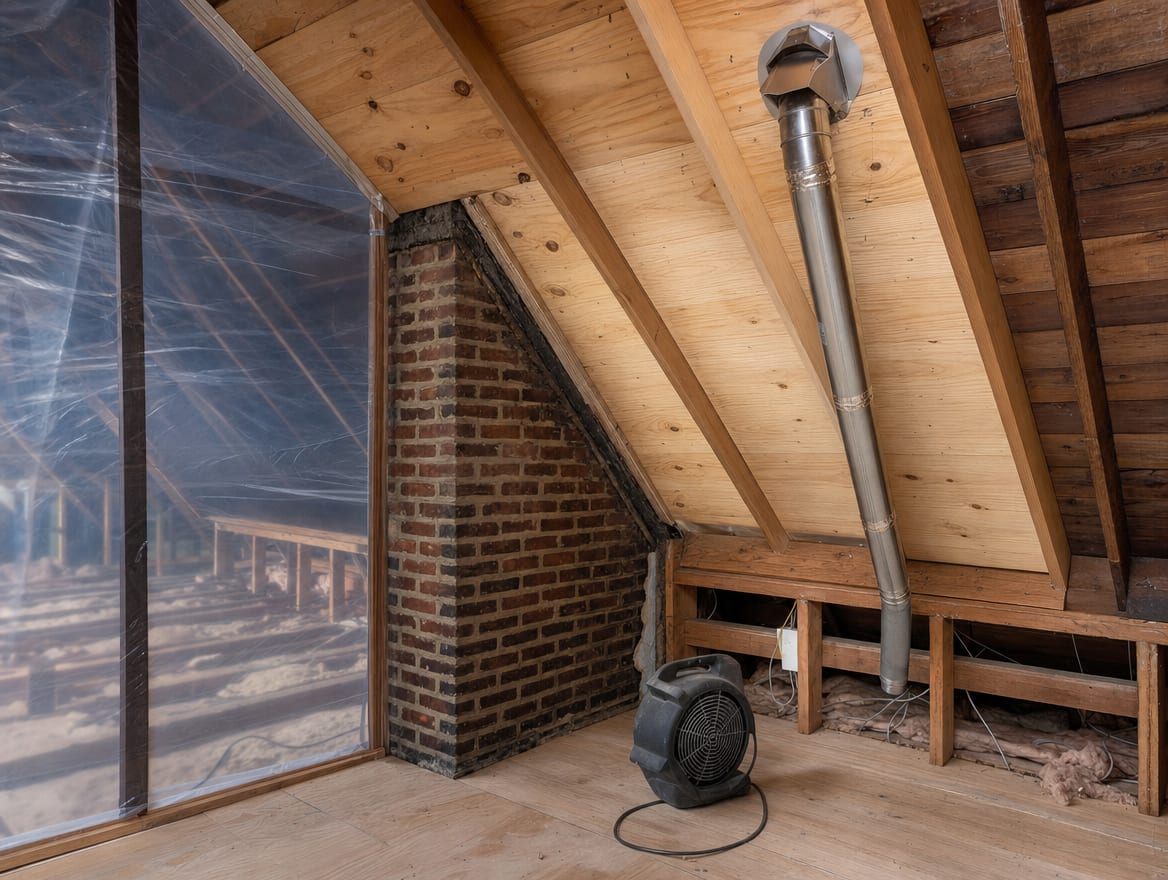
Keeping attic mold from coming back is about maintaining the right conditions: a dry, ventilated attic sealed off from the humid air below. That means bathroom and dryer fans that vent all the way outdoors, soffit and ridge vents kept clear, ceiling penetrations sealed, and roof components kept in good repair. In a shared building, the owner can handle the interior air sealing and the exhaust routing inside the unit, while roof and common-vent maintenance stays with the association.
The way to prevent a responsibility dispute is to keep the completion record factual. It should state what was found, what was cleaned or removed, that the attic was dried, and that the source was repaired or assigned to the correct trade. It should not declare who owned the source or who should pay. Those determinations belong to the governing documents and the insurance carriers, and a contractor cannot guarantee coverage under any policy. A record that documents conditions rather than assigns blame protects the owner, the neighbors, and the association alike.
Frequently Asked Questions
Is attic mold just a ventilation problem?
Not always. Ventilation matters, but the water can come from a roof leak, a bathroom or dryer fan venting into the attic, HVAC condensation, or warm indoor air leaking up and condensing on cold sheathing. Adding more roof vents does not help if the real source is a disconnected exhaust duct or an unsealed ceiling, so the fix depends on which pathway is actually feeding the moisture.
Who fixes it when the roof is association-maintained?
That depends on your community's governing documents. In many townhouses and condos the roof and common attic are association responsibilities, while the finished materials inside the unit are the owner's. A remediator documents where the moisture is and whether the source is a unit component or a common one, but does not decide who is legally responsible. The declaration, bylaws, and rules settle that.
Do I need access to a neighbor's attic?
Sometimes. If the source is a shared roof plane, a common ventilation path, or a party-wall boundary, the inspection or repair may require access to common areas or an adjacent unit. That access is arranged through the association or property manager, and reporting the issue early helps, because moisture in a shared assembly keeps traveling until the common part is reached.
Does the roof sheathing have to be replaced?
No, not automatically. Sheathing that is stained but structurally sound can often be cleaned and dried in place. Replacement is reserved for wood that is delaminated, rotted, or too damaged to clean. The decision rests on the condition of the material, not on the color of the stain.
Do I need testing before the mold is removed?
Usually not. When growth is already visible and the moisture source is clear, the response does not change based on the species, so testing is not an automatic first step. Testing earns its place when it answers a defined question, such as confirming hidden growth, checking a wall or ceiling cavity, or meeting post-remediation criteria in a real estate, insurance, or association matter.
Will insurance cover attic mold?
Only your carrier can decide, based on your policy, the cause of loss, and any exclusions. A sudden covered roof or plumbing event may be treated differently from long-term condensation or deferred maintenance, and in a shared building both an association policy and a unit-owner policy can be involved. A contractor cannot guarantee coverage, which is why documented conditions and a clear scope matter from the start.
When attic mold turns up in a Princeton Junction home, townhouse, or condo, the first move is to separate the source from the responsibility, and let a documented diagnosis guide the scope. ExecPro Restoration & Cleaning serves Princeton Junction and the West Windsor area with mold remediation across Princeton Junction, handling inspection, containment, removal, drying, source coordination with your association, verification, and rebuild, with records that document conditions rather than assign blame. You can reach our team at (888) 300-3772 or get in touch through our contact page to start with a clear look at what is happening above your ceiling.
Attic Mold and Shared-Roof Terms
Tap a term to see what it means.
Roof sheathing. The wood decking beneath the shingles that forms the roof surface visible from inside the attic, and the first place attic mold usually appears.
Serving Princeton Junction
ExecPro Restoration & Cleaning provides mold remediation services in Princeton Junction, NJ, from inspection and testing through removal, drying, and post-remediation verification. Call (888) 300-3772 for 24/7 emergency response.
Related Articles
Attic Mold Remediation in Deal, NJ: The Coastal Attic Equation of Roof, Air, and Condensation
Attic mold in Deal, NJ rarely comes from one cause. Learn the three coastal moisture pathways, roof leak versus condensation, and the correct fix for each.
Sound, Sistered, or Replaced: Structural Mold Repair in Princeton Junction NJ Townhouses and Condos
In a Princeton Junction townhouse or condo, a mold-damaged joist raises one structural question: is the member sound, can it be sistered, or must it be replaced?
Dark Mold, Shared Walls: Black Mold in Princeton Junction NJ Townhouses and Condos
In a Princeton Junction townhouse, dark basement mold can trace back to an association-controlled source. Why color and responsibility are separate questions.