Attic Mold Remediation in Deal, NJ: The Coastal Attic Equation of Roof, Air, and Condensation
Cal HewittPublished
- attic mold remediation
- attic mold
- mold remediation
- coastal
- new jersey
- deal
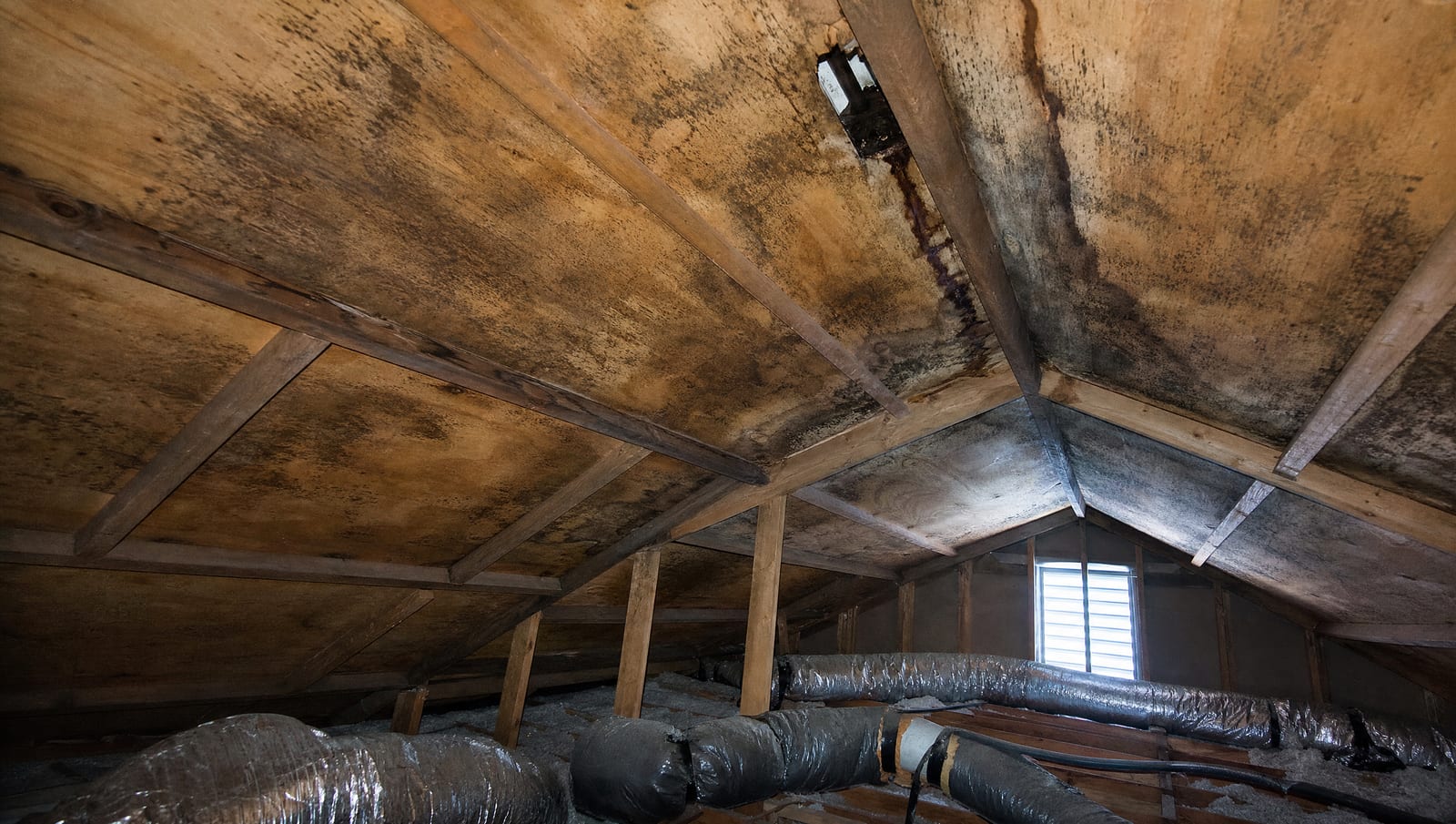
A caretaker climbed into the attic of a Deal estate the week after a winter nor'easter, expecting to find nothing. Instead, one flashlight sweep across the roofline told three different stories. Above the primary bedroom wing, a dark stain traced down from a valley where wind-driven rain had worked past the flashing. Over the older section of the house, the underside of the roof decking was silvered with frost that melted into damp streaks by midday. And near the mechanical closet, an air handler had left a ring of moisture beneath a sweating condensate line. Three attic sections. Three completely different moisture problems. One roof.
That single walkthrough is the whole point of this article. Attic mold in a Deal home is rarely a single event with a single cause. It is usually the sum of a coastal roof taking a beating, warm indoor air slipping upward through the ceiling, and mechanical equipment adding its own moisture inside the attic. If you try to solve all three with one method, you fix at most one of them and the mold comes back. So before anyone sprays anything, the real work is separating the pathways.
Why Deal Attics Face a Different Moisture Pattern
Deal is a shore borough with a small year-round population and a much larger inventory of seasonal and estate homes. That mix creates conditions you do not see in an inland town. The Atlantic exposure means roofs take heavy rain, strong wind, salt-laden air, and coastal storms. Water can find its way in through damaged shingles, tired flashing, skylights, chimneys, dormers, and the intersections where a roof meets a wall.
The homes themselves add to it. Many Deal properties are large, with several additions, dormers, roof valleys, and changes in roof elevation. A house like that does not have one attic. It has several attic sections, and each can behave differently. On top of that, a lot of these homes carry attic HVAC equipment, ductwork, and condensate lines, which introduce a moisture source that has nothing to do with the roof or the weather.
Then there is the seasonal factor. When a home is closed for part of the year, a leak, a blocked condensate line, or a ventilation problem can continue quietly for weeks before anyone looks. A closed home also runs with reduced heating and cooling, which changes the indoor humidity and the temperature of the roof surfaces above. None of this proves mold on its own. It simply explains why Deal attics develop moisture in more than one way at once, and why a careful diagnosis matters more than a quick cleaning.
The Three Moisture Pathways
Almost every attic moisture problem traces back to one of three pathways, and Deal homes often have more than one running at the same time. Sorting them out is the difference between a repair that holds and a cleanup that fails by the next season.
The first pathway is water entering from outside. This is the roof and everything that seals it: shingles, flashing, valleys, skylights, chimneys, and vents. A coastal storm can open a path that only leaks during wind-driven rain, which makes it hard to catch on a dry day.
The second pathway is moist indoor air entering from below. Warm, humid air from the living space rises and escapes through gaps in the ceiling plane, around recessed lights, attic hatches, plumbing chases, and duct penetrations. When that air hits cold roof decking in winter, it condenses or freezes. This is the pathway most people overlook because it has nothing to do with the roof at all.
The third pathway is mechanical condensation inside the attic. An air handler, ductwork, or a condensate line placed in the attic can sweat or leak, wetting insulation and framing from within the attic itself. Bathroom or dryer exhaust that dumps into the attic instead of outdoors belongs here too, because it is releasing warm moist air directly into the space.
The Three Attic Moisture Pathways
Outside water (the roof)
Rain and wind-driven storm water entering through damaged shingles, worn flashing, valleys, skylights, chimneys, and roof-wall intersections.
Indoor air from below
Warm, humid household air leaking up through the ceiling plane at recessed lights, attic hatches, plumbing chases, and duct penetrations, then condensing on cold decking.
Mechanical condensation
Attic air handlers, ducts, and condensate lines that sweat or leak, wetting insulation and framing from inside the attic.
Roof and flashing
The most common outside-water culprit, especially at valleys and penetrations after a coastal storm.
Ceiling air leakage
The hidden driver of winter frost and damp decking, often mistaken for a roof leak.
Blocked soffit vents
Insulation packed against the eaves cuts off intake airflow, so humid air has no way to clear.
Disconnected bath exhaust
A fan venting into the attic instead of outdoors adds moisture with every shower.
Attic HVAC condensate
A sweating line or a clogged drain pan that quietly wets the framing nearby.
How to Tell a Roof Leak From Condensation
Owners often assume any wet attic means a roof leak, so the first call is to a roofer. Sometimes that is right. Often it is not. The two problems leave different fingerprints, and reading them correctly saves you from paying to fix the wrong thing.
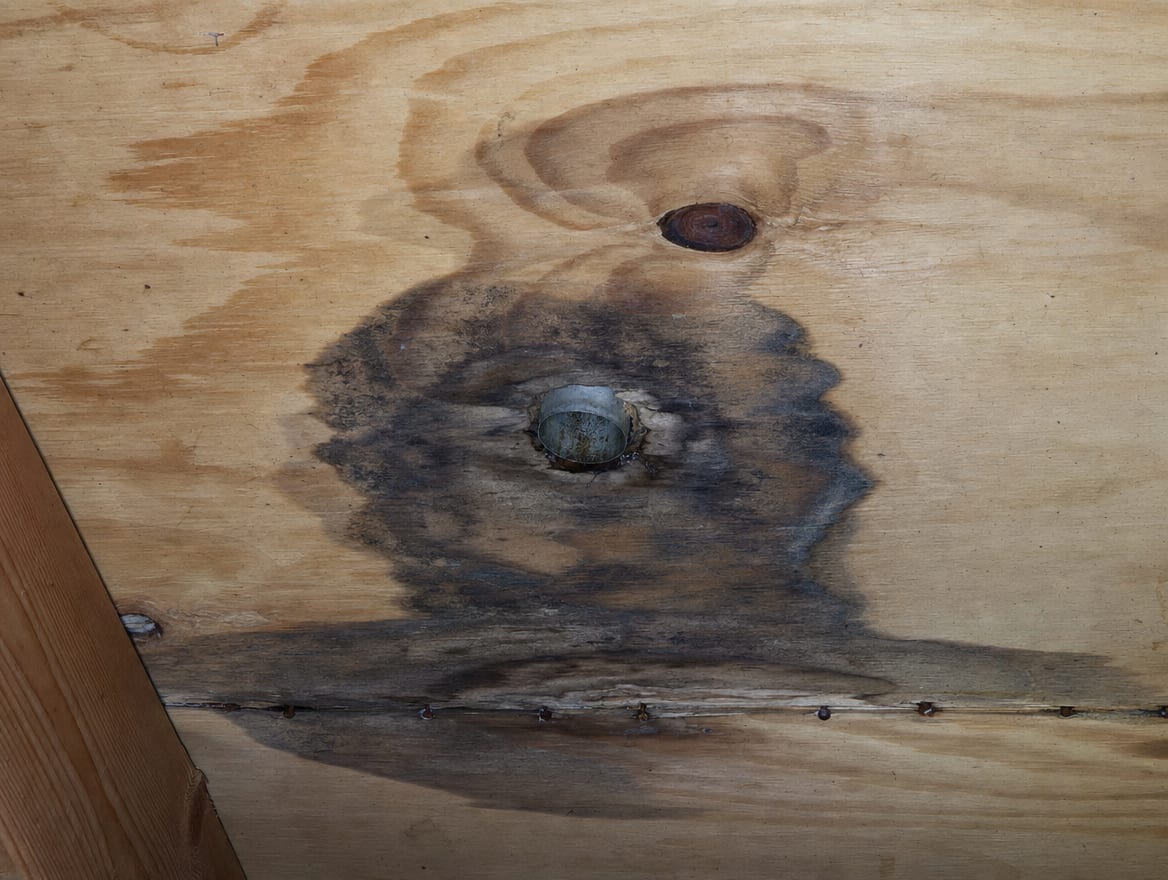
A roof leak tends to be local and directional. It shows up in a specific spot, usually below a valley, a penetration, a skylight, or a chimney, and it often worsens during or right after wind-driven rain. You may see staining that runs downward along framing, because water can travel along a rafter before it drops onto the insulation. That is why the visible stain is sometimes far from the actual entry point.
Condensation from indoor air leakage looks different. It is spread more evenly across cold surfaces rather than concentrated at one opening. In winter you may find frost on the underside of the decking or on nail heads, which then melts and dampens the wood as temperatures rise. It tends to appear near the ceiling penetrations where warm air escapes, such as around attic hatches and recessed lights. Mechanical condensation, the third pathway, clusters around the equipment: a ring of moisture under a condensate line, damp insulation beneath an air handler, or sweating on ductwork. Matching the pattern to the pathway is the heart of a good diagnosis, and it is why moisture readings and a full inspection beat a glance at the stain.
Hover or tap a row to highlight it.
| Signal | Outside water (roof/flashing) | Indoor-air leakage (condensation/frost) | Mechanical condensation (HVAC/exhaust) |
|---|---|---|---|
| Where it appears | At and below valleys, skylights, chimneys, and penetrations | Broadly across cold decking; near attic hatches, recessed lights, and duct gaps | Around the air handler, ducts, drain pan, and condensate line |
| The pattern | Local and directional; may run along framing far from the source | Even film, frost, or nail-head sweating that melts as it warms | Clustered wet spots and damp insulation next to equipment |
| When it shows | During or right after wind-driven rain and storms | Cold-weather condensation and winter frost cycles | Whenever the equipment runs; worse in humid weather |
| The correct fix | Roofer repairs shingles, flashing, and penetrations | Air seal the ceiling plane and balance soffit-to-ridge ventilation | HVAC service, correct condensate routing, vent exhaust outdoors |
Why Large Homes Can Have Several Attic Microclimates
The three-pathway idea gets more complicated in a large Deal home, because a single house can hold several attics that never share the same air. Additions, firewalls, vaulted ceilings, and changes in roof elevation split the space into separate zones. One section may have healthy airflow from soffit to ridge, while another, sealed off behind a knee wall, stays damp and still.
That is why the estate in our opening had three different problems in three places. Each zone has its own roof exposure, its own ventilation, and sometimes its own mechanical equipment. A valley over one wing gets hammered by storms while a protected section stays dry. An older part of the house may have retrofitted insulation blocking its soffit vents, while a renovated wing is tight and energy efficient but drives warm indoor air into a cold cavity. Treating the whole attic as one uniform space misses this entirely. A real assessment walks each accessible zone separately, because the fix for one section may do nothing for the one next to it.
Bathroom Exhausts, Soffit Blockages, and HVAC Drain Problems
Three specific culprits show up again and again in Deal attics, and all three fall under the pathways above. They deserve a closer look because they are common, they are fixable, and they are frequently missed.
Bathroom and dryer exhausts are meant to carry moist air outdoors. When the duct terminates inside the attic instead, every shower and every load of laundry releases warm, humid air straight into the space. Over a season that adds up to a lot of moisture landing on cold wood. The fix is to route the exhaust fully outside, not into the attic cavity.
Blocked soffit vents are the quiet version of a ventilation failure. Soffit vents at the eaves are the intake side of attic airflow. When insulation is packed against them without baffles to hold a clear channel, the intake chokes off and humid air has no path to clear. Adding more roof vents does not fix this. The intake and exhaust have to be balanced, and the soffits have to stay open.
HVAC drain problems belong to the mechanical pathway. An attic air handler with a sweating refrigerant line, a clogged drain pan, or a disconnected condensate line will wet the framing and insulation nearby. This has nothing to do with the roof or the weather, which is exactly why a roofer cannot solve it. It calls for an HVAC contractor to correct the condensate routing and stop the moisture at the source.
What a Complete Remediation Scope Includes
Once the pathways are identified, a complete remediation follows a clear order. Skipping steps is how a job looks finished but fails within a season. A thorough scope covers the following.
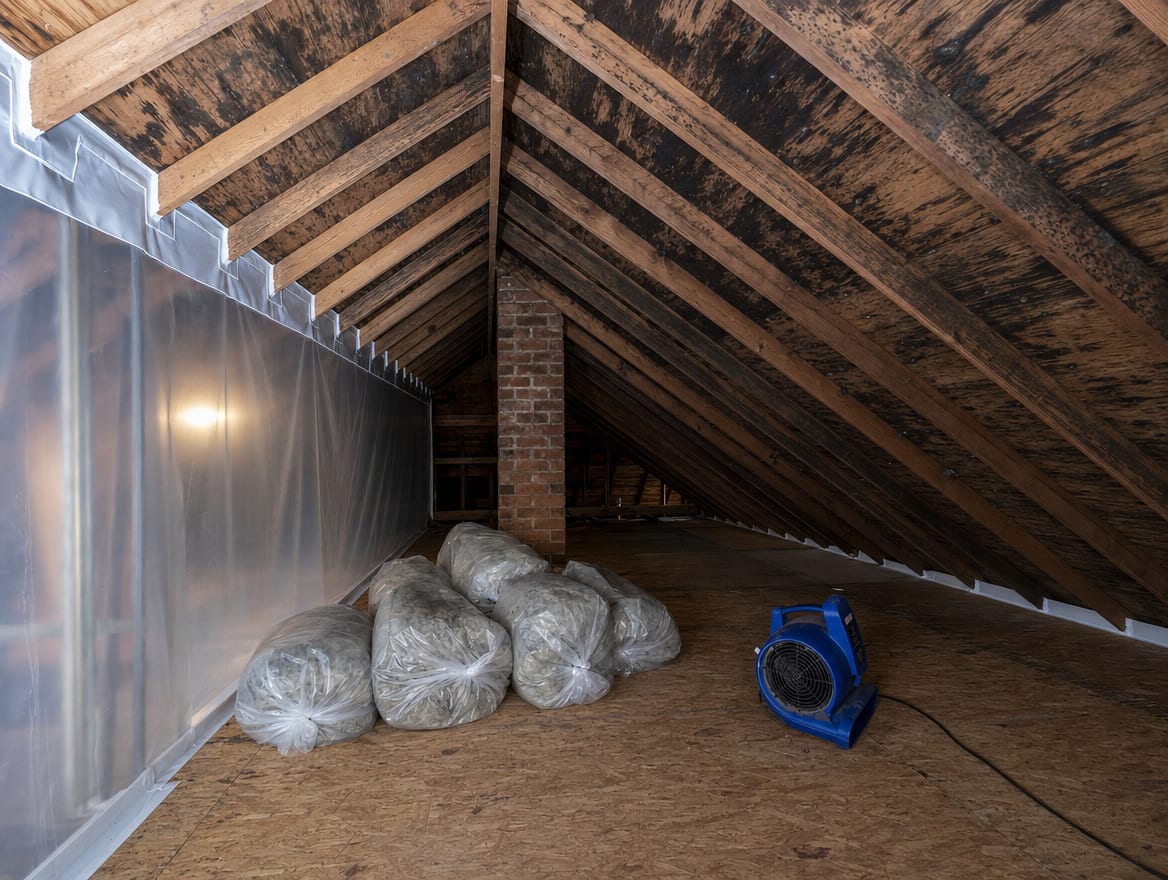
It starts with containment and air control. The affected attic sections are isolated and HEPA-filtered air control is set up so that disturbing the growth does not push spores into the living space below.
Next comes removal and cleaning, handled by material. Contaminated or water-damaged insulation is removed and bagged, because porous materials often cannot be cleaned in place. Affected wood and hard surfaces are HEPA vacuumed and cleaned. Materials that cannot be adequately cleaned are removed rather than coated over.
Then the crew corrects the pathway. This is the step that separates a lasting repair from a temporary one. An active roof leak goes to a roofer, indoor air leakage goes to air sealing and balanced ventilation, exhaust problems get routed outdoors, and HVAC condensate goes to an HVAC contractor. Spraying, fogging, or painting over growth without correcting the moisture and physically cleaning the contamination is not a complete solution.
Finally, the attic is dried and verified. It should be dry before any insulation or finishes go back in. Verification can include confirming visual cleanliness, checking moisture readings, and confirming the source repairs are done. Testing is used when it answers a specific question about the scope or the result, not as an automatic step. Owners are wise to compare written scopes rather than bottom-line totals, because a lower quote often leaves out source correction, insulation replacement, or verification.
Attic Mold: Diagnosis to Verified Fix
- 1
Inspect and identify the pathways
Walk each accessible attic zone, check roof and flashing, ventilation, exhaust routing, and HVAC condensate, and take moisture readings to separate outside water, indoor-air leakage, and mechanical condensation.
- 2
Contain and set up HEPA air control
Isolate the affected sections and run HEPA-filtered air control so spores do not spread into the living space during the work.
- 3
Remove and clean per material
Bag and remove contaminated or wet insulation, HEPA vacuum and clean sound wood and hard surfaces, and remove materials that cannot be adequately cleaned.
- 4
Correct the pathway
Bring in the right trade for each source, roofer, HVAC contractor, insulation contractor, or exhaust correction, so the moisture actually stops.
- 5
Replace sheathing, insulation, and framing where needed
Rebuild only the materials that are damaged beyond cleaning once the attic is confirmed dry.
- 6
Verify the result
Confirm dryness, visual cleanliness, and completed source repairs, with testing when it answers a defined question.
When Sheathing, Insulation, or Framing Must Be Replaced
A common worry is that any stain on the roof decking means the whole roof has to come off. That is usually not true. Replacement depends on the condition of the material, not on how dark the stain looks. Color does not prove species, and staining does not prove structural damage.
Sound sheathing that is stained but still solid can often be cleaned and kept. Sheathing that is delaminated, rotted, or structurally compromised is a different story and needs to be replaced. The same logic applies to framing. Rafters and trusses that have been wet long enough to soften or rot have to be repaired or replaced, while sound wood is cleaned in place.
Insulation follows its own rule. Only insulation that is contaminated, wet, obstructing access, or otherwise unsalvageable belongs in the removal scope. Insulation that is dry and clean can stay. What matters most is timing. New insulation should never go back in until the attic is confirmed dry and the moisture source is corrected, because fresh insulation laid over an unresolved leak or condensation problem simply hides the next round of damage. Some of this work, such as structural sheathing replacement, electrical changes, or HVAC alterations, may require permits from the Borough of Deal, which is worth confirming before reconstruction begins.
Preventing Recurrence Before the Home Is Closed for the Season
For a seasonal Deal home, the most important prevention happens before the house is closed up. An attic problem that starts in an empty home can run for weeks with no one to catch it, so the goal is to leave the attic in a state that stays dry on its own.
Before closing, it is worth confirming a few things. The roof, flashing, valleys, and penetrations should be sound, because these are the entry points a coming storm will test. Bathroom and dryer exhausts should vent fully outdoors, not into the attic. Soffit vents should be clear, with baffles keeping insulation off the intake so air can still move from soffit to ridge. Any attic HVAC equipment, drain pans, and condensate lines should be checked so a slow leak does not run unnoticed all season. And the ceiling plane below the attic should be reasonably air sealed at hatches, recessed lights, and penetrations, so warm indoor air is not feeding condensation on cold decking.
A quick inspection after major storms, when someone can get to the property, closes the loop. Catching water intrusion early, before it sits long enough to support growth, is far cheaper and simpler than remediating after a season of quiet damage. Prevention is not one action. It is the same three pathways handled in advance: keep outside water out, keep indoor air from leaking up, and keep the mechanical equipment from sweating.
Frequently Asked Questions
Is attic mold just a ventilation problem?
Usually not on its own. Poor ventilation is one pathway, but attic mold in Deal often comes from a mix of a roof leak, warm indoor air leaking up through the ceiling, and mechanical condensation from attic HVAC or misrouted exhaust. Adding more roof vents without diagnosing the actual source can leave the real problem untouched. The right approach separates the pathways first, then corrects each one.
How do I tell a roof leak from condensation?
A roof leak is usually local and directional, showing up near valleys, skylights, chimneys, or penetrations and getting worse during wind-driven rain. Condensation from indoor air leakage is more evenly spread across cold decking, often as winter frost or nail-head sweating that melts as it warms, and it tends to appear near ceiling gaps like attic hatches and recessed lights. Mechanical condensation clusters around the HVAC equipment. Matching the pattern to the pathway is the key, which is why moisture readings and a full inspection beat judging by the stain.
Does the sheathing have to be replaced?
Not automatically. Replacement depends on the condition of the wood, not the color of the stain. Sheathing that is stained but still solid can often be cleaned and kept, while wood that is delaminated, rotted, or structurally compromised needs to be replaced. A proper assessment checks the material condition rather than assuming the worst.
Is testing needed before removal?
Not always. Visible growth and clear moisture often define the cleanup on their own. Testing is most useful when it answers a specific question, such as documenting the result, verifying the work after remediation, or clarifying an uncertain source. It is a tool for a defined purpose, not an automatic first step.
Will insurance cover attic mold remediation?
That cannot be guaranteed, because coverage depends on the policy and the cause of loss. Sudden, covered damage such as a storm-driven roof breach may be treated differently from long-term condensation or deferred maintenance. Remediation does not guarantee coverage. It helps to preserve documentation, including storm and leak dates, photos, moisture readings, and the remediation scope, so you have a clear record if you file a claim.
How do I prevent attic mold before closing the home for the season?
Handle all three pathways before you close up. Confirm the roof, flashing, and penetrations are sound, make sure exhausts vent outdoors, keep soffit vents clear with baffles, check attic HVAC and condensate lines, and air seal the ceiling plane at hatches and lights. Then inspect after major storms when someone can reach the property. The aim is to leave the attic dry and self-maintaining so a small problem does not run for weeks in an empty house.
Talk to ExecPro About Your Deal Attic
If your attic is showing stains, frost, damp insulation, or a musty smell, the answer is not to guess at one cause and hope. It is to separate the pathways and fix each one correctly. ExecPro Restoration & Cleaning inspects each attic zone, identifies whether the moisture is coming from the roof, from indoor air, or from mechanical condensation, and builds a scope that corrects the actual source. Our team handles attic mold remediation for Deal homeowners from containment through verified drying, and we can start with a mold inspection to pinpoint the source or close out the job with post-remediation verification so you have documented results. You can see how we support the wider area on our Deal mold remediation service page.
When you are ready for a clear diagnosis, reach out to ExecPro Restoration & Cleaning. Call (888) 300-3772 or contact our team online to get from uncertainty to a real plan for your attic.
Attic Mold Terms
Tap a term to see what it means.
Roof sheathing. The wood decking beneath the shingles that forms the roof surface you see from inside the attic.
Serving Deal
ExecPro Restoration & Cleaning provides mold remediation services in Deal, NJ, from inspection and testing through removal, drying, and post-remediation verification. Call (888) 300-3772 for 24/7 emergency response.
Related Articles
Reopening a Deal NJ Shore Home: When Air Quality Testing Answers a Real Question
Reopening a closed Deal NJ shore home? Learn when air quality testing helps after vacancy, humidity, a storm, or renovation, and what a test cannot tell you.
Property Management Mold Services in Deal NJ: A Seasonal-Home Protocol
A repeatable mold protocol for managers of seasonal Deal NJ homes: pre-arrival inspections, remote humidity monitoring, emergency access, and owner reporting.
Structural Mold Repair in Deal NJ: Clean, Reinforce, or Call an Engineer
Structural mold repair in Deal NJ starts with one decision: is framing cleanable, decayed, or a job for a licensed engineer. Here is how to tell.