Dust and Air Sampling During Hospital and Clinic Construction in New Jersey
Cal HewittPublished
- environmental consulting
- containment
- sampling
- new jersey
Hospital construction dust control comes down to one promise you make before the first ceiling tile comes out: dust stays in the work zone, and you can show it did. The renovation near your patients might be ceiling access, an HVAC replacement, a plumbing repair behind a procedure suite, or demolition on the floor below. Each sends fine dust toward vulnerable people, and CDC identifies construction dust and moisture as potential exposures for susceptible patients. As the facilities manager, infection preventionist or project lead, you carry the questions of what the risk assessment requires, what containment is expected, whether air sampling will help, and which records to keep. The answers follow the order a project moves, from planning through closeout, with the New Jersey approvals that sit alongside them.
Key Takeaways
The ICRA sets the work plan
CDC recommends completing an infection-control risk assessment before repairs, demolition, construction or renovation, and the precaution class it assigns drives the barrier, the pressure and the permit.
Each air check answers a different question
Pressure and airflow readings and particle counts test containment, targeted fungal sampling is a decision for infection prevention, engineering and a laboratory, and OSHA silica monitoring protects workers.
Records close the project
The approved ICRA, daily barrier and pressure logs, monitoring data, cleaning records and HVAC restoration sign-off belong in one file at closeout.
Start with an ICRA so every barrier choice has a reason
CDC recommends a multidisciplinary team, with infection-control staff included, for demolition, construction and renovation projects. That team completes an infection-control risk assessment (ICRA) before work begins and looks at the work area, the adjacent patient-care areas, supply storage, and the spaces above and below the project. The Joint Commission requires organizations to keep a preconstruction risk-assessment process covering air quality, infection control, utilities, noise, vibration and other hazards, and it leaves the choice of assessment form to the organization.
The ASHE ICRA 2.0 matrix pairs four construction activity types with four patient-risk groups to assign a precaution class from I through V. The activity types run from Type A, inspection and noninvasive work, through Type B for small jobs with minimal dust and Type C for moderate dust or more extensive demolition, to Type D for major demolition or substantial dust. The patient-risk groups run from Low, such as public hallways and offices, through Medium for waiting areas and materials management and High for patient rooms, emergency departments, imaging and laboratories, to Highest for transplant, intensive-care and oncology units, operating rooms, procedural suites and dedicated isolation units.
Hover or tap a row to highlight it.
| Patient-risk group | Construction activity type | Precaution class |
|---|---|---|
| Low | Type A | Class I |
| Medium | Type C | Class III |
| High | Type C | Class IV |
| Highest | Type C | Class V |
| High | Type D | Class V |
| Highest | Type D | Class V |
ASHE states that Class III Type C work and all Class IV and V work need an infection-control permit and approval. Conditions such as mold, sewage, asbestos, gray water and black water raise the class in the matrix, so a water event above the ceiling you plan to open belongs in the assessment. Treat the matrix as a planning tool, and pair it with the approvals the state and your facility policy require.
Build barriers and negative pressure that hold around patient care
Once the ICRA names the class, the containment design follows. CDC recommends physical barriers that can contain smoke and dust, and for longer projects that produce moderate to large amounts of dust, those barriers commonly use rigid sheetrock, drywall, plywood or plaster board covered with plastic sheeting. Two questions come up most often.
What is the best dust barrier for construction projects?
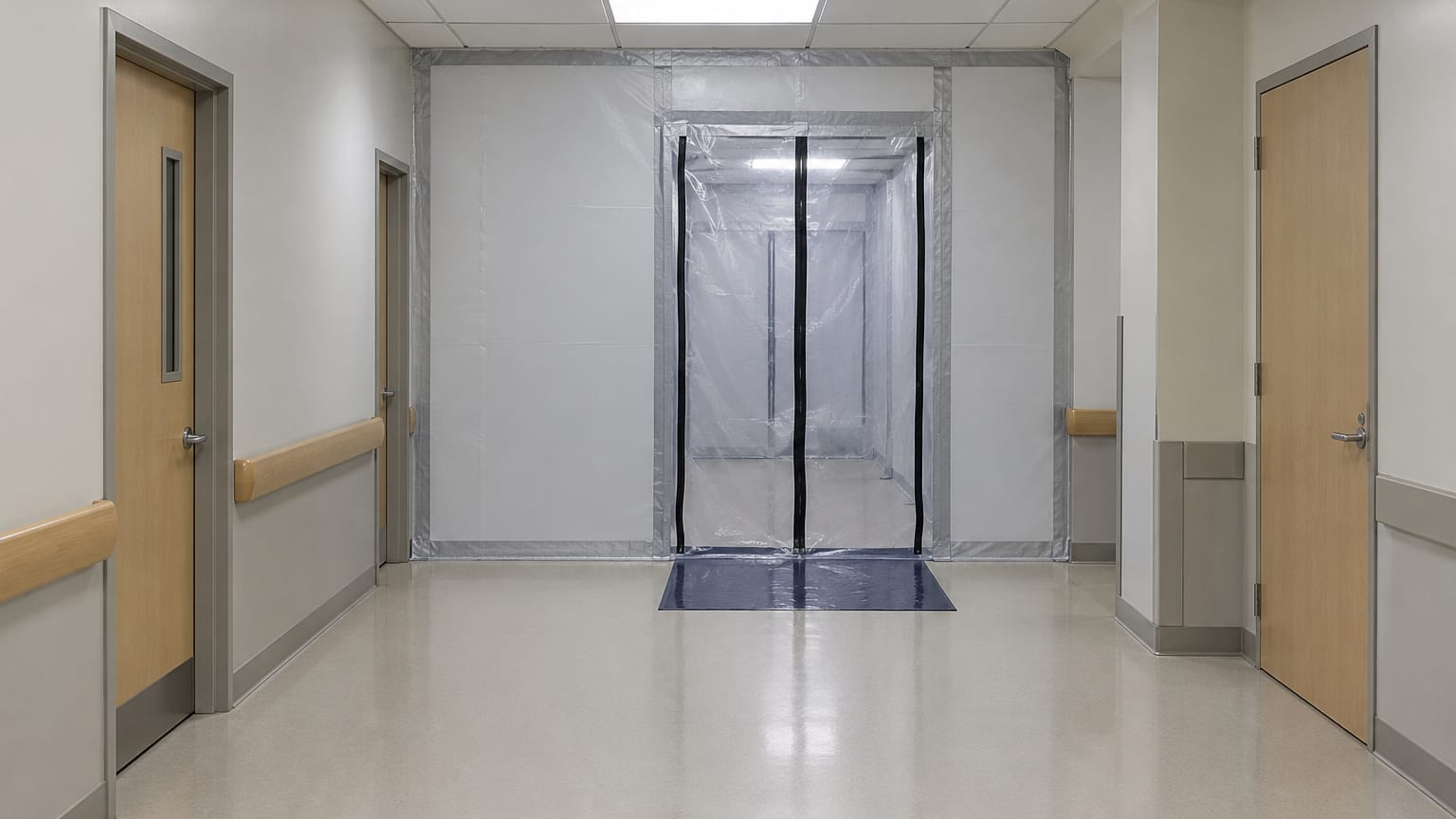
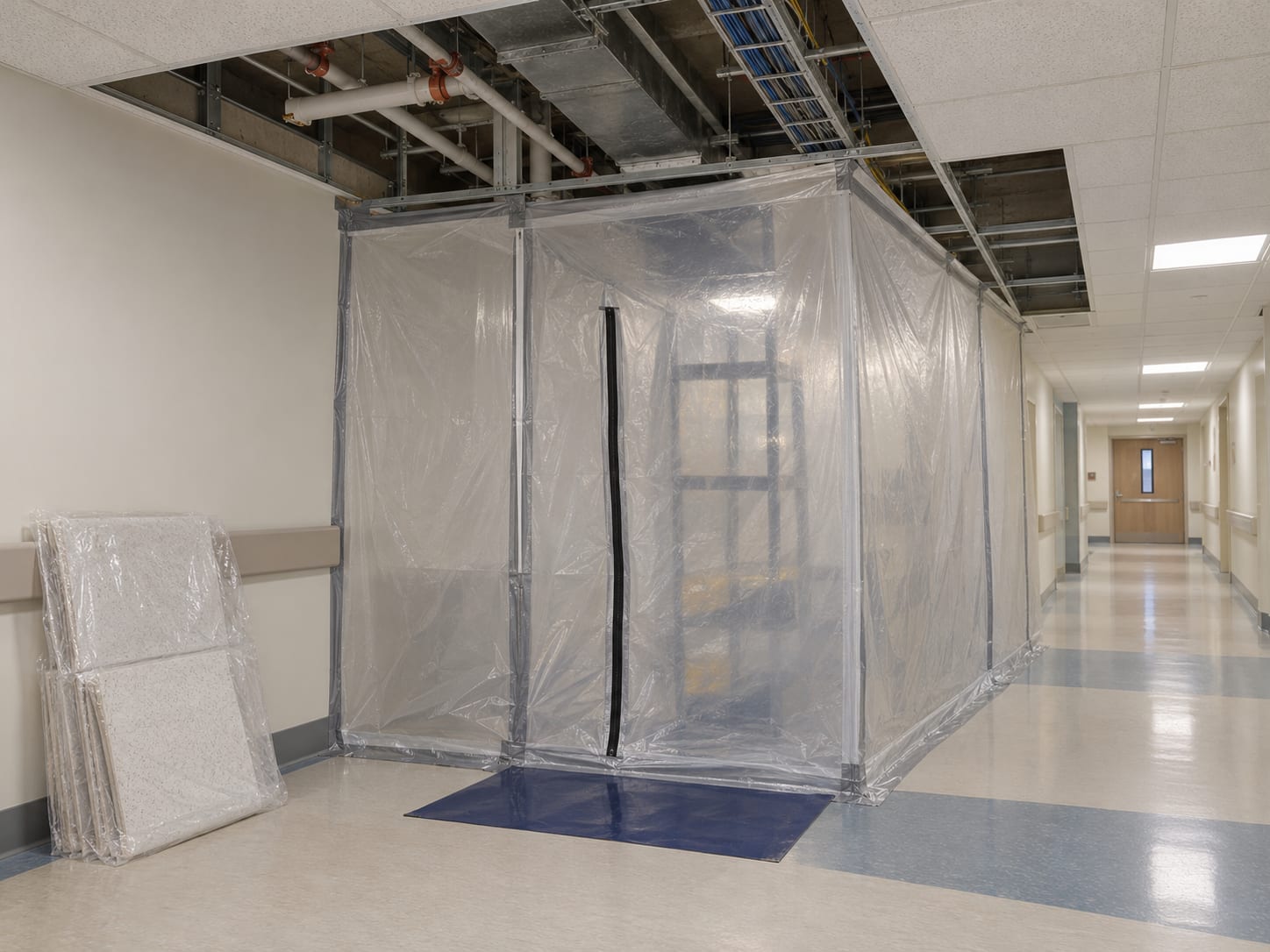
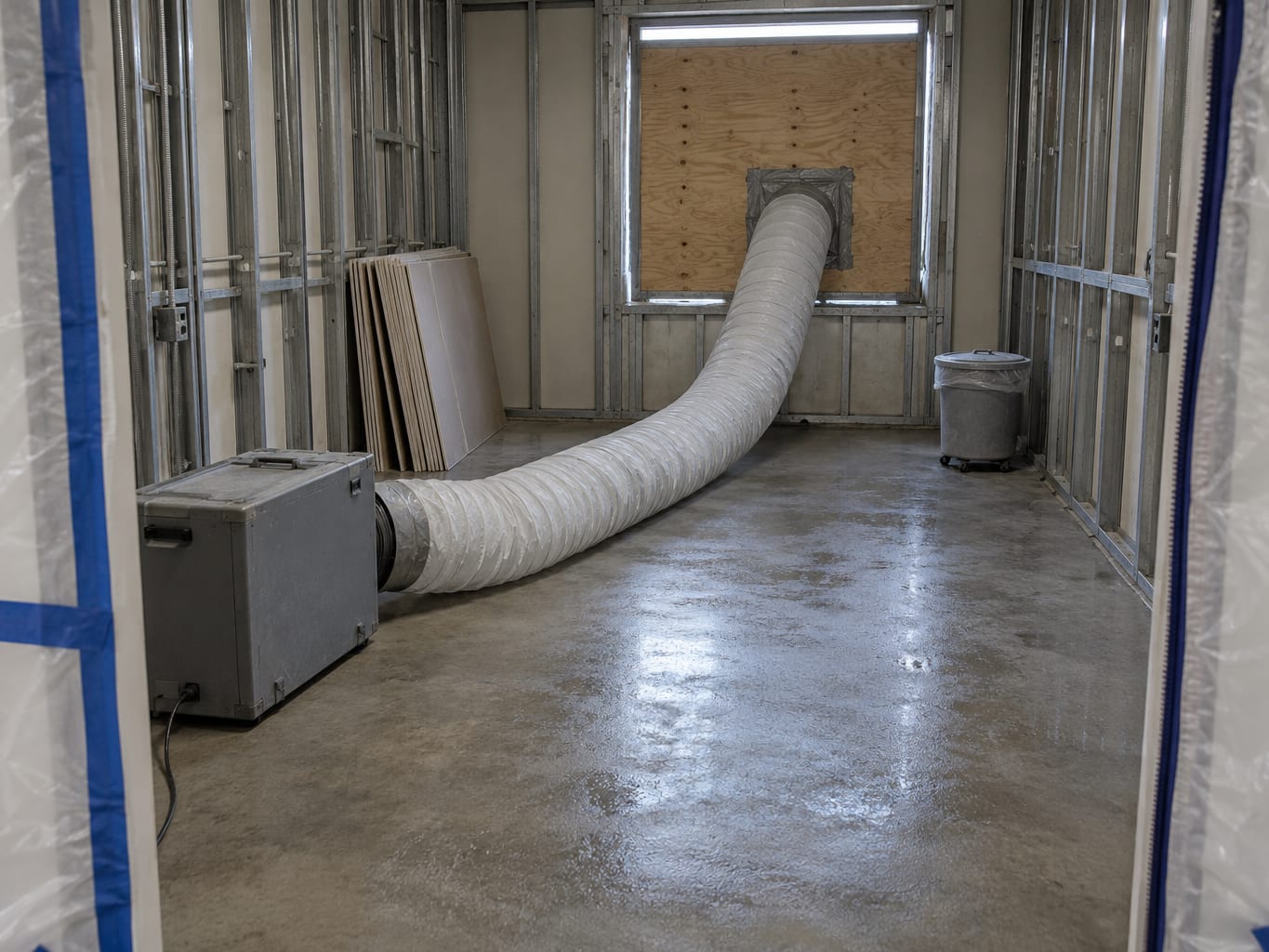
The best barrier is the one the ICRA specifies for the activity, the patient-risk group, the duration and the amount of dust. CDC describes rigid, noncombustible barriers with sealed and taped joints at the top, bottom and sides, a barrier that runs floor to floor while accounting for the ceiling plenum, and sealed temporary doors. Shorter, lower-dust work may call for lighter containment when the approved ICRA permits it. For major repairs above a false ceiling, CDC recommends plastic sheets or prefabricated plastic units with negative pressure inside the enclosure, plus either a portable industrial HEPA filter rated at 300 to 800 cubic feet per minute or exhaust straight outdoors.
What are the dust control measures used in construction projects?
CDC recommends negative pressure in construction zones next to patient-care areas, with airflow monitored inside the rigid barriers so air moves into the work zone and dust stays inside despite gaps and door openings. Around that core, healthcare projects add:
- Designated routes: Workers, debris and equipment use assigned entrances, corridors and elevators that stay away from patient-care areas.
- Anteroom or changing space: Workers remove protective clothing and store equipment before they leave the work zone.
- Tacky mats: Mats sit inside the construction entrance.
- Debris handling: Debris is covered and secured before removal, and tools and carts are wet-wiped before they leave containment.
- Daily upkeep: Barriers are inspected and repaired every day, and work zones and entrances are cleaned daily.
A HEPA unit adds filtration, and the barrier still does the containing. The ICRA should say where filtered air goes, how airflow is maintained, whether the HVAC system is affected, how filters are protected from loading, and how a failed unit gets detected. CDC also recommends verifying the affected air-handling system after the barriers go up and before negative pressure starts. At the end of the job, CDC recommends restoring appropriate air changes, humidity and pressure differential, cleaning or replacing filters, finishing the cleaning and keeping the pressure-monitoring documentation.
Dust Control Measures Around a Work Zone
Rigid, sealed barriers
Sealed and taped joints at the top, bottom and sides, running floor to floor while accounting for the ceiling plenum, with sealed temporary doors.
Negative pressure
Airflow monitored inside the barriers so air moves into the work zone and dust stays inside despite gaps and door openings.
Designated routes
Workers, debris and equipment use assigned entrances, corridors and elevators away from patient-care areas.
Anteroom or changing space
Workers remove protective clothing and store equipment before they leave the work zone.
Tacky mats
Mats sit inside the construction entrance.
Debris handling
Debris is covered and secured before removal, and tools and carts are wet-wiped before they leave containment.
Daily upkeep
Barriers are inspected and repaired every day, and work zones and entrances are cleaned daily.
Match each air check to the question it answers
CDC describes two broad forms of air evaluation, particulate sampling and microbiologic sampling, and it separates both from parametric monitoring of physical conditions. Worker silica monitoring adds a fourth track with a different purpose.
What are two types of air sampling?
Particulate sampling measures particle numbers, particle-size ranges or filtration performance. CDC identifies it as a tool for evaluating barrier integrity, dust-control performance, filter efficiency and ventilation. Microbiologic sampling evaluates airborne microorganisms, and CDC directs attention to airborne fungi when sampling is justified. Parametric monitoring covers pressure differentials, airflow direction at doors and openings, air changes and filter checks. Silica monitoring is the occupational-hygiene track: personal sampling measures a worker's exposure, and area sampling characterizes conditions in a location.
Four Air Checks, Four Questions
Particulate sampling
Measures particle numbers, particle-size ranges or filtration performance, to evaluate barrier integrity, dust-control performance, filter efficiency and ventilation.
Microbiologic sampling
Evaluates airborne microorganisms, with attention on airborne fungi when sampling is justified.
Parametric monitoring
Covers pressure differentials, airflow direction at doors and openings, air changes and filter checks.
Silica monitoring
The occupational-hygiene track: personal sampling measures a worker's exposure, and area sampling characterizes conditions in a location.
How are air samples taken, and with what instruments?
Particle counters and anemometers carry the particulate and airflow work, with pressure instruments for differentials. For fungal sampling, CDC describes volumetric impactors, filtration devices and impingement systems. CDC reserves settle plates for limited qualitative purposes and recommends other methods for quantifying airborne fungal spores. OSHA describes a silica sampling train of a cyclone, cassette, tubing and personal air-sampling pump, with analysis under Appendix A of the OSHA silica standard.
Every sample record should list the location, date and time, project phase, activity, HVAC status, pressure or airflow condition, instrument or method, sample volume or duration, comparison location, laboratory and analyst, and interpretation. CDC adds that conditions matter: whether the area was undisturbed, whether people were walking or vacuuming, and the temperature, humidity and traffic.
Decide sampling timing and interpretation inside the ICRA
The project team settles timing and interpretation on paper before any instrument comes out.
How often should air sampling be performed?
CDC leaves sampling frequency and method to infection-control professionals, laboratorians and engineers, based on the project, the purpose of the sampling, the patient population and the conditions being evaluated. Sampling can happen during construction, periodically to check indoor air quality or dust-control effectiveness, or during commissioning of renovated space. Put your schedule in the ICRA and the monitoring plan: pressure checks during active work, particle counts where the plan calls for them, and parametric checks before occupancy.
Fungal sampling is a targeted decision. CDC's recommendations leave routine microbiologic air sampling before, during or after construction as an unresolved issue, so infection prevention, engineering and laboratory professionals decide together whether it is warranted for a given project. CDC reports that fungal air sampling has technical limitations. Suggested values from investigators exist, and CDC notes that they have yet to be tied to healthcare-associated fungal infection rates. Agree on how results will be interpreted before collecting a single sample.
How long does dust stay airborne?
It depends on particle size, airflow, ventilation, humidity, filtration and activity. Larger particles settle faster, and smaller respirable particles can stay suspended and travel through the HVAC system or on foot traffic. Measure the actual conditions at your barrier with the instruments above, and base decisions on those readings and your ICRA.
Keep a record trail from planning through closeout
Each phase of a project generates records, and keeping them together answers the questions a committee, surveyor or insurer asks later.
- Planning: The approved ICRA, activity type, patient-risk group and precaution class, the infection-control permit when required, project plans, and contractor training records.
- Before work starts: Barrier design, worker and debris routes, the HEPA or exhaust arrangement, the pressure-monitoring method, the response plan for a loss of containment, and verification that the affected air-handling system is operating.
- During work: Daily barrier inspection and corrective-action logs, negative-pressure readings or airflow verification with the phase, location and instrument, particle-monitoring data, HVAC status, and daily cleaning and debris-removal records. Reassess after a scope change, a barrier failure, an HVAC change, a water event or a new dust-generating task.
- Closeout: Final cleaning records, any fungal-sampling reports with method, volume, laboratory and comparison locations, restored HVAC operation, pressure relationships, filters and air changes, and the occupancy approval, with confirmation that barriers can come down without releasing dust.
If patients or staff report symptoms, or the project has a barrier failure, bring the facts to your clinical and infection-prevention leadership.
Records From Planning Through Closeout
- 1
Planning
The approved ICRA, activity type, patient-risk group and precaution class, the infection-control permit when required, project plans and contractor training records.
- 2
Before work starts
Barrier design, worker and debris routes, the HEPA or exhaust arrangement, the pressure-monitoring method, the response plan for a loss of containment, and verification that the air-handling system is operating.
- 3
During work
Daily barrier inspection and corrective-action logs, negative-pressure readings or airflow verification, particle-monitoring data, HVAC status, and daily cleaning and debris-removal records.
- 4
Closeout
Final cleaning records, any fungal-sampling reports, restored HVAC operation, pressure relationships, filters and air changes, and the occupancy approval.
Confirm New Jersey approvals, worker rules and insurance records before work starts
New Jersey adds approval steps alongside the ICRA. The Uniform Construction Code, N.J.A.C. 5:23, governs building work, and the Department of Community Affairs lists the 2024 International Building Code, New Jersey edition, as the building subcode adopted August 17, 2026. NJDOH describes its Certificate of Need process under N.J.A.C. 8:33 as the review for construction, relocation or renovation of certain healthcare facilities, and some projects need full or expedited review. The N.J.A.C. 8:43G hospital licensing standards call for plans and specifications to go to the NJDOH Construction and Monitoring Program for approval before hospital construction, alteration or renovation. The copy on the NJDOH site carries a 2000 effective date and 2005 expiration date, so confirm the current pathway with NJDOH and DCA, and ask your design professional to identify the applicable FGI edition.
New Jersey's PEOSH indoor air quality standard, N.J.A.C. 12:100-13, covers existing buildings occupied by public employees and recognizes construction and renovation as sources of indoor contaminants. Its application depends on the facility's ownership and employees.
What is the OSHA standard for dust control?
For construction dust that contains respirable crystalline silica, the standard is 29 C.F.R. 1926.1153. It sets a permissible exposure limit of 50 micrograms per cubic meter of air as an 8-hour time-weighted average and an action level of 25. It requires exposure assessment, engineering and work-practice controls such as wet methods, local exhaust ventilation and housekeeping, reassessment when conditions change, and records. These are worker-exposure values for silica-generating tasks like cutting, grinding, drilling and crushing, and they live in the worker-protection plan beside the ICRA.
What are the OSHA air-monitoring requirements?
The employer assesses covered employee exposures under the scheduled-monitoring or performance option. A qualified laboratory analyzes the samples using the Appendix A procedures, employees receive their results in writing within five working days after the assessment, and the employer keeps the monitoring records. The OSHA small-entity compliance guide lists the record elements, including dates, tasks, methods, durations, results and the laboratory.
Hover or tap a row to highlight it.
| Item | What the post states |
|---|---|
| Standard | 29 C.F.R. 1926.1153 |
| Permissible exposure limit | 50 micrograms per cubic meter of air as an 8-hour time-weighted average |
| Action level | 25 |
| Results to employees | In writing within five working days after the assessment |
| Where the limits apply | Worker exposure during silica-generating tasks like cutting, grinding, drilling and crushing |
Raise insurance before work starts. Coverage for testing, relocation, containment, cleanup, damaged materials, business interruption, professional services and contractor liability varies with the policy, the cause of loss and the endorsements, so ask your broker, carrier and attorney which items apply. Your contractor can support a claim file by preserving the ICRA, work authorization, photographs, monitoring records, laboratory reports, invoices, change orders and closeout documents.
Ask your environmental contractor for these items in writing
A contractor or consultant working near patient care should be able to read your ICRA, work inside your infection-control plan and document what happens. Before you sign, ask for:
- A written scope that states the services: healthcare construction dust monitoring, silica monitoring, fungal investigation, post-remediation verification, HVAC or pressure verification, containment cleaning, water or mold response, or a combination.
- A monitoring plan that names locations, methods, timing, comparison areas, the laboratory and how results get interpreted.
- Daily records of barrier inspections, pressure readings, cleaning and corrective actions.
- Reports that identify the locations, methods, conditions, results and limitations.
- A closeout package with final cleaning records, sampling results and the HVAC restoration status.
You will also want the contractor's own credentials stated plainly, in writing, so your committee can review them. Approvals such as NJDOH plan review, DCA permits and your infection-control permit come from the agencies and your facility, and the records above feed those reviews.
ExecPro Restoration & Cleaning offers air quality testing, environmental consulting, mold inspection and testing, commercial mold inspection, containment and negative-air work, and post-remediation verification. Mold testing samples go to accredited laboratories, and the reports come back with locations, methods and results.
Frequently Asked Questions About Hospital Construction Dust Control
Q: Does a project need an ICRA and an infection-control permit?
CDC recommends an ICRA before any repair, demolition, construction or renovation. Under the ASHE matrix, an infection-control permit and approval apply to Class III Type C work and to all Class IV and V work.
Q: Do we need particle counts, fungal sampling or both?
Match the check to the question. Particle counts and pressure readings test whether containment holds. Fungal sampling is a targeted step that infection prevention, engineering and a laboratory choose together.
Q: Is there a CDC or OSHA particle limit for the occupied clinical area?
Set project-specific performance criteria in the approved ICRA with infection prevention and engineering. OSHA's silica limits apply to worker exposure.
Q: What happens if dust escapes the barrier?
Stop or isolate the dust-generating work, notify infection prevention and facilities, record the location, time, visible dust, barrier and pressure condition and HVAC status, and correct the gap.
Q: Who approves a healthcare construction project in New Jersey?
Approvals can come from NJDOH, DCA and the local construction office, and Certificate of Need review applies to some projects. Confirm the pathway for your facility type with NJDOH and DCA before work begins.
Healthcare Construction Dust, Quick Check
1. What does CDC recommend completing before repairs, demolition, construction or renovation?
2. Which work needs an infection-control permit and approval under the ASHE matrix?
3. Which readings test whether containment is holding?
4. Who decides together whether fungal sampling is warranted for a project?
5. What is OSHA's permissible exposure limit for respirable crystalline silica?
Pick an answer to begin.
Moving Forward
Healthcare construction dust control works when the ICRA is finished first, the barrier and pressure design follows its class, each air check matches a question, and the records are kept as the project moves. Particle counts and pressure readings show whether containment is holding, and silica monitoring protects the workers doing the cutting and grinding.
A project run this way ends with a closeout file you can hand to your infection-prevention committee, your insurer or a surveyor. Patients stay protected during the work, and the facility returns the space to service with its ventilation and pressure relationships restored.
If you are planning renovation near patients in New Jersey and want a second set of eyes on the testing and documentation side, ExecPro Restoration & Cleaning can help. Share your ICRA and monitoring plan with us, and we will talk through where air quality testing, mold inspection, containment support or post-remediation verification fits. Call us at (888) 300-3772 or reach us through our contact page.
Healthcare Construction Terms
Tap a term to see what it means.
ICRA. The infection-control risk assessment completed before work begins, looking at the work area, adjacent patient-care areas, supply storage, and the spaces above and below the project.
Related Articles
How Commercial Mold Remediation Works While a New Jersey Building Stays Open
Commercial mold remediation in New Jersey while tenants and staff stay: containment, after-hours phasing, notice, and the closeout documents to ask for.
Mold Testing in New Jersey Commercial Buildings: What Gets Sampled and What the Results Mean
Mold testing for a New Jersey commercial building: when sampling helps, how air, surface and bulk tests differ, and how to read the lab report.
What a Home Indoor Air Quality Test in New Jersey Actually Checks
Indoor air quality testing in NJ: what a professional test measures, what a home monitor misses, what sets the cost and which steps to take first today.