How Commercial Mold Remediation Works While a New Jersey Building Stays Open
Cal HewittPublished
- commercial mold remediation
- containment
- documentation
- new jersey
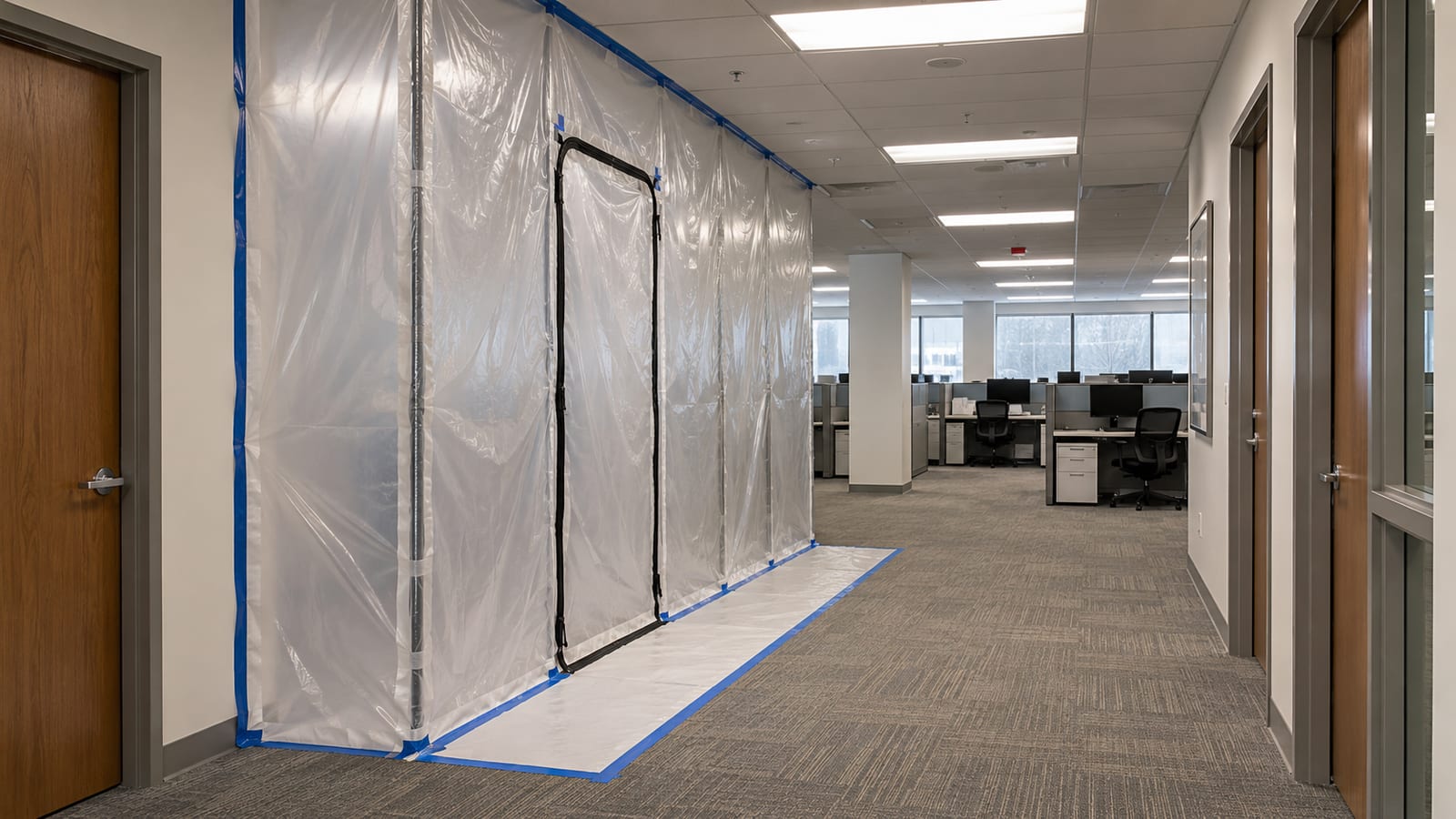
A ceiling tile is stained after a roof leak, or a tenant calls about a smell near the break room, and then someone opens the wall and finds growth. Now you have people at their desks, customers at the counter or students in the hallway, and no good way to close the doors for a week. Commercial mold remediation in New Jersey is built for this situation, because the work can be sealed off, scheduled around your day and documented from the first photo to the last invoice. Your first jobs are small ones: keep people away from the wet or damaged area, stop the water if you can do it safely, and take photographs before anything is moved. The rest is a written plan that says which rooms stay open, how air is kept from traveling, who is told what, and what has to be true before anyone moves back in. The sections below follow that plan in the order it happens.
Key Takeaways
Containment decides what stays open
EPA's commercial guidance calls for limited containment at roughly 10 to 100 square feet and full containment above 100 contiguous square feet or whenever occupants could be exposed, so a sealed work zone can sit beside working offices.
Moisture comes first
the leak, condensation or humidity that fed the growth has to be corrected, or the mold can return after cleanup.
Finished means documented
ask for the scope, moisture readings, photographs, waste records and a written reoccupancy statement, and decide before work starts who will verify the result.
Price and schedule follow your building
affected area, hidden damage, HVAC involvement, after-hours work and verification set both, so ask for a phased written scope instead of a single number.
An Occupied Building Needs a Phased Plan, Not a Shutdown
Most commercial mold starts with water: a roof leak, a failed supply line, HVAC condensation, seepage into a lower level, or humidity that never dries out. Visible growth is often only part of the affected area. Moisture can travel behind drywall, wallpaper and paneling, above ceiling tiles, under carpet, and into pipe chases and roof assemblies, so what you see on a wall tells you where to start looking rather than where the problem ends.
Because the building keeps running, the question is how to separate the work from the people. You can isolate the affected area and keep everyone else working, move the occupants of that area to another space for a short time, or restrict access to that part of the building until it is under control. EPA's guidance for schools and commercial buildings treats remediation as a planned sequence for this reason: fix the water or humidity source, clean and dry the area, remove contaminated materials carefully, keep talking with occupants, and revise the plan if hidden damage turns up.
What is the difference between mold removal and mold remediation?
Removal usually means taking the growth or contaminated materials out of a space. Remediation is the larger project: correcting the moisture source, controlling spread, containing the work, removing or cleaning materials, drying the structure, handling HVAC or hidden growth when involved, and verifying the result. The ANSI/IICRC S520 standard from the IICRC describes remediation this wider way; it is an industry procedural standard, not a New Jersey law. Our commercial mold remediation work follows that wider scope.
The First Day Sets the Scope
What you do in the first hours costs nothing. Stop or control the water if you can do it safely. Keep occupants away from visible growth, wet materials, demolition and any HVAC equipment that may be contaminated. Leave concealed areas alone, because cutting, sanding or stripping wallpaper before the work zone is controlled can spread growth into clean rooms. Photograph the stained ceiling, wet carpet, equipment and surrounding rooms, then tell the building owner, facility manager, tenant representative or employer, and your insurer if the event may be covered.
The First Hours Checklist
Control the water
Stop or control the water if you can do it safely.
Keep people away
Keep occupants away from visible growth, wet materials, demolition and any HVAC equipment that may be contaminated.
Leave concealed areas alone
Cutting, sanding or stripping wallpaper before the work zone is controlled can spread growth into clean rooms.
Photograph before anything moves
Capture the stained ceiling, wet carpet, equipment and surrounding rooms.
Tell the right people
The building owner, facility manager, tenant representative or employer, and your insurer if the event may be covered.
By the end of the day you want an assessment that names the moisture source, the affected materials, places growth may be hiding, whether the HVAC system touches the area, where people walk, and where a containment boundary could go. A commercial mold inspection is built around those questions. Visible growth usually does not need sampling before work begins, according to EPA's page on whether sampling is necessary, so the day-one assessment is mostly about moisture, extent and access.
If someone has symptoms that seem tied to the workplace, that person should see a physician. Also ask whether the repair or rebuild needs permits; New Jersey's Uniform Construction Code can apply.
Work Is Sequenced Around Tenants and Employees
A good plan reads like a schedule you could hand to a tenant. It names the sequence (assessment, source correction, containment, removal, cleaning, drying, verification, rebuild) and the people and routes around it: employee schedules, school operations, deliveries, elevators, waste paths and emergency exits. The waste route through hallways and loading areas belongs in the plan.
The Sequence of an Occupied-Building Job
- 1
Assessment
Names the moisture source, the affected materials, places growth may be hiding, whether the HVAC system touches the area and where a containment boundary could go.
- 2
Source correction
The leak, condensation or humidity that fed the growth is fixed, or the mold can return after cleanup.
- 3
Containment
A temporary room is built around the work, limited or full depending on the size of the problem and the risk to people nearby.
- 4
Removal
Porous materials that cannot be cleaned come out in sealed, impermeable bags.
- 5
Cleaning
HEPA vacuuming and damp wiping with detergent.
- 6
Drying
Drying is documented before any wall is closed.
- 7
Verification
The criteria are agreed in writing and a named party checks the result.
- 8
Rebuild
Drywall, ceilings and finishes go back once the area is dry and cleared.
After-hours work is a main tool for an occupied building. OSHA's mold bulletin recommends scheduling remediation for off-hours when occupants are less likely to be affected. In practice that can mean evening or weekend demolition, floor-by-floor sequencing so one level is under work at a time, and temporary moves for the people closest to the work zone.
What do you tell occupants?
OSHA says owners, managers and employers should tell occupants in affected areas that mold is present, what is being done and when it should be finished. A one-page notice covers most of it:
- Where: the affected area, and the areas that stay open.
- HVAC: whether the system serving the area is isolated.
- When: work dates and hours, with expected noise, odors and access limits.
- Relocation: any temporary move or work-from-home arrangement.
- Contact: one person who takes tenant or employee questions.
- Reoccupancy: the conditions that must be met before people return.
What does New Jersey require of owners and employers?
New Jersey has no general mold-specific notice rule and no state exposure limit, and the Department of Health states there are no standards for acceptable mold levels in buildings. Your duties come from workplace-safety law, your lease, your contracts and the facts of the incident. Under OSHA's General Duty Clause, private employers must provide a workplace free from recognized hazards likely to cause death or serious physical harm, and OSHA's indoor air quality FAQ explains that there is no specific indoor-air-quality standard. Public employers fall under PEOSH. A tenant with an unrepaired leak should contact the local building-code office, as the Department of Health advises. For a disputed notice deadline, ask an attorney.
Containment, Negative Air and HVAC Isolation Keep the Work Zone Closed
Containment is a temporary room built around the work. EPA's remediation guide ties the type to the size of the problem and the risk to people nearby:
- Limited containment: roughly 10 to 100 square feet. It generally uses a single layer of fire-retardant polyethylene sheeting, sealed vents and openings, and a controlled entry.
- Full containment: more than 100 contiguous square feet, or whenever occupants could otherwise be exposed. It generally uses double polyethylene sheeting and an airlock or decontamination chamber.
Square footage alone should not decide the level; a small patch above a reception desk can need more protection than a larger one in an empty storage room.
Hover or tap a row to highlight it.
| Level | When it applies | Barrier | Entry |
|---|---|---|---|
| Limited containment | Roughly 10 to 100 square feet | Generally a single layer of fire-retardant polyethylene sheeting, with vents and openings sealed | A controlled entry |
| Full containment | More than 100 contiguous square feet, or whenever occupants could otherwise be exposed | Generally double polyethylene sheeting | An airlock or decontamination chamber |
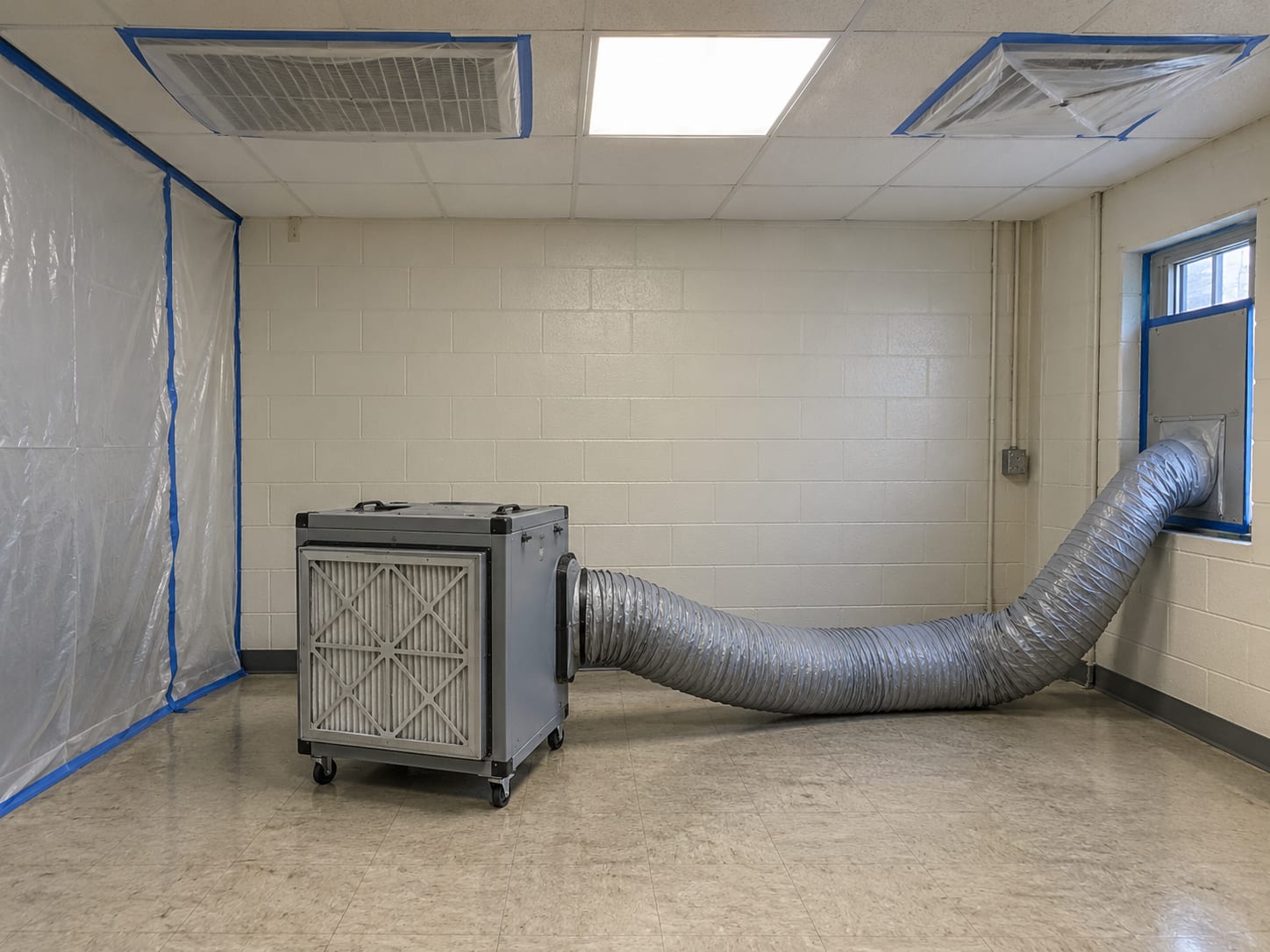
Inside the barrier, the air is held under negative pressure, a little lower than the air outside it, so leaks pull inward instead of out. EPA describes a HEPA-filtered fan exhausted outdoors as one way to do this. A HEPA filter captures very fine particles, and the exhaust path has to suit the building, weather, fire-safety rules and HVAC layout.
HVAC needs its own decision. EPA states that a system known or suspected to be contaminated should not be operated, and that HVAC remediation should involve professionals experienced with those systems. Vents, returns, doors, chases and risers inside the work zone get sealed. A ceiling plenum that works as a return-air path makes ceiling growth more serious, because the air moving through it reaches other rooms. Our page on HVAC mold remediation covers jobs that involve ducts or air handlers.
What do professionals use to remediate mold?
There is no single chemical. EPA and OSHA describe moisture and humidity meters, physical containment, HEPA-filtered air equipment, negative air, HEPA vacuuming, damp wiping with detergent, controlled removal of porous materials that cannot be cleaned, sealed waste bags, and protective and respiratory equipment where required. In older buildings, possible asbestos or lead gets its own check.
Timing and Cost Depend on the Scope in Your Building
Nobody can give an honest duration or price for an occupied commercial building before the scope is known. The moisture source, the area affected, hidden damage, building materials, HVAC involvement, drying needs, tenant access, work-hour limits, permits, waste handling, verification and rebuild set both.
How long does commercial mold remediation take?
In our experience, a straightforward single-room or single-suite project can often be finished in one to three days when the moisture source is already resolved. Larger projects with several floors, extensive drywall removal, HVAC work or structural drying take longer and are sequenced in phases. If more damage appears once a wall is open, EPA says the plan should be revised, so ask any contractor for a phased schedule that ties each phase to an area, to moisture correction, to HVAC work and to verification.
How much does professional mold removal cost?
Ask for a written estimate that lists containment, removal, drying, verification, repairs, permits and after-hours work as separate items. That lets you compare bids on the same basis. Professional involvement tends to pay for itself when growth is extensive, hidden, tied to HVAC, close to occupied rooms or part of a larger water loss, and the written scope becomes the record for owners, occupants and insurers.
You Know the Work Is Finished When the Criteria Are Met in Writing
A contractor saying the visible work is done is not the same as a finished project, so agree on the criteria at the start. EPA's post-remediation guidance points to these indicators:
- Moisture: the source is corrected and the area is dry.
- Appearance: a visual inspection shows no evidence of present or past mold growth.
- Odor: no moldy or musty smell remains.
- Use: the space can be occupied without persistent health complaints tied to the remediated conditions.
- Sampling: if air sampling is done, it supports the visual and sensory inspection and does not replace it.
EPA notes that sampling is usually not necessary to judge whether remediation worked. Neither EPA nor the Department of Health's mold guidance sets a numerical clearance level, so the criteria you write into the contract become the standard for your project. Also settle who verifies: an independent indoor environmental professional, a qualified consultant, the remediation company or another party you name. Our commercial mold testing page explains how sampling fits when a project calls for it.
What do you throw away after mold remediation?
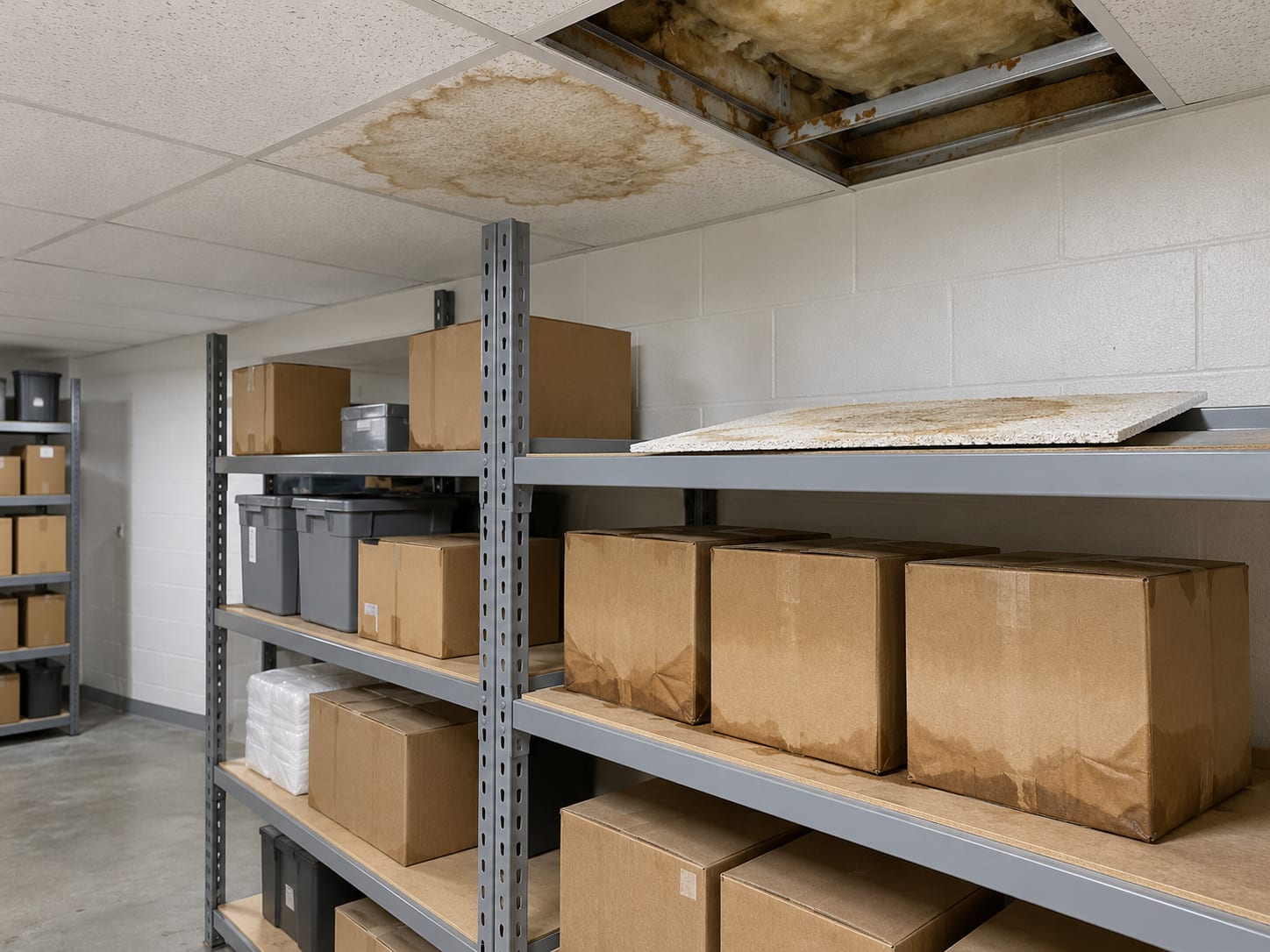
Wet, mold-contaminated porous materials that cannot be cleaned effectively are the usual candidates: affected drywall, insulation, ceiling tiles, carpet and carpet padding. OSHA says materials that cannot be cleaned should be removed in sealed, impermeable bags. Disposal rules change if asbestos, lead, sewage or chemicals are present, so ask how each material is handled and documented. If a claim is open, hold damaged materials until the insurer has had a chance to inspect them.
Request the closeout package in writing before the project begins: the final scope and areas addressed, moisture-source correction records and drying readings, photographs before, during and after, the containment and HVAC controls used, waste records, the verification report and any sampling results, remaining limitations and maintenance actions, permit and rebuild documents, and a written statement on whether the space is ready for reoccupancy under the agreed criteria.
What a Closeout Package Contains
Scope
The final scope and the areas addressed.
Moisture records
Moisture-source correction records and drying readings.
Photographs
Before, during and after the work.
Controls used
The containment and HVAC controls used.
Waste records
How removed materials were handled and documented.
Verification
The verification report and any sampling results.
Limitations
Remaining limitations and maintenance actions.
Permits and rebuild
Permit and rebuild documents.
Reoccupancy statement
A written statement on whether the space is ready under the agreed criteria.
Insurance, Permits and Rebuild Planning Start Early
New Jersey's Department of Banking and Insurance advises policyholders to report a loss promptly, ask which documents are required, make the temporary repairs needed to prevent further damage, keep receipts, photograph the damage and avoid discarding damaged property until the insurer has inspected it. Permanent repairs should wait for the adjuster unless something must be done right away to protect the property.
What a policy pays depends on the policy. The department's Bulletin 02-14 described a mold and fungus coverage option for ISO-member policies with a $10,000 annual aggregate and optional limits of $25,000 and $50,000, plus coverage for removal, tear-out needed to reach contamination, and testing when the loss came from a covered peril. Those figures describe 2002 forms; your declarations page, exclusions and deductible control your claim, so ask the carrier in writing whether mitigation, testing, remediation, contents, business interruption and rebuild costs are covered. Our insurance restoration services page describes how we coordinate with adjusters.
Demolition, plumbing, electrical, HVAC and structural repair can fall under the Uniform Construction Code, N.J.A.C. 5:23, and your local construction official can tell you what applies. New Jersey does not certify mold companies, so check a contractor's qualifications, insurance, experience, written scope and safety procedures yourself. When drywall, ceilings and finishes come out, a post-mold-remediation rebuild puts them back once the area is dry and cleared.
Keeping Mold From Coming Back Means Keeping the Building Dry
Mold returns when the water source remains, hidden growth was missed, wet materials were closed up before drying, or contaminated HVAC components keep moving material through the building. EPA states that moisture control is central to a lasting result.
Can mold grow back after remediation?
It can, and prevention is mostly maintenance. Repair the roof flashing, pipe or condensate line that caused the event and confirm the repair before finishes go back. Have drying documented before any wall is closed. Watch the places that fed the first problem, such as ceiling tiles under roof drains, mechanical rooms, exterior walls and lower levels, and respond to the next stain or odor fast. If mold keeps appearing in one place, the water source is still active, and the next step is a moisture investigation.
Frequently Asked Questions About Commercial Mold Remediation New Jersey
Can the building stay open during mold remediation?
Often it can. Containment, negative air, sealed HVAC and after-hours or floor-by-floor scheduling let the affected area be isolated while other areas operate, and occupants nearest the work may need a temporary move. The size and location of the growth, the HVAC layout and the access routes decide it, and a site assessment settles all three.
Is testing required before remediation in New Jersey?
No. EPA says visible mold usually does not need sampling before remediation, and New Jersey has no rule requiring a test first. Sampling helps when the source is unclear or documentation is needed, and it should be tied to a question you want answered.
Occupied-Building Mold Work, Quick Check
1. When does EPA call for full containment?
2. When does OSHA recommend scheduling remediation?
3. Does New Jersey require a test before commercial mold remediation?
4. What should be settled in writing before the work starts?
Pick an answer to begin.
The Bottom Line
An occupied building does not have to close for mold work. A written plan, a sealed work zone under negative air, isolated HVAC, after-hours scheduling and clear notices to occupants let the rest of the building keep operating, and the finish line is defined in writing: a dry structure, no visible growth or odor, a named verifier and a closeout package.
Planning early protects your tenants and staff, keeps the claim and permits in order, and leaves records you can use if the building is ever sold or leased. Fixing the moisture source keeps the result in place.
If you manage or own a commercial property anywhere in New Jersey and have found mold, call ExecPro Restoration & Cleaning at (888) 300-3772 or contact us and we will walk the building, name the moisture source and give you a phased written scope. We handle commercial mold inspection, remediation, water damage restoration and rebuild work, so one team can keep your doors open and your records complete.
Occupied-Building Mold Terms
Tap a term to see what it means.
Remediation. The larger project: correcting the moisture source, controlling spread, containing the work, removing or cleaning materials, drying the structure, handling HVAC or hidden growth when involved, and verifying the result.
Related Articles
Mold Testing in New Jersey Commercial Buildings: What Gets Sampled and What the Results Mean
Mold testing for a New Jersey commercial building: when sampling helps, how air, surface and bulk tests differ, and how to read the lab report.
Pre-Purchase Mold Inspection in New Jersey: What Buyers Get Before Closing
A pre-purchase mold inspection in NJ covers what a home inspection excludes. See who pays, how long it takes and what to do if mold turns up.
Mold in a Commercial Property: A New Jersey Property Manager's First Week
Tenant reported mold in your commercial property? Follow a New Jersey property manager's first-week plan: document, contain, scope the work and close out.