ERMI Mold Test: What It Measures and What the Score Means
Cal HewittPublished
- mold testing
- sampling
- indoor air quality
- new jersey
An ERMI mold test turns up in a doctor's note, a forum thread or a test kit ad, and it comes with a single number that sounds like an answer. Before you order one, it helps to ask a plainer question: would a dust result change what you do next?
If you can see mold, New Jersey Department of Health guidance puts the effort into correcting the moisture and cleaning the growth, and says further testing is not necessary. If you only smell something or suspect a hidden leak, a dust test may have a place, but beside an inspection and moisture readings rather than in place of them.
What follows covers what the test measures, how the dust gets collected, what it costs, and what to ask a provider in writing before you pay. By the end you can say what question a test would answer for your property and what the score can support.
Key Takeaways
ERMI compares dust to a reference set
A lab measures mold DNA from 36 indicator molds in settled dust and reports one relative index against a reference distribution of U.S. homes.
EPA calls it a research tool
EPA has not validated ERMI for non-research purposes and does not recommend routine public testing in homes, schools or other buildings.
Visible mold means moisture and cleanup first
New Jersey Department of Health guidance says additional testing is not necessary when mold is visible.
Ask for the numbers in writing
One lab lists ERMI at $240 to $435, and shipping, rush service and any professional interpretation can change the total, so request a quote and a full calendar timeline.
ERMI Compares the Mold DNA in Your Dust With a Set of U.S. Homes
ERMI stands for Environmental Relative Moldiness Index. EPA scientists developed it through research tied to HUD's American Healthy Homes Survey, where standardized dust samples from a nationally representative set of U.S. homes were analyzed. A lab measures settled household dust for 36 indicator molds using mold-specific quantitative PCR, a DNA-based method that counts the genetic material each mold leaves behind.
The 36 molds fall into two groups. Group 1 holds 26 molds associated with water-damaged homes. Group 2 holds 10 molds that mostly enter a home from outdoors and are commonly found even where there has been no water damage. The lab converts each concentration to a base-10 logarithm, adds up the Group 1 numbers, adds up the Group 2 numbers, and subtracts the second total from the first. Subtracting Group 2 helps account for differences in outdoor ecology, ventilation, window use, air conditioning and cleaning habits.
The result is your ERMI score: one relative index showing how your dust compares with the reference homes used to build the scale. EPA's 2021 fact sheet describes that scale as running from about -10 to about 30. The number reflects a panel of mold-DNA measurements in dust. It is not a direct reading of total fungal exposure, airborne mold, or the mold in every part of the house.
Does the EPA Recommend ERMI Testing?
EPA's fact sheet says ERMI was developed for research studies on mold exposure and health impacts, and that it has been peer-reviewed for research purposes but not validated for non-research purposes. EPA does not recommend routine public ERMI testing in homes, schools or other buildings. EPA also says that inspection for water damage and mold remains the key part of its current mold-assessment guidance, which matches New Jersey's order of a visual inspection first.
Moisture Signs Come Before Any Dust Test
Whatever you decide about testing, the first hours and days look the same. In the next hour, photograph and write down visible staining, musty odors, leaks, flooding, condensation and the rooms where you have concerns. Leave suspected growth undisturbed, and do not treat an ERMI number as the thing that decides whether the building is safe.
In the next day, look for active moisture around plumbing, the roof, the foundation, the basement, crawl spaces, bathrooms, HVAC equipment and any wall or ceiling with water staining. A visual inspection and a moisture assessment connect to the cause far more directly than one settled-dust score does.
What Are the Signs Your House Has Mold?
The Department of Health lists visible mold, stained or discolored areas that keep growing or changing color, and a pungent musty smell as indicators that mold may be present. Water intrusion, flooding, persistent dampness, condensation and moisture-damaged materials are reasons to investigate the building even when nothing is visible yet. EPA's guidance points the same direction.
When growth is visible, the state's advice is to correct the moisture and clean the contamination. For a patch you can see, professional mold removal addresses that directly, and a dust score would not add much to the plan.
The Dust Sample Comes From a Vacuum Pass or a Swiffer-Style Pad
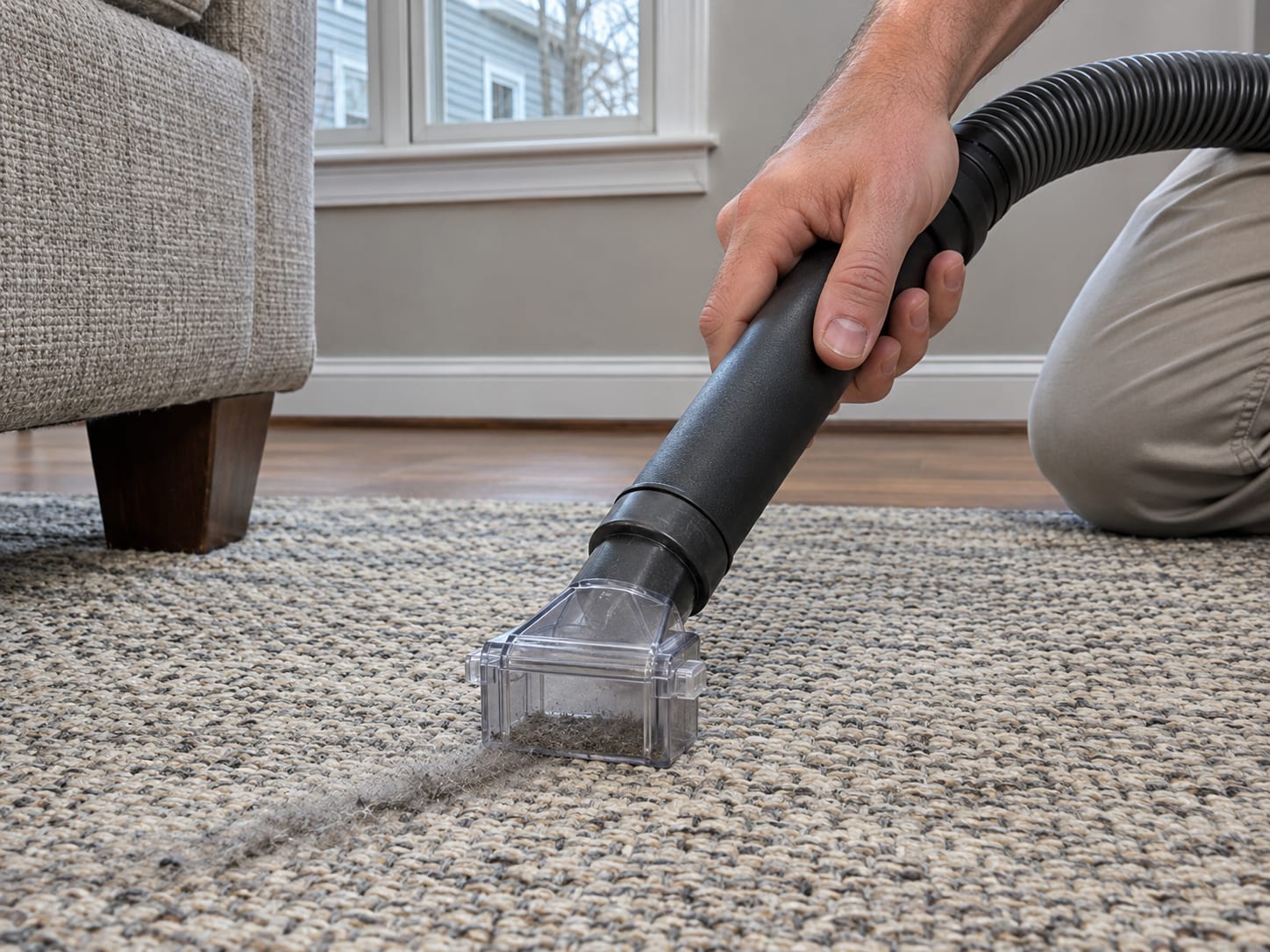
ERMI is built around settled dust, which builds up over time, rather than a momentary air sample. That is why the collection method matters as much as the lab. The EMLab P&K sampling instructions call for vacuuming about 2 square meters in a living room and 2 square meters in a bedroom, five minutes per area, with a vacuum fitted with a Mitest sampler or a DustChek cassette. The aim is roughly 30 to 100 milligrams of dust.
EMSL's instructions allow a residential sample to use one vacuum dust collector for a composite of the living room and bedroom. Dust from other areas, beyond the living room, family room or bedroom, goes into its own collector. Some providers also offer Swiffer-style collection, and EnviroBiomics lists both vacuum and Swiffer kits, with analysis of 36 mold species that includes ERMI and HERTSMI-2 information.
Do At-Home Mold Test Kits Really Work?
At-home ERMI kits can collect settled dust for laboratory DNA analysis, and providers offer vacuum and Swiffer-style options. What you get back is still a relative dust index, and it describes your dust compared with the reference homes, not the walls, the air or the moisture behind them.
If your question is where the mold is or why it is there, an inspection with moisture readings is the faster route to an answer.
Inspection, Moisture Readings and Air Samples Answer Different Questions
Each method tells you something different, and it helps to match the method to the question. ERMI shows how your sampled dust compares with the reference scale and which of the 36 mold targets were detected. A visual inspection identifies visible growth, staining, odors, damaged materials and likely moisture pathways. Moisture readings find damp building materials and help locate active or past water intrusion. Air samples characterize the spores in the air during the sampling period and are often compared with outdoor air.
Hover or tap a row to highlight it.
| Method | What it tells you |
|---|---|
| ERMI | How your sampled dust compares with the reference scale, and which of the 36 mold targets were detected |
| Visual inspection | Visible growth, staining, odors, damaged materials and likely moisture pathways |
| Moisture readings | Damp building materials, and active or past water intrusion |
| Air samples | The spores in the air during the sampling period, often compared with outdoor air |
On its own, an ERMI result cannot locate the moisture source, show whether mold is behind a particular wall, establish the size of a mold condition, measure the air you are breathing at a given moment, set a legal exposure level, or prove that remediation is complete. A high score is not proof of the exact room or wall with the problem, and a low score is not proof that hidden mold is absent.
What an ERMI Result Cannot Do on Its Own
Locate the moisture source
A dust score does not point to where the water is getting in.
Show whether mold is behind a particular wall
A high score is not proof of the exact room or wall with the problem.
Establish the size of a mold condition
It compares your dust with reference homes; it does not measure how much mold there is.
Measure the air you are breathing right now
ERMI reads settled dust that builds up over time, not a momentary air sample.
Set a legal exposure level
No such level comes from an ERMI result.
Prove that remediation is complete
A low score is not proof that hidden mold is absent.
An inspector might still reach for ERMI when a defined settled-dust question exists and the result can be read alongside a full inspection, such as a suspected hidden condition where the visual inspection has not found the source. Our mold inspection and mold testing services cover visual inspection, moisture readings, and air and surface sampling with third-party laboratory analysis.
How Accurate Is the ERMI Mold Test?
ERMI gives a standardized relative comparison from DNA measurements of 36 molds in settled dust. EPA says it cannot comment on the accuracy of results from others using ERMI, because the approach has not been validated through a multi-laboratory study. The Department of Health adds that sampling alone usually does not give all the information needed to judge the extent of a mold and moisture problem.
Is a Mold Test Accurate?
Any mold test can give useful information when it answers a defined question and is read with the building's moisture history, the visible conditions and the sampling location. One result cannot establish that a property is safe or unsafe. When mold is suspected but not visible, the state says qualified sampling may help determine species, concentrations and whether mold is actively growing.
HERTSMI-2 is a smaller mold-DNA index derived from selected ERMI-related mold groups, and some laboratories sell it as a separate report or interpretation. EPA's public ERMI guidance does not establish HERTSMI-2 as a validated public clearance or health test, so treat it as another way to read dust DNA rather than an approved standard.
Listed ERMI Prices Run From $240 to $435 Before Shipping and Interpretation
The price of an ERMI test depends on the provider, the kit and how fast you want the report. The total stacks up from the collection kit, the laboratory processing speed and anything a professional adds, such as an inspection or an explanation of the report. Knowing which of those a quote includes lets you compare real numbers instead of headline prices.
How Much Does an ERMI Test Cost?
EnviroBiomics, one named commercial laboratory, listed ERMI testing at $240 to $435 on its product page in November 2026. The price varies by collection kit and processing speed, with same-day, one-day and overnight processing options. Processing time is counted in business days after the lab receives and checks in the sample. Shipping time and the time it takes you to collect the dust come on top, and the page gives no single total turnaround because kit delivery, return shipping and processing are separate steps.
Hover or tap a row to highlight it.
| Line item | What to know |
|---|---|
| Listed range at one lab | $240 to $435 on EnviroBiomics' product page in November 2026 |
| Collection kit | The price varies by kit |
| Laboratory processing | Same-day, one-day and overnight options, counted in business days after the lab receives and checks in the sample |
| Shipping | Kit delivery and return shipping are separate steps on top of processing time |
| Rush service | Can change the total |
| Professional inspection or interpretation | Anything a professional adds, such as an inspection or an explanation of the report |
Other labs set their own prices, so ask each one for a written quote that separates the kit, shipping, laboratory processing, rush service and any professional inspection or interpretation. Ask for the full calendar timeline too, from the day you order to the day the report is released.
From Order to Report
- 1
Order placement
Ask the provider for the full calendar timeline before you pay.
- 2
Kit delivery
Shipping time to you is a separate step from lab processing.
- 3
Collect the dust
A vacuum pass of about 2 square meters in a living room and 2 in a bedroom, five minutes per area, aiming for roughly 30 to 100 milligrams of dust.
- 4
Return shipping and sample receipt
The lab receives and checks in the sample before processing time starts.
- 5
Laboratory processing
Same-day, one-day and overnight options, counted in business days.
- 6
Report release
Ask whether you also receive the raw laboratory data, the sampling location and the collection method.
Will Insurance Pay for a Mold Test?
Coverage depends on your policy, the cause of the loss and the circumstances of the claim. New Jersey Department of Banking and Insurance Bulletin 03-24 describes mold/fungus coverage guidelines with a $10,000 annual aggregate option that includes testing of air or property to confirm the absence, presence or level of mold, fungi, wet or dry rot or bacteria, when the mold loss results from a peril insured against during the policy period. It also describes optional higher limits of $25,000 and $50,000.
Call your insurer or claims representative before you order anything, and ask what documentation it wants.
Settle the Question and the Paperwork Before You Order
When testing is appropriate, the Department of Health says a qualified person should perform the sampling. New Jersey has no state certification program for companies that perform mold or general indoor-air services, and the state's lists of consultants, laboratories and remediation firms are not endorsements, so ask each provider about its qualifications and how it will read the results. Choose a test because the result will change a decision, not because it produces a number.
Put these questions to the provider in writing before you pay:
- Timeline: the full calendar from order placement through kit delivery, sample receipt and report release.
- Quote: kit, shipping, processing, rush service and any professional interpretation listed on separate lines.
- Report contents: whether you receive the raw laboratory data, the sampling location, the collection method and the turnaround.
- Verification criteria: if a cleanup is planned, the written criteria for checking it, and whether they rely on visual inspection, moisture conditions, air sampling, surface sampling or another defined method.
- Insurer position: what your insurer says about the claim before the order goes in.
After a cleanup, EPA's guidance centers on fixing the moisture source, removing or cleaning damaged materials, eliminating visible mold and moldy odors, and conducting a visual review. EPA says bioaerosol sampling is usually not necessary to judge whether remediation worked and may be less effective than visual and sensory surveys. A post-remediation ERMI result should not stand in for written criteria, which is what post-remediation verification documents.

A Score Cannot Settle a Health Question, but Records Can Protect the Property
An ERMI result does not establish a medical condition or show whether someone's symptoms came from the building. The Department of Health advises talking with a physician about severe exposures or health effects associated with mold. Take your health questions to your doctor and your building questions to an inspector.
For the property, EPA says moisture must be controlled because mold can return if the underlying water problem is not solved. A finished cleanup area should show no visible present or past mold growth, no moldy or musty odors and no unresolved water damage, and EPA describes the final evaluation as a judgment call rather than one numerical pass or fail. If water is still getting in, water damage restoration comes first. In a sale, inspection and laboratory documentation may affect negotiations, repair decisions and the buyer's understanding of the property, though an ERMI score does not set a value adjustment.
Keep photographs, dates of leaks or flooding, repair invoices, inspection findings, laboratory reports, sample locations, chain-of-custody records, the remediation scope, moisture readings and post-remediation verification records together. The New Jersey Division of Taxation says mold inspection or detection services are not subject to sales tax, while mold removal and remediation are taxable as repair or servicing of real property.
Frequently Asked Questions About the ERMI Mold Test
What is an ERMI test?
It is a laboratory analysis of settled household dust for 36 indicator molds using DNA-based quantitative PCR. The lab combines the results into one relative index compared with a reference distribution of U.S. homes. EPA developed it as a research tool.
How does ERMI compare with air sampling?
ERMI reads settled dust, which collects over time. An air sample characterizes the spores in the air during the sampling period and is often compared with outdoor air. They answer different questions, and neither replaces the visual inspection.
Can an ERMI test show that mold remediation worked?
Ask for the written verification criteria before the work begins. EPA's remediation guidance centers on the moisture fix, removal or cleaning of damaged materials, no visible mold or moldy odor, and a visual review.
Test Your ERMI Knowledge
1. How many indicator molds does an ERMI test measure in settled dust?
2. What does EPA say about routine ERMI testing in homes, schools or other buildings?
3. What does New Jersey Department of Health guidance say when mold is visible?
4. Which method finds damp building materials?
5. What should you ask a provider for before you pay?
Pick an answer to begin.
Final Thoughts
An ERMI score compares the mold DNA in your dust with a reference set of U.S. homes. It does not find the moisture, map the mold or answer a health question, and EPA does not recommend routine public testing. When mold is visible in your New Jersey home, moisture correction and cleanup come first, and a dust result adds little to that plan.
A visual and moisture assessment tells you where to act, and a written quote, a full timeline and your insurer's position let you decide about testing with the facts in hand. Records from the first day make every later conversation with a buyer, landlord or adjuster easier.
If you are holding a test ad, a doctor's suggestion or a damp spot you cannot explain, call ExecPro Restoration & Cleaning at (888) 300-3772 or reach us through our contact page. We inspect, test, remediate and rebuild after mold and water damage for homes and businesses across New Jersey.
ERMI Terms
Tap a term to see what it means.
ERMI. The Environmental Relative Moldiness Index, a relative index that compares the mold DNA in your settled dust with a reference distribution of U.S. homes.
Related Articles
Mold Testing in Robbinsville, NJ: Air Samples, Swabs and the Moisture Behind Them
What a mold sample shows is one moment in one room, not the source. See when mold testing in Robbinsville, NJ is worth paying for and who needs the result.
Home Mold Test Kits: What Each Kit Shows and When to Call a Pro
Do mold test kits work? See what settle plates, swabs and mail-in labs record, what a lab fee adds, and when a New Jersey home needs professional sampling.
Commercial Indoor Air Quality Testing in NJ: What Gets Measured
What a commercial indoor air quality test measures in New Jersey buildings, what drives the cost, when mold sampling fits, and what a useful report contains.