Outside the Wall, Then Under It: Basement Mold Remediation in East Windsor, NJ
Cal HewittPublished
- basement mold remediation
- below grade moisture
- foundation drainage
- east windsor nj
Stand outside the house first. Before a lower level in East Windsor ever smells musty, water is usually doing something ordinary in the yard: landing on a roof, leaving a downspout, spreading across soil that leans toward the foundation instead of away from it, and soaking into the ground within a few feet of the wall. From there it has nowhere to go but sideways and down, against the outside face of a wall that is holding back earth all year long.
That is the direction most below grade mold problems actually travel, and it is the reason a basement question is different from any other mold question in the building. The EPA notes that water can enter a building by leaking in from outside or by seeping up through basement floors, which describes two separate doors on the same lower level. Working the problem in the order water travels, from the ground outside to the wall to the slab to the finished surface you can see, keeps the repair aimed at the cause instead of the symptom.
Key Takeaways
The visible stain is the last stop, not the first
By the time growth shows on a finished wall or a stored box, water has already crossed soil, a foundation wall or a slab, and whatever sat behind the finish.
Two doors, not one
EPA describes water leaking in from outside and water seeping up through basement floors as distinct routes, and they call for different corrections.
Grade and runoff belong in the diagnosis
East Windsor's own stormwater information treats runoff as a contributor to flooding, and the same water behavior happens at the scale of a single lot.
Some lower level moisture starts indoors
Air moisture can condense on a cool slab, and plumbing or equipment can wet materials without any exterior water at all.
Someone else may own the outside of your wall
In attached and managed housing, exterior drainage and shared pipes are often not the occupant's to repair.
Cleanup and construction are separate phases
Removing wet material is remediation work, while reconstruction can bring East Windsor's Construction Department into the project.
Start at the Grade, Not at the Stain
Almost every below grade investigation worth trusting begins with a walk around the outside of the building. Where does roof water land, and where does it go after that? Is the soil sloped away from the foundation for the first several feet, or has it settled back toward the wall over the years? Are downspouts discharging next to the foundation or carried well away from it? Is there a window well that fills, a patio that pitches inward, or a low spot that holds water for a day after a storm?
None of this is exotic building science. East Windsor's stormwater information recognizes runoff as a contributor to local flooding, and the same behavior plays out lot by lot. A roof is a large collection surface, and the water it sheds has to end up somewhere. When that somewhere is the strip of soil pressed against a foundation wall, the wall is the next thing in line. Correcting the outside condition is often less expensive than anything that happens inside, and it is the only correction that stops the supply rather than managing the result.
The Wall and the Floor Are Two Different Doors
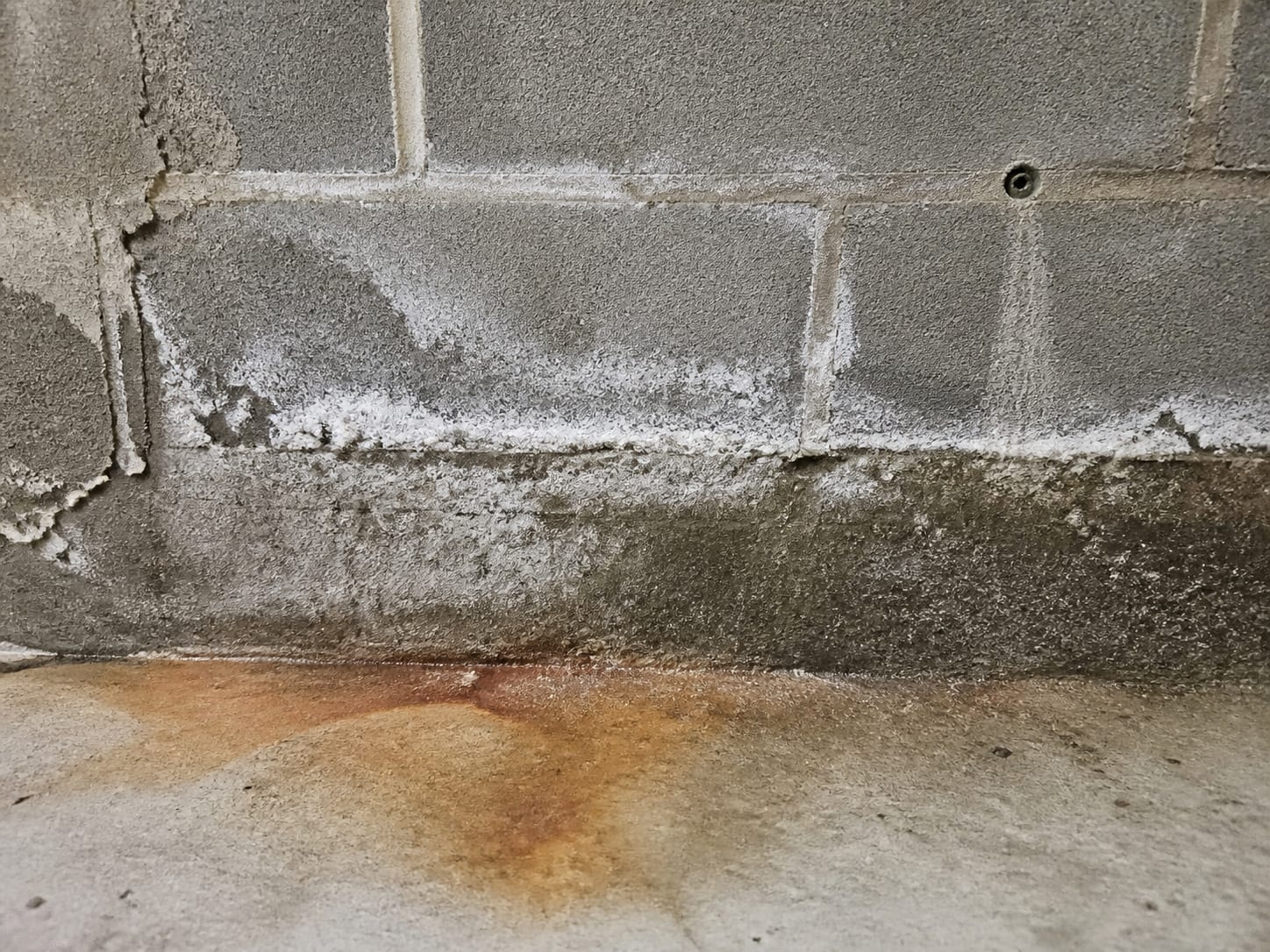
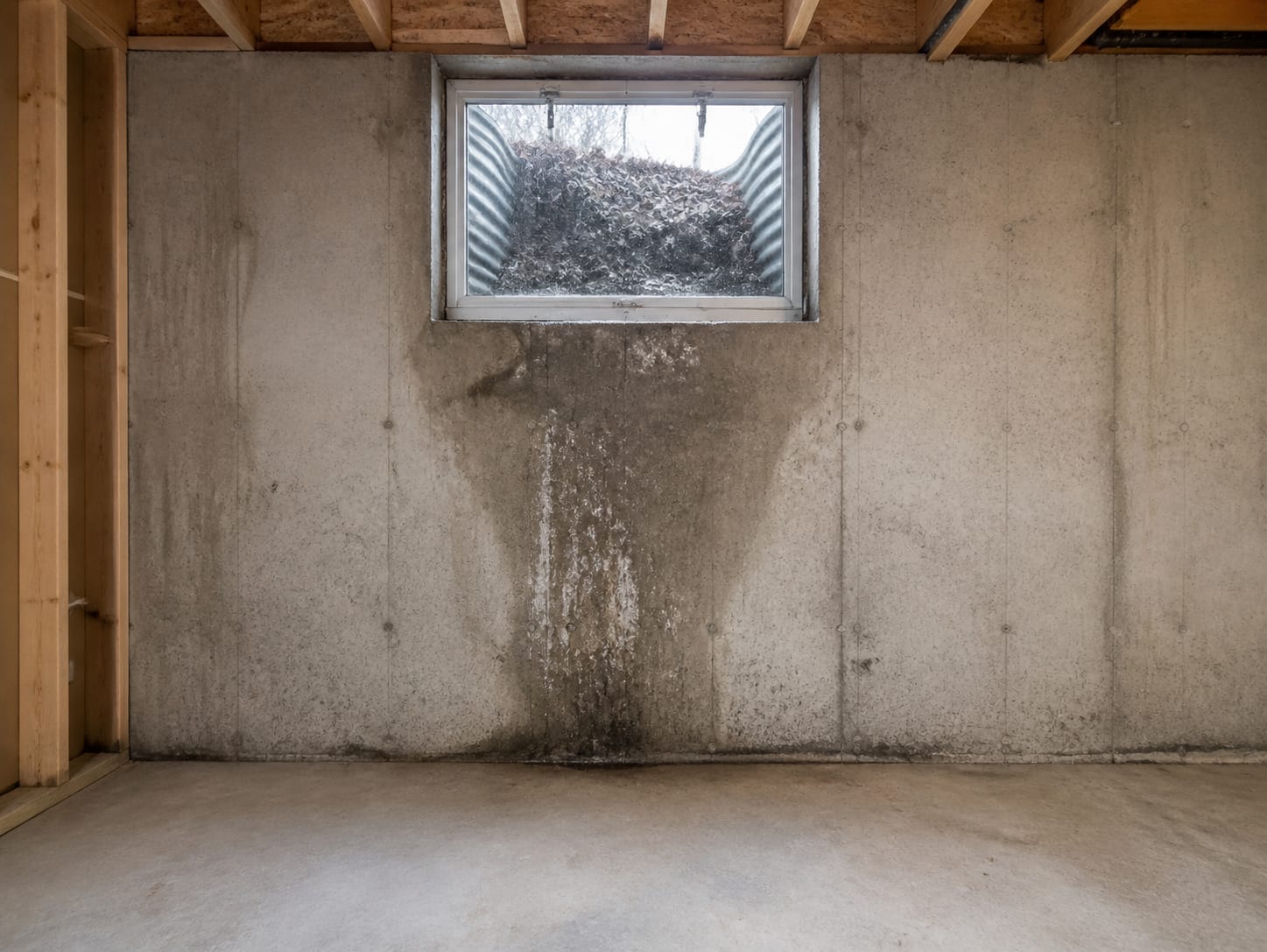
Once water is in the soil beside the building, it has two ways in, and they leave different evidence. Through the wall, it shows up along mortar joints, at tie rod holes, at the cold joint where the wall meets the footing, around a pipe penetration, or in a window well opening. Through the floor, it arrives under hydrostatic pressure and appears at the perimeter seam or in the middle of a slab, sometimes with no wall staining anywhere near it.
That distinction matters because the corrections do not overlap much. A wall entry points toward exterior water management, sealing at a specific penetration, or drainage work. A slab entry points toward what is under and around the floor. Guessing wrong means paying for the wrong fix and finding the same wet material next spring.
Hover or tap a row to highlight it.
| Route in | Where the evidence usually shows | What the correction points toward |
|---|---|---|
| Soil against the foundation wall | Mortar joints, cold joint at the footing, tie rod holes, staining behind finished walls | Grading, downspout discharge, exterior drainage, sealing at the specific penetration |
| Window well or exterior opening | Below the opening, in a localized patch rather than along the whole wall | Well drainage, cover, and the grade feeding the well |
| Seepage up through the slab | Perimeter floor seam, mid floor patches, damp flooring adhesive, wet carpet padding | Drainage below and around the floor, and what the floor finish can tolerate |
| Air moisture condensing on a cool slab | Under carpet, rugs, and stored items directly on the floor, worse in humid weather | Humidity control, flooring choices, and separating stored contents from the slab |
| Plumbing, appliance, or equipment failure | A defined wet area near a fixture, line, or unit, often with a start date the owner remembers | Repair by the responsible trade, then drying and material decisions |
| Inland floodwater during a storm event | Broad, uneven wetting with debris or sediment, not a single entry point | Documented water history, contamination assessment, and possibly a different rebuild path |
Not Everything Below Grade Comes From Outside
The outside in view explains a lot, but it is not the whole story, and pretending otherwise leads to expensive digging on a problem that never involved the yard. The EPA describes air moisture condensing on a cooler slab, which can expose materials like carpet to enough moisture to promote mold. That is an indoor humidity condition, not a drainage failure. A supply line, a water heater, a condensate line, or a washing machine can also wet a lower level thoroughly with the surrounding soil bone dry.
The honest version of this work identifies which of those is happening at a specific address rather than assuming the common case. Crawl space and attic conditions follow their own moisture routes and are handled as separate services, so they are not folded into a basement scope here.
What the Water Finds Once It Is Inside
The order of damage inside is fairly predictable, and it explains why a small visible patch is so often a poor measure of the problem. Water reaching the inside face of a wall meets whatever was built against it: framing, insulation, a vapor layer, drywall, paneling, baseboard, and the flooring at the bottom of all of it. Those materials are porous, they hold moisture at different rates, and the finish on the room side hides the wet edge from view.
Stored contents are the second target, and in many lower levels they are the reason anyone noticed. Cardboard sitting on a slab and fabric in a closet along an exterior wall pick up moisture before wood framing looks damp. Beyond that, mechanical equipment, ductwork, insulation, and the underside of the floor above can all be involved depending on the actual event. A documented mold inspection is where those observations get collected in a form a repair scope can use, rather than a general impression that the basement seems wet.
Who Actually Controls the Outside of the Wall
This is the question that decides whether a source correction is even possible for the person making the call. East Windsor has an estimated 12,422 housing units, and about 54 percent of them are single unit structures. That leaves a substantial share of attached and multifamily housing, and Census figures put owner occupancy at roughly 61.1 percent, so renters, landlords, associations, and property managers are all part of the picture. Twin Rivers, identified by the Township as a planned unit development, is one local example of a setting where exterior grading, common drainage, and shared piping are managed rather than individually owned.
In those buildings, an occupant can see the wet wall and still have no authority over the soil, the downspout, the shared line, or the exterior wall assembly that is letting water in. Naming the responsible party early is not a formality. It determines whether the moisture source can be corrected on the same schedule as the cleanup, or whether the cleanup is going to be repeated.
Working the Path in Order
From the Yard to a Finished Lower Level
- 1
Record the water history
Note when the lower level got wet, how often, what the weather was doing, and whether anything changed outside recently, because a pattern narrows the route faster than any single observation.
- 2
Walk the exterior
Check grade, downspout discharge, window wells, patios, and low spots, since the correction that costs the least usually lives out here.
- 3
Distinguish wall entry from floor seepage
Look at where the evidence sits, because water through the wall and water up through the slab call for different work.
- 4
Rule the indoor sources in or out
Confirm or eliminate plumbing, appliances, equipment, and condensation on a cool slab before committing to an exterior theory.
- 5
Define the affected materials
List what is actually wet or affected, including behind finishes and under stored contents, and set the boundary of the cleanup from that list.
- 6
Correct the source, then dry
Address the water route first, then remove or clean materials as the evidence warrants and dry the space, since EPA guidance treats moisture control as the foundation of mold control.
- 7
Separate repair from cleanup
Decide what reconstruction the space needs after drying, and route any code governed work through the Township rather than treating it as part of the cleanup.
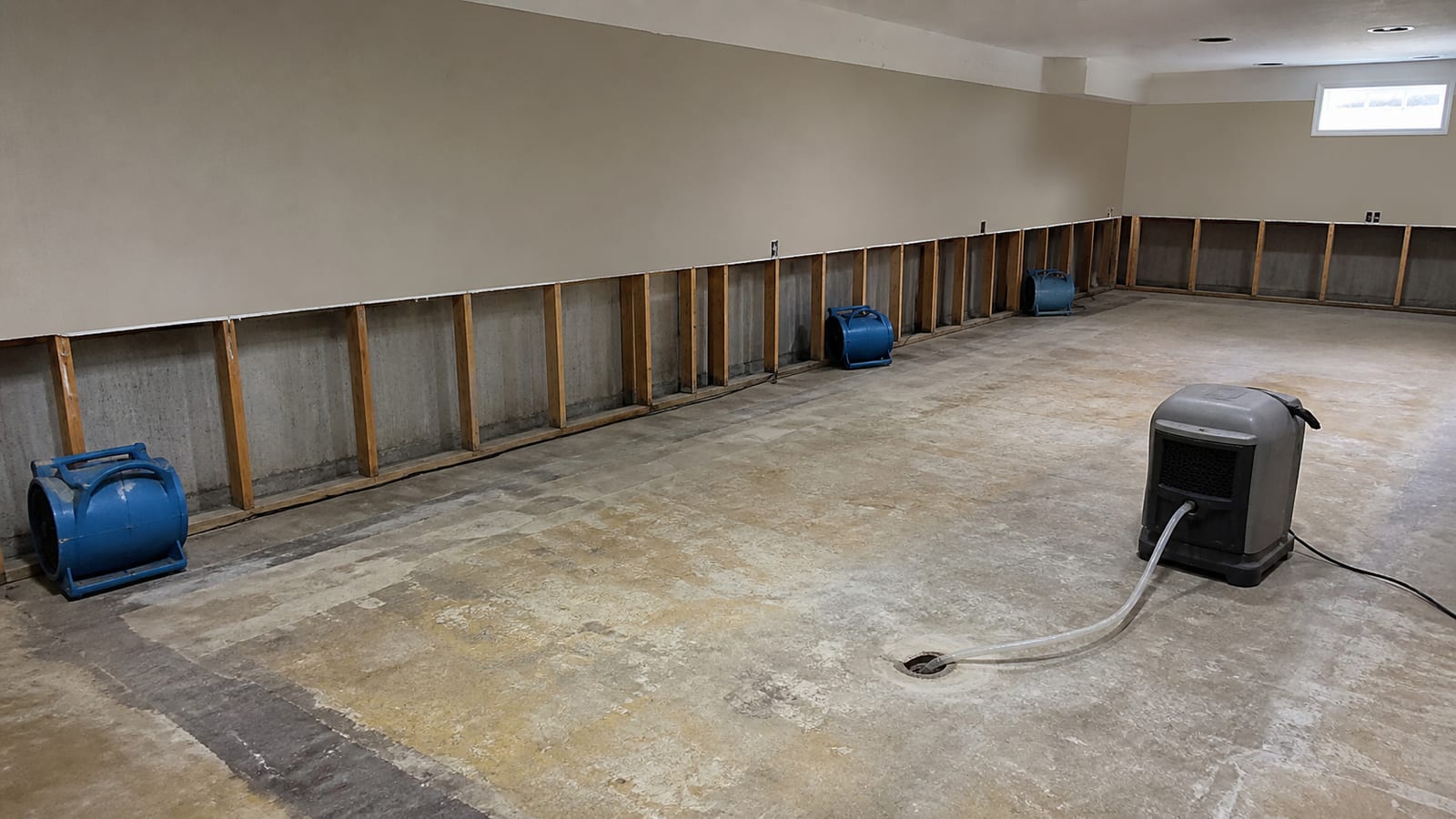
Timing follows those steps rather than a promise. The EPA advises drying wet or damp materials within roughly 24 to 48 hours after a leak or spill to reduce mold growth, which is a useful urgency marker for a fresh event. It is not a completion schedule for a lower level that has been damp for two seasons, where access, hidden wetness, source repair by another trade, and material decisions all set the pace. Where the drying itself is the heavy part of the job, structural drying equipment and monitoring is the piece that verifies the space actually reached dry rather than looking dry.
Where East Windsor Enters the Project
Cleanup by itself does not automatically involve the Township. The line gets crossed when the work becomes alteration or reconstruction. East Windsor's Construction Department administers the Uniform Construction Code locally and handles building, electrical, fire, mechanical, and plumbing applications, plan review, and inspections. If a lower level repair reaches those systems, that office is the one that decides what applies, and its permit fees are calculated as the sum of the applicable subcode fees rather than a single flat amount for a basement job.
There is a second local layer that only matters in specific circumstances. The Township maintains flood hazard maps and studies, and its technical standards require anyone proposing development in a flood hazard area to apply to the Floodplain Administrator and obtain the required permits. Those standards also address elevation requirements for new or substantially improved habitable buildings, including basements and attendant utilities. None of that establishes that a particular property sits in a mapped flood hazard area, and no one should assume it from a neighborhood impression. It is checked against the Township's own records, and it is checked with East Windsor rather than with West Windsor or Hightstown, which are separate municipalities running their own processes.
What Moves the Cost
There is no standard published price for this work in East Windsor, and any figure offered before someone looks at the space is a placeholder. The real drivers are all scope facts: whether the source is a one time spill or an ongoing exterior entry, the size and number of affected lower level spaces, how much porous finish and stored contents are involved, how accessible the wet areas are, whether hidden material has to be exposed to be assessed, the water category, the amount of drying required, and what the source repair itself takes.
Costs move sharply in a few predictable situations. A managed property that needs common area access adds coordination. An active source that requires another trade adds a dependency. Work that reaches permitted plumbing, mechanical, electrical, or structural repair adds a municipal step with its own fees. A transparent scope separates those lines instead of blending them, and our basement mold remediation service page sets out what the cleanup portion covers.
Frequently Asked Questions About Basement Mold Remediation in East Windsor NJ
How do I tell whether water came through the wall or up through the floor?
Look at where the evidence sits before anything gets torn out. Wall entry tends to show along mortar joints, at the joint where the wall meets the footing, around penetrations, or below a window well, and it is often localized. Floor seepage shows at the perimeter floor seam or in the middle of the slab, sometimes with dry walls above it. The two point toward different corrections, so it is worth establishing before spending money on either one.
My basement only gets damp after heavy rain. Is that still a mold problem?
Intermittent wetting is enough to support growth if the material stays damp long enough between events, and it usually points toward an exterior route rather than a plumbing failure. The rain link is useful information, not a reason to wait. It tells you where to look first, which is the grade, the downspouts, and the window wells outside the affected area.
Do I need a permit to clean up mold in my basement?
Cleanup on its own does not automatically require one. The question arises when the work turns into repair or reconstruction that touches regulated building, electrical, mechanical, or plumbing systems. East Windsor's Construction Department is the office that determines what applies to a specific scope, and confirming with them once the repair is defined is more reliable than assuming either way.
Does the age of my house tell me whether the basement will have problems?
Not by itself. Local data shows a mixed age housing stock, with a small share built before 1950, and that supports a general description of the Township rather than a conclusion about any one address. Newer construction has drainage failures and plumbing losses too. Age is a reason to ask certain questions during the inspection, not evidence of a defect.
Is a wet basement covered by my homeowners insurance?
That depends entirely on the cause and on the policy language. The New Jersey Department of Banking and Insurance notes that homeowners policies exclude flood damage, and other water causes are handled according to the specific policy. A documented source, a condition history, and an itemized list of affected materials help a claim get reviewed on the facts. They do not guarantee an outcome, and no contractor can promise one.
If I finish the basement again, will the mold come back?
Only if the water route is still open. Finishes rebuilt over an uncorrected source get wet on the same schedule as the ones that came out. That is why the sequence puts source correction and verified drying ahead of any reconstruction, and why a scope that never names the water route is worth questioning before work starts.
Final Thoughts
A lower level mold problem in East Windsor reads much more clearly when you follow it in the direction the water traveled. It usually begins in the soil beside the building, moves through a wall joint or up through a slab, soaks into whatever was built or stored against that surface, and only becomes visible at the end of that sequence. Reversing the order, starting at the stain and working outward, is how projects end up cleaning the same wall twice.
The useful outcome is a file that names the route, the affected materials, the correction, and the boundary between cleanup and construction. That record follows the property through later repairs and claims, and it holds up better than a general statement that the basement was treated.
If your lower level is wet and you are not sure whether the answer is out in the yard or behind the finished wall, ExecPro Restoration & Cleaning can trace it in order and tell you plainly which one it is. Call (888) 300-3772 or reach our team through the contact page, and we will start outside and work our way in.
Below Grade Moisture Terms
Tap a term to see what it means.
Below grade. Any part of a building that sits at or beneath the level of the surrounding soil, where water can press against it from the outside.
Serving East Windsor
ExecPro Restoration & Cleaning provides mold remediation services in East Windsor, NJ, from inspection and testing through removal, drying, and post-remediation verification. Call (888) 300-3772 for 24/7 emergency response.
Related Articles
The Lot Decides the Repair: Basement Mold Remediation in Alpine, NJ
Cleaning a lower level in Alpine is the straightforward half. Whether the source correction stays indoors, and whether the paperwork lands before a closing, is the half that sets the schedule.
Basement Mold Removal: What Comes Out, What Can Stay, and Why
Basement mold removal in NJ: see which materials usually come out, which can be cleaned and kept, when DIY stops and how to keep mold from coming back.
Basement Mold Remediation in Bridgewater, NJ: Seepage, Sumps and a Musty Lower Level
A musty lower level after rain often means water is still getting in. How to read seepage, a struggling sump or a leak, and what removal in a basement involves.