
Mold Remediation in Hopewell, NJ
Hopewell sits in Mercer County, where Jacobs Creek, the Delaware River and old village basements all shape how water behaves. ExecPro Restoration & Cleaning inspects, removes mold, dries the structure and tells you in writing what we found before anything comes out of a wall.
Mold Remediation Services in Hopewell, NJ
If you have found mold or a musty, damp smell in a Hopewell home, the first job is to find the water and stop it, and the second is to remove what the water fed. Mold remediation in Hopewell NJ means locating the moisture source, containing the affected area, removing contaminated material, drying the structure and confirming the space is clean before any rebuilding starts. Hopewell is in Mercer County, and it is really two places: Hopewell Borough, a compact village of 1,918 people at the 2020 Census, and Hopewell Township, the much larger, low-density municipality of 17,491 that surrounds it. A home off Route 31, along Route 518 toward Lambertville, or out past Titusville and Pleasant Valley can have a very different moisture problem from one a few miles away. Call ExecPro Restoration & Cleaning at (888) 300-3772 and we will start with where the water is coming from.
Why do Hopewell properties stay damp after a water event?
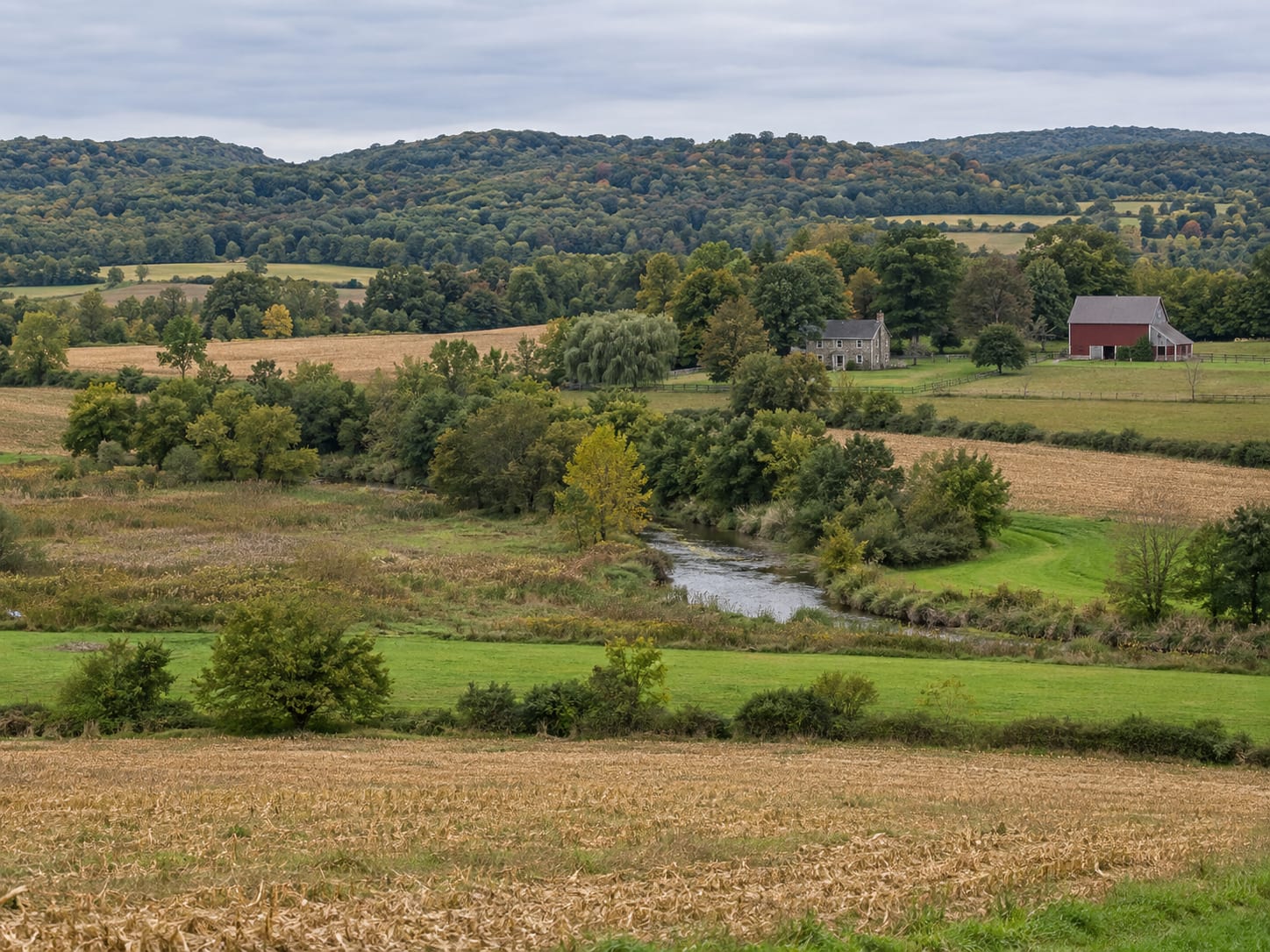
Hopewell has more kinds of water than most towns its size. The Delaware River forms the township's western edge. Jacobs Creek runs through the western side toward the river, Ewing Creek drains the south and flows toward Jacobs Creek, Stony Brook crosses the north, and Beden Brook belongs to the Millstone River drainage instead. Between them the ground rises from river terraces and nearly level lowlands to ridges and low hills. Underneath is Piedmont shale, and the FEMA flood insurance study explains why that matters. Shale holds little rainfall, so heavy rain runs off quickly and creeks peak in a short burst. The Delaware behaves differently, with flooding that lasts longer. One property can take a fast surge of surface water in a single storm, and another can stay saturated for days after a river event. Either one can leave a crawl space or finished basement wet long after the visible water is gone. That is why dampness lingers here. Drywall paper, carpet pad, framing and insulation hold moisture well below the surface, so a floor that looks dry can still be feeding growth inside the wall. Fast emergency water extraction and structural drying are what keep a wet week from turning into a mold job.
What are the signs of mold and moisture in Hopewell homes?
Start with your nose and your hands. A musty smell in a basement, closet or crawl space that comes back after you air it out usually means a damp surface somewhere close. Paint that bubbles or peels, drywall that feels soft near the floor, wallpaper that lifts at the seams, white mineral crust on a foundation wall and floor tiles that curl at the edges all point to moisture moving through the building. Visible growth is the clearest sign, and it tends to show first in corners, behind furniture on exterior walls, along the bottom of drywall, on the underside of a bathroom ceiling or around window frames that collect condensation. In an older Hopewell home look at the areas that rarely get looked at: the stone or block foundation wall, the space under porches and additions, and the attic near the roof edge. Also think about timing. If the smell or the stain shows up after a heavy storm, a burst pipe, a washing machine failure or a stretch of high humidity, the water event and the growth are probably connected, and both need attention. When you are not sure what you are looking at, a mold inspection will tell you where moisture is sitting behind surfaces you cannot see.
What does mold remediation in Hopewell, NJ involve?
Every Hopewell job follows the same order, because skipping ahead is how growth returns.
Find and stop the water
We take moisture readings, inspect the lower level and the exterior, and identify whether the source is a leak, a roof or window failure, groundwater, surface runoff or condensation. Remediation does not hold until the source is fixed.
Contain the area
Plastic barriers and controlled airflow keep spores from spreading to the rest of the house while work is underway.
Remove what cannot be saved
Porous materials that have grown mold, such as drywall, insulation and carpet pad, come out and are bagged. Solid framing is cleaned and treated in place.
Dry the structure
Air movers and dehumidifiers bring framing and slabs back to a normal moisture level, and we confirm it with readings before closing anything up.
Verify and rebuild
A post-remediation verification confirms the space is ready, and if walls or floors were removed we can handle drywall replacement after mold so you deal with one company from start to finish.
What sets the cost of mold remediation in Hopewell?
The number depends on how much material is affected and how hard it is to get to, not on the town alone. We give you the scope in writing after the inspection, and this is what moves it up or down. The size of the affected area is the biggest factor: a corner of a bathroom ceiling is a small job, while a finished basement that took on water is a large one. The material matters too, because drywall and carpet pad come out and get replaced while framing gets cleaned. Then there is access. A tight crawl space under an addition or an attic with little headroom takes longer than an open room. Hopewell's housing adds its own variables. A pre-1940 farmhouse or village home may have plaster, stone foundations and mixed repairs from several decades, and a large-lot rural house may have a long run of exposed basement wall. Water source counts as well: clean water from a supply line is a different job from groundwater or sewage-contaminated water. If you have insurance coverage for the water event, our insurance restoration services team documents the work the way your carrier expects.
What should you do before remediation begins?
Stop the water first if you can. Shut off the supply to a leaking fixture or appliance. If the water is coming in from outside, stay out of a wet basement while the power is on, and turn off the breaker for that area only if you can reach it safely and dry. Then leave the area as it is. Do not scrub or bleach visible mold, and do not aim a fan at it, because moving air carries spores into other rooms. Take photos of the damage and of the source, and carry valuables and dry items out of the wet zone. Write down when the water arrived and where you first noticed the smell, because that timeline helps us set the scope. Tell us if the property is on a private well or a septic system, since a soggy yard or a slow drain changes what kind of water we are dealing with. Keep your full mailing address handy too; the township uses several postal ZIP codes, and the address settles which municipality and flood map apply. Then call us before you start tearing anything out.
How do Hopewell's rivers, terrain, flood exposure and utilities affect your property?
Your address tells you more than the town name does. The Hopewell Valley takes in Hopewell Township, Hopewell Borough and Pennington Borough, and the risk changes from one part of it to the next. A home close to the Delaware can face flooding that lasts, while a house near Jacobs Creek, Ewing Creek or Stony Brook is more likely to see a fast, short surge after a hard rain. If you live near a creek or in a low spot, check the property against the current FEMA flood map and your municipality's flood hazard information. A general map does not settle a specific lot, and a house outside a mapped flood zone can still take on water from runoff. After a flood or major storm, our flood damage cleanup and storm damage restoration crews handle the water and the drying. Utilities change the picture as well. Hopewell has a mix of public water and municipal utilities, private wells, public sewer and private septic systems, and township land-use review pays close attention to wetlands, waterways, slopes, stormwater and seasonal high groundwater. If your home sits on a slope or beside wetlands, ask about local stormwater and groundwater conditions before you assume a leak is the only cause. A septic or well problem can leave a yard soggy against a foundation. Getting to you is rarely the issue. Route 31 runs north and south through the township, Route 29 follows the river, Routes 518, 546, 569 and 579 cover the county roads, and Interstate 295 serves the southern part.
How do older village homes, rural properties and newer township housing differ?
Hopewell is not one kind of neighborhood. Most of the township's housing is detached and owner-occupied. The township's 2025 housing plan, using 2023 Census survey data, counts 6,504 housing units, with about 87 percent in one-family detached buildings. It also shows 858 units built before 1940, or 13.2 percent, while 69 percent were built after 1960, with the 1990s the largest single building period at 23.2 percent. That mix means three different jobs. In the historic village of Hopewell Borough, with its Colonial village architecture and Victorian-era neighborhoods, and in historic districts like Harbourton, Pleasant Valley and Titusville, the buildings are old. Stone foundations, older plaster and additions built in different decades create hidden voids where moisture can sit. Out on the large rural lots around Marshall's Corner, Bear Tavern and Woodsville, a farmhouse or detached home may have a private well, a septic system and a big wooded or open yard, and each of those changes how water reaches the foundation. In newer housing from the 1990s on, a slow leak can sit behind finished drywall for a long time before anyone sees it. About 12 percent of housing is renter-occupied, and 849 units are attached or multifamily, so our residential mold remediation work covers owners and renters alike. If you rent, tell your landlord or property manager about the water as soon as you see it, and keep a written record of when you reported it.
How do you keep moisture from coming back?
Fixing the damage is half the job; the other half is the property. Start with water leaving the roof. Clean gutters, extend downspouts well away from the foundation, and check that the ground slopes away from the house instead of toward it. Hopewell's shale bedrock sheds rain fast, so grading and downspouts do more work here than people expect. Inside, watch the humidity. A basement or crawl space that stays damp all summer benefits from a dehumidifier and, where the water is coming from the ground, a permanent drying solution. Our basement mold remediation and crawl space mold remediation work covers both the cleanup and the conditions that caused it. Check the places that fail quietly: supply lines under sinks, water heaters, washing machine hoses, window seals and roof flashing. Older roofs and mixed repairs over the years are common sources, so look at flashing and shingles after a hard storm. A yearly walk-through after the first hard spring rain and again in fall catches most problems while they are still small.
Areas we serve in and around Hopewell, NJ
ExecPro Restoration & Cleaning serves Hopewell Borough and the township's communities, including Titusville, Harbourton, Pleasant Valley, Mount Rose, Washington Crossing, Woodsville, Marshall's Corner, Harts Corner, Baldwins Corner, Stoutsburg and Bear Tavern. Township ZIP codes include 08525, 08530, 08534, 08540, 08558 and 08560. We also work in the neighboring towns of Pennington, Ewing, and Lawrence Township, Montgomery Township and East Amwell Township. See the full list of service areas across central New Jersey. Whether you live near Washington Crossing State Park, Baldpate Mountain, Mercer Meadows or Howell Farm, the process is the same.
Frequently asked questions about mold remediation in Hopewell, NJ
The price depends on the size of the area, the materials involved, access and the water source. We give you the scope in writing after the inspection and before any work starts.
About Hopewell, NJ
Hopewell is really two municipalities. Hopewell Borough is a compact village of 1,918 people at the 2020 Census, with Colonial village architecture and Victorian-era neighborhoods, and Hopewell Township, with 17,491 residents, surrounds it. The township is large and low-density, and its housing is mostly detached and owner-occupied. The township's 2025 housing plan, using 2023 Census survey data, counts 6,504 housing units, 87 percent of them one-family detached, with 858 built before 1940 and 69 percent built after 1960. That mix runs from village and farm properties to 1990s subdivisions, large rural lots and a smaller number of attached and multifamily units, so a job in Hopewell can mean plaster and stone in one home and finished drywall over a slow leak in the next.
Water comes at Hopewell from several directions. The Delaware River is the township's western boundary, Jacobs Creek runs west toward it, Ewing Creek drains the south, Stony Brook crosses the north, and Beden Brook belongs to the Millstone River drainage. The ground rises from river terraces and lowlands to ridges and low hills over Piedmont shale, which sheds rain quickly, so creeks can peak fast after a hard storm while the Delaware floods for longer. Properties also differ in their utilities, with public water and sewer on some lots and private wells and septic systems on others. If you own here, check your full address against the current FEMA flood map, know whether your building has a basement, crawl space or slab, and look at where your roof and downspouts send water.
Neighborhoods We Serve in Hopewell
Around Hopewell
- Washington Crossing State Park
- Baldpate Mountain
- Woolsey Park
- Rosedale Park
- Mercer Meadows
- Howell Farm
- Independence Park
- Curlis Lake Woods
- Lawrence Hopewell Trail
- Hopewell Township Municipal Athletic Complex
- Enos Titus Farmstead
- Marshall's Corner Schoolhouse
- Delaware and Raritan Canal Historic District
- Ewing Township
- Lawrence Township
- Montgomery Township
- East Amwell Township
- Pennington Borough
- Upper Makefield Township, Pennsylvania
Do not see your neighborhood? We serve all of Hopewell and the surrounding area. Reach out and we will confirm coverage.